Shall we gather at the river?
Ecumenical worship service during the 227th General Assembly focuses attention on healing divisions

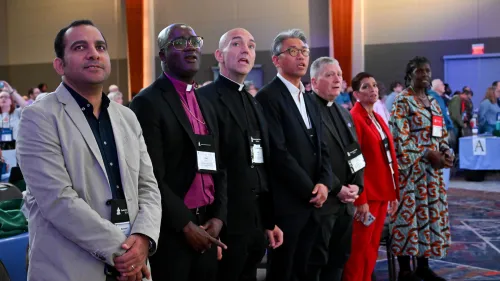
MILWAUKEE — Using the metaphor of a tree on both sides of the river, the Rev. Dr. Kevin Vandiver encouraged the attendees of the 227th General Assembly to strive to overcome the divisions that are apparent in the world today.
Vandiver, senior pastor of the Lutheran Church of the Reformation (ELCA) in Washington, D.C., preached during an ecumenical worship service that preceded formal business on Tuesday at the Grand Ballroom of the Baird Center.
The sermon was the centerpiece of a service that also included prayers by ecumenical leaders, uplifting songs, such as “Shall We Gather at the River,” and the collection of an offering for Common Ground, a multiracial, multifaith nonpartisan organization working to create positive change in the Milwaukee area.
“Merciful God, you gather us from the four corners and the farthest poles of the earth,” said the Rev. Philip Vinod Peacock, general secretary of the World Communion of Reformed Churches, in the opening portion of the service. “Make us a holy priesthood, ready to serve you in this present age — a great multitude that no one can count.”
Later, Vandiver opened his sermon by focusing on the concept of beginning with the ending in mind, using examples from baking, construction and music to illustrate the importance of planning and perseverance, but he also acknowledged that interruptions do arise when life zigs and zags. He then moved into Revelation 22:1-5, a biblical passage in which an angel reveals new things to John of Patmos.
The passage was read, via video, by Partner Advisory Delegate the Rev. Berla Andrade of the Presbyterian Church of Venezuela, which is helping to respond to the needs of people affected by the recent double earthquake in her country. The passage says:
“Then the angel showed me the river of the water of life, bright as crystal, flowing from the throne of God and of the Lamb through the middle of the street of the city. On either side of the river is the tree of life with its twelve kinds of fruit, producing its fruit each month, and the leaves of the tree are for the healing of the nations. Nothing accursed will be found there any more. But the throne of God and of the Lamb will be in it, and his servants will worship him; they will see his face, and his name will be on their foreheads. And there will be no more night; they need no light of lamp or sun, for the Lord God will be their light, and they will reign forever and ever.”
Transitioning from the scripture to modern life, Vandiver noted that “today, we know of rivers, not because of life-giving water that flows but rather what happens on the banks. … We know rivers, not just because of the water but because of the separating nature of what it means to be on an opposite bank from somebody else,” whether it be because of theology or politics.
“We sit here under the shadow of the 250th anniversary of the founding of this nation, and we know well what it is to be on opposite sides of the bank,” he said. “We know well what it is to exist in contradistinction to the ideals and values of somebody else over there.”
He noted maybe they are family members, maybe they are past friends, maybe they are former church members, or even commissioners sitting nearby. “Don’t look at them!” he said, drawing laughs.
Despite the division, there is hope.
“God will do whatever God needs to do — defy the very law of physics — to get us to where God wants us to go,” said Vandiver, adding, “Have you any rivers that you deem impossible to cross, or any mountains that you can't tunnel through? God specializes in the impossible.”
Vandiver also raised the possibility that people on the other side might not be the only ones in need of change.
“We are so good at prescribing medicine for them over there. We know what healing they need. We know exactly how many milligrams of justice need to go over there. But maybe we need to learn to take our own medicine,” he said. “Certainly, we know what it means to advocate for the dignity and the rights of other people as children of God, but there might be other medicine that we need to take and because we are not the Great Physician, we might misdiagnose the situation. Can you take the medicine, too?”
He noted, “It's tough medicine; that's why God put a tree in the middle. The seeds of this tree were planted by another tree on a hill far away on Calvary, and it is this forward-looking image that propels us to keep on going and to keep on keeping on.”
Be reassured that “God has greater plans than the plans that we can see with our minds,” he added.
The service concluded with a bilingual version of “We Are Marching in the Light of God” and a charge from Vandiver.
As the week continues, consider “how do you come to the banks? Here, we come with our skepticism, our hopes, our heartbreak, but also we should come with the anticipation of what God's vision looks like for our lives, and then also take your medicine. Lord, deliver us and heal us from our own smug self-interests. Lord, heal us from thinking we have all the answers, knowing that they rest in you.”
You may freely reuse and distribute this article in its entirety for non-commercial purposes in any medium. Please include author attribution, photography credits, and a link to the original article. This work is licensed under a Creative Commons Attribution-NonCommercial-NoDeratives 4.0 International License.