RIW Committee navigates polity and technology constraints to forge a unified Israel-Palestine resolution
Reformed Identity Around the World committee combines three Israel-Palestine overtures, affirms Kairos Palestine resource and supports Cuban churches after marathon deliberations
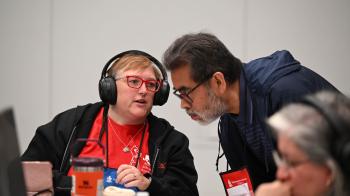
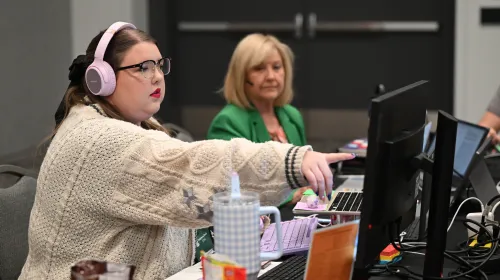
The Reformed Identity Around the World Committee of the 227th General Assembly spent nearly 10 hours Wednesday wrestling with some of the denomination’s most difficult international issues, overcoming parliamentary complexity, Session Sync challenges and the constraints of Presbyterian polity to produce a unified response on Israel and Palestine.
Convening at 10:20 a.m. Central Time and adjourning at 8:27 p.m., the committee utilized Equity Primes, pastoral pauses, prayer and breaks while considering major measures related to Israel and Palestine. By day’s end, commissioners had folded RIW-05 and RIW-06 into RIW-04, creating a single amended recommendation addressing genocide, military aid, consumer action, antisemitism, Islamophobia and settler violence.
The day began with educational grounding from the Rev. Dr. Whitney Wilkinson Arreche of the General Assembly Committee on Ecumenical and Interreligious Relations, who shared definitions of antisemitism and Islamophobia from a PC(USA) study resource and urged commissioners to exercise precision in their language.
“The real way forward to avoid the accidental leaning into anti-Semitic language is to speak with specificity,” Arreche said. “If you were talking about the actions of the State of Israel, then talk about the actions of the State of Israel.” She urged commissioners to avoid “conflation and generality” and to distinguish criticism of government actions from prejudice against Jewish people.
That framework became one of the defining themes of the day. Nearly every subsequent debate — whether over the use of the term genocide, military sanctions, boycott language or amendments clarifying the distinction between Israeli government actions and Jewish identity — returned to Arreche’s call for specificity.
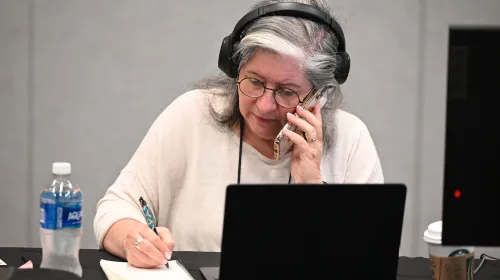
The committee then turned to RIW-05, which called for a blanket trade embargo on Israel. Overture advocates the Rev. Dr. Shannon Smythe and the Rev. John Anderson argued that economic pressure represented a faithful form of nonviolent resistance requested by Palestinian Christians. Smythe grounded her testimony in recent visits to the West Bank and in the history of the Nakba, the Arabic word meaning “the catastrophe.”
“The catastrophe for them was the creation of the State of Israel on top of Palestinian land, carried out through massacres, bombings, and forced removal,” Smythe said, noting that more than 700,000 Palestinians were displaced in 1948.
Anderson framed the embargo as a moral response to an entrenched system of injustice. “This overture is about the end game, the results not nibbling around its edges, not gently persuading or sugarcoating language, but procuring justice,” he said.
Resource persons and commissioners raised concerns about a blanket embargo’s consistency with existing Presbyterian policy and its potential effect on ordinary Israelis. Catherine Gordon, representative for international issues in the Office of Public Witness, and Dr. Rick Nutt of the Advisory Committee on Social Witness Policy (ACSWP) noted that the denomination historically had favored targeted economic actions rather than sweeping trade embargoes, except in the case of apartheid South Africa.
The committee ultimately voted 35-25 to answer RIW-05 with action on RIW-04, effectively bringing the embargo discussion into the broader genocide overture rather than advancing it independently. As commissioners moved into consideration of RIW-04 and RIW-06, the emotional tenor of the meeting deepened. A motion to consider each of the multiple items of RIW-04 one at a time was approved, setting a deliberate pace for the discussion and preventing amendments with larger editorial scope on the overture as a whole. Commissioners had to adjust to communicate their larger visions of the overture within the limitations of Zoom dialogue and consideration of point by point motions in Session Sync.
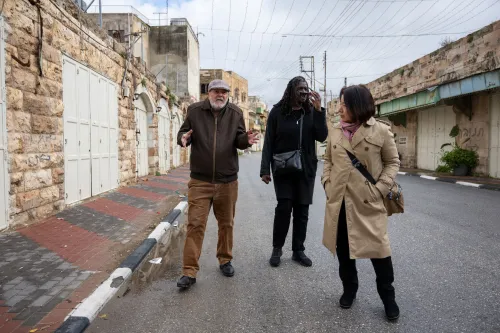
The committee heard directly from Palestinian and Israeli voices throughout its proceedings, beginning with Israeli allies of Palestinians, during the public hearings held Tuesday evening. Partner advisory delegate Nuha Shaheen participated from Palestine. The Rev. Dr. Fahed Abu-Akel, Moderator of the 214th General Assembly (2002) and a Palestinian American, addressed commissioners from the Presbytery of Greater Atlanta. During evening business, commissioners also heard recorded testimony from Nowar Diab, a 23-year-old Muslim Palestinian from Gaza. Diab described the impact of the war on Gaza’s Christian community and the bombing of St. Porphyrius Church, a historic church that also served as a shelter.
As debate intensified and tensions emerged around both substance and process, moderators called an extended pause in proceedings. When commissioners returned, the Rev. Eliana Maxim, the committee assistant responsible for supporting the committee’s work and helping guide its process, offered a pastoral word.
Addressing what had become an emotionally difficult conversation, particularly for commissioners from historically marginalized communities, Maxim acknowledged the strain created by discussing genocide, race, colonialism and oppression inside a predominantly white institutional framework. She encouraged commissioners to listen deeply to one another, recognize the different ways people experience these conversations and remain committed to the committee’s covenant life together. Participants later referenced her reminder about “the emotional toll, especially for BIPOC members, navigating white-dominant structures” and her call for “gentleness, listening, and affirming all as God’s image-bearers.”
The pastoral intervention helped reset the tone as commissioners returned to deliberation.
The committee then heard from Abu-Akel, who identified himself as “a survivor of the first Nakba” and connected the present crisis to his own experience of displacement. “We have opportunity, the responsibility as a church to do something about this catastrophe,” Abu-Akel told commissioners.
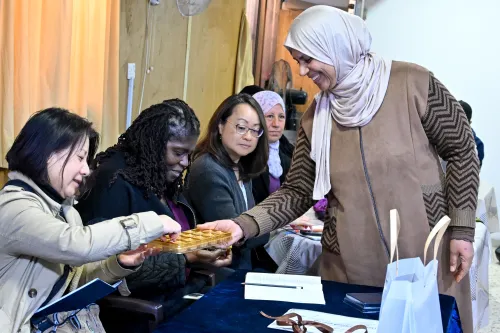
Shaheen urged commissioners not to view Gaza in isolation. She described increasing settler violence, land confiscation, attacks on Christian communities, settlement expansion and restrictions on Palestinian life in the West Bank, arguing that patterns already witnessed in Gaza were increasingly visible there as well. “It’s an ongoing genocide,” Shaheen said. “It’s going to happen in Palestine. If we don’t do something.”
Not all commissioners agreed on the level of specificity required to denounce the violence. Several elder commissioners navigating interfaith relations and politically diverse congregations encouraged the committee to grapple with the complexity of the conflict and cautioned against narratives that failed to account for the violent actions of Hamas as they urged broader historical and political framing.
Palestinian participants pushed back on what they viewed as attempts to create moral equivalence between occupier and those brutally occupied. Shaheen argued that discussions of balance should not obscure the scale of what Palestinians are experiencing. “The genocide is going to expand to the West Bank,” she said. “It’s an ongoing genocide.” She told commissioners that while she respected concerns raised about rising antisemitism, “when you look at what’s happening in Palestine ... it’s incomparable,” urging the committee to focus on the reality facing Palestinians under occupation and military assault.
Even as commissioners disagreed on language, Arreche’s earlier guidance continued to shape debate. Amendments repeatedly sought to clarify references to the Israeli government, distinguish criticism of state actions from criticism of Jewish people and affirm opposition to both antisemitism and Islamophobia.
Resource persons also emphasized the practical implications of the committee’s decisions. Sue Rheem of Presbyterian Ministry at the United Nations said adoption would strengthen the church’s advocacy by allowing staff to use language already employed by several United Nations bodies and investigators. Gordon told commissioners that passage would “free us up to advocate with other coalitions who are using the term genocide.”
After hours of amendments, procedural motions and votes, the committee approved RIW-04 as amended by a vote of 55-4 and unanimously answered RIW-06 with RIW-04. The final language explicitly called Israel’s war in Gaza “a genocide,” called for blocking military sales to and purchases from Israel, encouraged Presbyterians to refrain from purchasing products linked to violations of international law, rejected antisemitism and Islamophobia, affirmed that criticism of Israel is not inherently antisemitic, condemned attacks by all parties and denounced settler violence in the West Bank.
After dinner, the committee reconvened to consider two additional commissioner resolutions.
The committee approved RIW-10 affirming Kairos Palestine Two: A Moment of Truth, Faith in a Time of Genocide by a vote of 51-5. Advocates described the document as a call from Palestinian Christians to the global church and an invitation for Presbyterians to learn from partners living through the conflict.
Speaking in favor of RIW-10, Ruling Elder Commissioner Branden Tacadena reflected on testimony the committee had heard throughout the day from Palestinians including Abu-Akel, Shaheen and others who had shared their experiences directly and by video.
“Again, thank you for sharing your sacred stories,” Tacadena said. “I want to name the absurdity of the structural power that we as a committee have to make decisions that again will have material impact on you, those who you love, your people, your ancestral lands,” he continued. “I feel a call to repentance and confession for my complicity in this theater of white Western Christian colonial violence.” Tacadena connected that reflection to the Kairos Palestine document itself, describing it as “the voice of our Palestinian kin crying out for action, for our action and our solidarity.”
Abu-Akel praised the document, saying, “The power of this document is really focused on love, on justice, and nonviolence.”
Doug Dicks, Global Ecumenical Liaison for the Middle East and Europe, described Kairos Palestine as “an ecumenical grassroots organization” and said affirming the document would be welcomed by Palestinian Christian partners.
The committee then approved RIW-11 concerning Cuba by a vote of 54-4 after amending the resolution to direct advocacy efforts through the Office of Public Witness and Presbyterian Ministry at the United Nations. Testimony highlighted worsening humanitarian conditions, shortages of electricity and basic necessities, and the importance of strengthening relationships with the Iglesia Presbiteriana-Reformada en Cuba (IPRC).
Gordon, who as part of her work with the Office of Public Witness chairs the faith working group on Cuba in Washington, D.C., told the committee that she has worked on Cuba for 20 years and "never seen the situation as bad as it is now," noting that PC(USA) is already part of a broad ecumenical coalition pressing to ease sanctions.
“At the United Nations,” Rheem said, “there is overwhelming global support for lifting the U.S. embargo on Cuba — a resolution calling for its end passes each year with only three countries voting against it.” She reported that Cuban church leaders describe a worsening humanitarian crisis in which many young adults have left the island to find work, leaving elders and children in rural areas especially vulnerable. In that setting, she said, churches are doing everything they can to provide food, cope with rolling electricity shortages and support their communities, making a clear statement of solidarity from the General Assembly "very, very important for Cuban partners.”
As the committee concluded its final business, Moderator Rachael Eggebeen reflected on the weight of the preceding three days.
“We have done lots of hard work, we have sat with hard truth, we have sat with lots of things that we don’t necessarily have solutions for,” she said.
You may freely reuse and distribute this article in its entirety for non-commercial purposes in any medium. Please include author attribution, photography credits, and a link to the original article. This work is licensed under a Creative Commons Attribution-NonCommercial-NoDeratives 4.0 International License.