RIW Committee approves review of global mission restructuring in combining overtures
Commissioners endorse independent task force after lengthy debate
The Reformed Identity Around the World Committee convened at 10 a.m. CDT on the second day of its work. Following an executive session, the committee opened public hearings at 10:30 a.m. on RIW-01, "Call to Review the Restructuring of the PC(USA) World Mission," and RIW-07, "Concerning Mission Co-Workers." By noon, commissioners concluded hearings and shifted into questions, discussion and parliamentary guidance before beginning deliberations on two related overtures.
Much of the day centered on the Presbyterian Church (U.S.A.)'s 2025 restructuring of global engagement resulting in the ending of all mission co-worker positions and the creation of the Global Ecumenical Partnerships model with the unification process resulting in Presbyterian Life & Witness. Overture advocates, former mission leaders, commissioners and Presbyterian Life & Witness resource people wrestled with questions of transparency, consultation, stewardship and the future of global engagement.
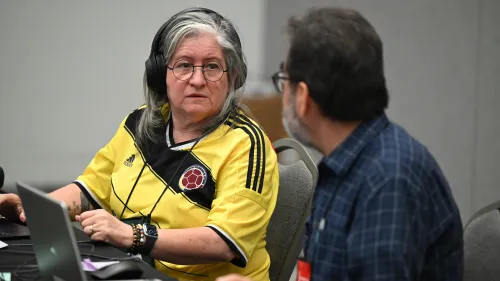
Speaking in support of RIW-01 in the public hearing, Debbie Braaksma, former Africa Area coordinator for Presbyterian World Mission and co-facilitator of several of the denomination's 2018-19 global and domestic consultations, argued that partner voices were not adequately incorporated into the restructuring process. "We spent half a million dollars on a strategic planning process that in my mind lacked integrity because there were predetermined outcomes," she said.
The Rev. Mike McClenahan, executive director of the Fellowship Community, urged commissioners to hear from churches and mission leaders who felt excluded from the process. He described support for a review as an issue that crossed theological lines and noted that some congregations devote significant portions of their budgets to mission.
The overture advocacy team included the Rev. Dr. Rubén Rosario Rodríguez, a professor of systematic theology at Saint Louis University and one of the overture's co-authors. Rodríguez stressed that supporters were not seeking a return to a previous era of mission but rather accountability and discernment. "We do not seek to turn back the clock, but rather to transform this disruption into an opportunity to chart a new path," he said before closely tying it to RIW-02, which was passed on Monday.
A central focus of the afternoon was extensive questioning of Presbyterian Life & Witness leadership, particularly senior director of Partnerships Beyond the PC(USA), the Rev. Mienda Uriarte, and Stated Clerk and Executive Director of PL&W, the Rev. Jihyun Oh. Commissioners repeatedly sought clarity about how decisions were made, what alternatives had been considered and what role the General Assembly plays in staffing decisions.
Oh offered an extended explanation tracing the decision through decades of mission conversations, declining denominational membership, shrinking mission revenue, changing understandings of partnership and the financial pressures intensified by the Covid pandemic. She said actuarial models showed the previous structure was unsustainable. Oh described the restructuring effort as one intended to steward "the long legacy of Presbyterian presence around the world" while preserving global engagement for future generations.
Commissioners also pressed Oh to explain who held responsibility for a decision of this magnitude and whether the General Assembly should have been directly involved. Responding to questions about governance, Oh explained that the denomination functions through both elected General Assembly leadership and agencies entrusted with carrying out assembly mandates. She noted that commissioners and advisory delegates elect and confirm agency leaders, then entrust those leaders with stewardship responsibilities, staffing decisions and implementation of assembly directives. Oh explained that every two years, General Assembly actions can reshape priorities and require agencies to realign budgets, programs and personnel. Agencies must balance Assembly mandates with available resources, Oh said, and staffing decisions have historically been part of that work. "The Assembly is tasked with thinking about the witness and the life of the denomination as a whole," Oh said, while agencies are responsible for tending the day-to-day operational and stewardship responsibilities entrusted to them. She added that leaders are expected to look at all General Assembly mandates and "steward that and tend that" within the responsibilities assigned to each agency.
Questions from commissioners reflected both support and skepticism for the intended outcome and impact of the overtures. Ruling Elder Commissioner Troy Horack of Charlotte, an organizational development professional, asked overture advocates what practical benefit would come from the expense of time and money. “What is the outcome, and what is the solution that this is going to provide by investing not just forty‑something thousand dollars or more and people’s time and effort? What are we going to get for that, as opposed to instead focusing on the change that has occurred, and how do we make it work?”
The Rev. Cynthia Betz-Bogoly, overture advocate for RIW-07, responded that the proposed review was intended not to reverse decisions but to promote healing, accountability and improved decision-making for the future.
As debate continued, commissioners amended RIW-01 several times. Commissioners briefly explored whether Monday's previously approved missiological study, RIW-02, should be reconsidered and combined with RIW-01 and RIW-07 to create a single review process. A motion to reconsider RIW-02 was introduced, seconded and discussed. Supporters argued one body could undertake all the work, while opponents raised procedural concerns. Ultimately, the effort did not move forward, and the committee returned to consideration of RIW-01 and RIW-07 as separate items from RIW-02.
Another amendment, offered by Diane Kenning of Plains and Peaks Presbytery, changed the proposed body from a commission to a task force after parliamentary guidance clarified that a task force better fit the intended role. The amendment passed 50-8.
Commissioners also approved an amendment expanding the task force from 11 to 17 members. Supporters argued that a larger group would better reflect the church's racial, regional and theological diversity and improve representation across the denomination. Opponents cited increased costs and concerns about efficiency, but the amendment passed 37-24.
Late in the debate, Teaching Elder Commissioner David Douthett of National Capital Presbytery reflected on the emotional tenor of the discussion, describing both the overture and its advocates as "fairly hot" while encouraging the committee to consider its overall tone before presenting to the Assembly.
Kenning, who expressed her personal satisfaction with the explanations provided by resource people from Presbyterian Life & Witness, ultimately said overture advocates persuaded her that further review remained necessary, remarking that how they "changed her mind because some are not OK."
Through guidance provided by the moderator and vice-moderator, the committee merged key provisions of RIW-07 into RIW-01, including requests for greater transparency about mission funding and a renewed call for congregations to support and train future missionaries. When consulted, the Rev. Ellen Sherby, manager of International Global Ecumenical Liaisons, said the missionary-training language from RIW-07 now added to RIW-01 reflected the denomination's former mission co-worker model more than the newly adopted Global Ecumenical Partnerships structure.
Supporters of merging RIW-07 with RIW-01 said the approach would avoid duplicate studies, reduce costs and prevent competing recommendations while still addressing concerns about mission co-workers, donor funds and transparency.
The committee approved RIW-01 by 49-8 and answering RIW-07 with RIW-01 by 54-5.
The committee closed its work session with prayer led by Vice-Moderator the Rev. Dr. Matt Bussell, who thanked God for the work of mission co-workers and the witness they have shared throughout the years.
In the final hour of the committee’s Tuesday session, Bussell opened the floor to a public hearing and overture advocates to speak to three overtures regarding advocacy on behalf of Palestine (RIW-04, RIW-05, and RIW-06) which the Reformed Identity Around the World Committee will consider when they reconvene on Wednesday at 10 a.m. Central Time.
You may freely reuse and distribute this article in its entirety for non-commercial purposes in any medium. Please include author attribution, photography credits, and a link to the original article. This work is licensed under a Creative Commons Attribution-NonCommercial-NoDeratives 4.0 International License.