The Rev. Dr. Margaret Aymer of Austin Presbyterian Theological Seminary stops by the ‘Sounding Board’ virtual studios
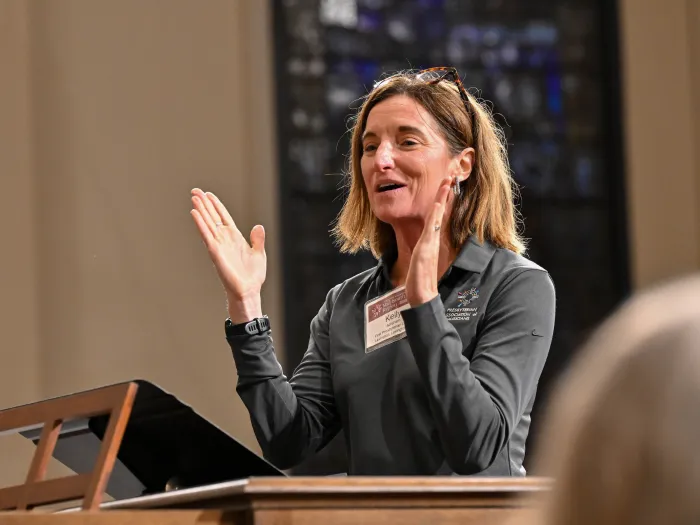
Aymer brought her considerable preaching skills to last year’s Presbyterian Association of Musicians’ Worship & Music Conference

LOUISVILLE — The Rev. Dr. Margaret Aymer, who contributed dynamic and thoughtful preaching during last year’s Presbyterian Association of Musicians Worship & Music Conference, is the most recent guest on PAM’s “Sounding Board” podcast, which can be seen here and heard here and here. Twice each month, musicians Sarah Abushakra and Jeremy Roberts host “Sounding Board.”
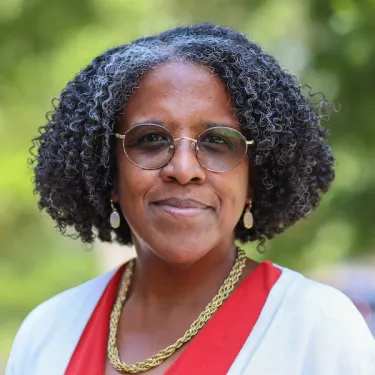
A scholar of the New Testament, Aymer is Vice President for Academic Affairs and Dean of the Faculty at Austin Presbyterian Theological Seminary.
Born in Barbados, Aymer grew up in the British Caribbean. Her father was from Antigua and her mother was Jamaican. “I grew up in the British Methodist church singing English hymns,” she told the hosts. “The beginning of my faith journey was the hymns of the church.” In her Methodist school, one of the textbooks was a hymnal. “I grew up with the sung theology of the church, which deeply informed my faith from the beginning.”
“I am a preacher’s kid,” she said. “We came to this country so my father could do a Ph.D. in New Testament,” just as his daughter would one day. “It’s a family business,” she said with a smile.
After college, Aymer became a social studies teacher. The classroom “is the place where I have my greatest joy,” she said. Even after ordination as a minister, “I have leaned into the fact that we are teaching elders.”
While attending an evangelical Episcopal church in New York City, “the minute I first served communion as an ordained elder, I knew this is what I should be doing,” she said. “I pulled my pastor aside and he said, ‘We wondered when you were going to figure that out.’”
The hosts asked Aymer about the process for preparing to preach last summer at PAM’s Worship & Music Conference.
“There is nothing like having a remarkable team of liturgists and musicians — creative and thoughtful people,” Aymer said. “It was such a gift as a preacher to be upheld by that team in prayer and in structure and content.” Together, the team chose the biblical texts for each day, “and talked about what texts would go with the different themes.”
“I could just walk up there and say anything and it would be fine, because there was so much worship going on,” Aymer said. She called the conference “one of the highlights of my ministerial career. That was my bucket list,” said Aymer, who previously preached at General Assembly and the Presbyterian Women Churchwide Gathering. “PAM’s Worship & Music Conference, where 700 Presbyterians [each week] are singing in four-part harmony — that’s a little piece of heaven right there.” The artwork and stoles, the Rev. Dr. David Gambrell’s “absolutely brilliant liturgy” and “the interplay between [musicians] Tom Trenney and David LaMotte — it’s so much more than just a sermon,” Aymer said. “It’s a whole network of folks.”
“Some of you know my husband [Dr. Laurent Oget] died catastrophically the October before the conference,” Aymer said. When Oget died in bed of a heart attack, “I quickly became a widow and a single mother,” Aymer told the hosts. “The team of pastors and church musicians [at the Worship & Music Conference] made it possible for me to do what I did and say what I said. It was a rough year, and they really helped me.”
Dr. Eric Wall, Aymer’s former colleague at Austin Seminary, asked Roberts to pose this question to Aymer: What does it look like for church musicians to think biblically?
“A musician can reflect a story without words,” Aymer said. “You have the ability to get underneath the words to the feeling, the color and the rhythm of the text.”
“How a text is set to music affects the way we read the text overall,” she said. “As you’re thinking as musicians exegetically, don’t just think about, ‘What is a tune everyone knows?’ The question is, ‘How is the music I am choosing helping to open the Word for the people? How does it help strengthen the faith of the community?’”
That might come about by choosing the most popular or most well-known tune, she said. “Or it might be using all your brilliance to go into the back of the hymnal to look at all the available tunes and pick one that works better. If you’re doing a service of lamentation,” she said, “you may want to use a tune of lamentation for that text.”
Hymnwriters do well to “think about the characters we don’t usually think about,” she said. “What is the hymn of the rooster on Good Friday? What do the ravens who bring Elijah food have to teach us? How do we write our hymns to reflect the whole Creation?”
It was “Jesus Christ, Superstar” that “raised the question, what did Judas think?” Aymer said. “What does pharaoh think and feel? How do we learn from pharaoh who God is calling us to be? What is the story there?”
Americans may enjoy identifying in general with the underdog, Aymer said, but “we’re not the underdog. We are much closer to the imperial powers than we are to the underdogs, just by virtue of who we are in the world. That’s not a political statement; it’s simply a historical fact.”
“Music has always been used to help us hear and understand the scripture better,” she said. “The gift of music is it reaches us exegetically in a different place than Greek and Hebrew do.”
“You know who does this well? Musicians in the Black church,” Aymer said. “Watch the interplay between the organist and the preacher in the Black church. That preacher is preaching. It’s effective preaching, but the organist is what’s pushing the message along.”
The truth is, “worship is intended to evoke emotion,” she said. “that’s the case whether we’re doing Quaker worship that’s totally silent or in Taizé worship or chanting. The worship of God [requires] your whole being, and that includes your emotions. Should you play the ‘Jaws’ theme when you’re reading Jonah? Maybe only in Vacation Bible School.”
Roberts recalled something a seminary professor used to tell students: “Nobody goes home [from worship] humming the sermon.”
“There is something about the music of the church that creates community different from the sermon,” Aymer said. Music “creates intergenerational community, and it can be much more easily brought into the everyday experiences of people.”
Asked to comment on a lecture she delivered on the New Testament as migrant writings, Aymer noted the “wonderful work” put in by students at Austin Seminary, including one who said in a paper that the church must transition from a hospitality of services toward a humanizing hospitality that recognizes the Imago Dei in the migrant, transforming both guest and host into an authentic faith community.
She also shouted out her colleagues on the Special Committee for a New Confession, whose work will be before the 227th General Assembly this summer.
“It’s a nice mix of various folks,” she said of the 16-member Special Committee, which she co-moderated along with the Rev. Dr. Edwin David Aponte. “We come from various theological, ethnic and historical backgrounds. We have immigrants from different parts of the world,” including one “whose first language is not English. We have people who are queer and trans. We have people of different ages, which is lovely.”
“It took us a while to figure out what the ‘what’ is,” Aymer said. “It’s hard to write a confession if you don’t know what you’re confessing about.”
“We wanted to write something that is liturgically useful,” she said. “We used the Eucharistic Prayer as our model, where you start by praising who God is and you confess what the people of God have done wrong and how God keeps calling us back.”
Near the end of the conversation, Abushakra asked Aymer about what is the church’s place, given the nation’s political climate and wars being fought in different regions.
“The church’s place is always at the foot of the cross,” Aymer said. In communities that have experienced disaster, “the church’s place is with those who mourn, and with those who have lost homes and livelihoods. It is with those who are trying to heal the Earth so we don’t become extinct.”
When there’s a mass shooting, the church’s place is not only with the victims and their families and close friends, but with “the person who did the shooting, because someone needs to pastor that person.”
“There’s always more ministry to do than there are church people,” Aymer said.
She said she and her son love attending worship at University Presbyterian Church in Austin.
“That community of faith has continually fed me and my son,” she said. “I practice tai chi, a lovely practice that strengthens and centers my body and invites me into a time of stillness and meditation,” which can be “hard to find sometimes when you’re the dean.”
You may freely reuse and distribute this article in its entirety for non-commercial purposes in any medium. Please include author attribution, photography credits, and a link to the original article. This work is licensed under a Creative Commons Attribution-NonCommercial-NoDeratives 4.0 International License.