This month in Presbyterian history
The Committee on Freedman submits its first annual report, Henderlite makes history, More Light Churches gather, and Purchase volunteers
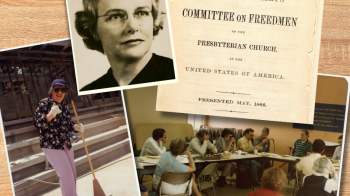
In May 1866, the Committee for Education of Freedmen shared its first annual report with the Old School faction of the Presbyterian Church in the U.S.A.
Both sides of the denomination had gathered that year in St. Louis, Missouri, for their General Assembly meetings — the New School at First Presbyterian Church, the Old School at Second.
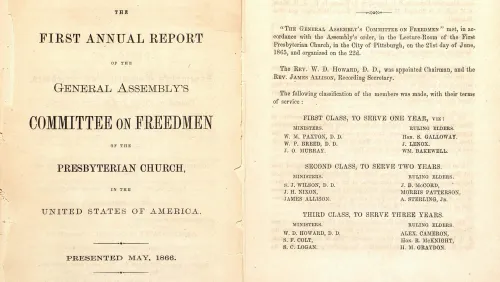
The PCUSA had split in 1838 over social and theological issues, including slavery, infant baptism, and ecumenicism in foreign missions. Minutes of the 1866 Old School GA report that “the assembly expresses its fraternal affection for the other branch of the Presbyterian Church and its earnest desire for reunion.” New School minutes show that the two assemblies held a joint celebration of the Lord’s Supper on May 23, 1866, at the Second Presbyterian Church.
As the Civil War came to an end, the Old School's General Assembly organized the Committee for Education with the purpose of establishing churches and schools among the communities populated by the formerly enslaved. Their report shares that “The American Bible Society has donated 2000 volumes of the Word of God to be distributed among the Freedmen, under direction of this Committee … Thus encouraged, the Committee entered upon its duties …” From June 1865 to May 1866, the committee sent 36 missionaries and teachers into the field.
Upon their reunion in 1870, the Old School's Committee for Education of Freedmen merged with the Freedmen's Department of the New School Committee of Home Missions. The new group was named Committee of Missions for Freedmen. In 1883, the Freedmen's Committee was formally incorporated as the Board of Missions for Freedmen. Access PHS’s Guide to the UPCUSA Board of Missions for Freedmen Records here.
The evening of May 12, 1965, was a historic one for the Presbyterian Church in the United States (PCUS) as they welcomed the first woman ordained into the denomination.
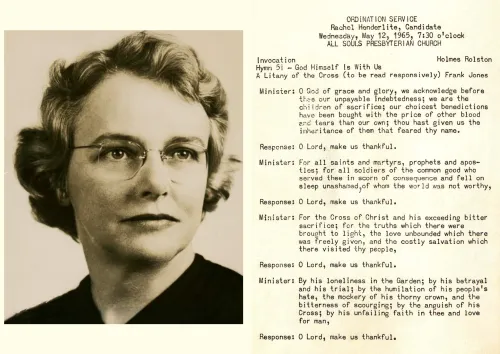
The Rev. Dr. Rachel Henderlite was a teacher, scholar, author, ecumenical leader and advocate for justice. In addition to her historic ordination, Henderlite achieved a number of other great “firsts.” She was the first woman on the full-time faculty at Austin Presbyterian Theological Seminary, and the first woman president of the committee on the Consultation on Church Union, to name a few.
On May 12, Henderlite was ordained by Hanover Presbytery in the sanctuary of her home church, All Souls Presbyterian Church in Richmond, Virginia. There, surrounded by her loved ones, she made history. Access PHS’s Guide to the Rachel Henderlite Papers here.
More Light Churches hosted their inaugural conference at West Hollywood Presbyterian Church in May 1985. More Light Presbyterians is an organization with roots that reach back to the 1974 UPCUSA General Assembly, when the Presbyterian Gay Caucus (PCG) bloomed into existence. PCG’s founder was David Sindt, an openly gay Presbyterian who, at the Assembly that year, held up a sign that said, “Is Anyone Else Out There Gay?” The group was organized with the mission of allowing the full participation of LGBTQIA+ people in life, ministry, and witness of the church and in society.
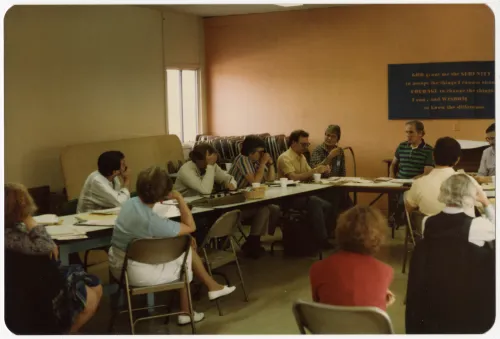
In 1978, when the UPCUSA General Assembly ruled that LGBTQIA+ people could not serve in ordered ministry, several churches began to declare themselves “More Light” churches — churches dedicated to welcoming the LGBTQIA+ community into their congregations more fully. The number of More Light churches continued to grow, until, in 1992, they joined together to create the More Light Churches Network. In 1999, they merged with the PGC to become More Light Presbyterians — a group that continues its advocacy work today with over 300 churches as members. Access PHS’s Guide to the David Sindt Papers here.
In May of 1992, Margaret Purchase was photographed with a broom in hand, hard at work as a volunteer with the Friendship Service Project in Galilee.
Purchase, a UPCUSA missionary, spent decades serving overseas in various capacities. She served in Iraq from 1956 to 1969, and Lebanon from 1969 to 1973 — where she served as director of the Christian Education Division of the Near East Council of Churches. She returned to Lebanon in 1979 to teach English at the Hamlin Hospital School of Nursing in Hammana, where she stayed until 1986.
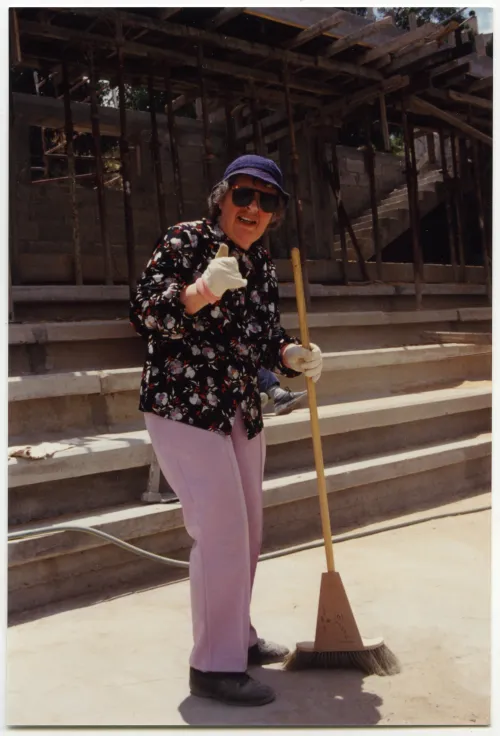
Upon her retirement and return to the United States in 1986, Purchase became involved in Christian-Muslim interfaith dialogue and educating people about Islam and the Middle East through volunteer work with the Institute for Global Education in Grand Rapids, Michigan, where she initiated a project on "Understanding Islam" in 1993.
Concerned about the Israel/Palestine conflict, she made several mission trips to Israeli and Palestinian communities in the 1990s. It is during one of these trips that this image of her was taken by Leigh Baguley of Ann Arbor, Michigan. Access the Guide to the Margaret Purchase Papers here.
Since 1948, Presbyterian General Assemblies have repeatedly addressed the Middle East, especially Israel and Palestine. In a letter published late July 2025, the Stated Clerk of the General Assembly and Executive Director of what is now Presbyterian Life & Witness, the Rev. Jihyun Oh, called for urgent accountability in the devastating crisis in Gaza. She wrote that the church "has long-standing ties to the Holy Land and decades of policy affirming the rights of both Palestinians and Israelis to live in peace, security and dignity ... We reject hate in the form of antisemitism, Islamophobia and anti-Palestinian racism ... We hold in prayer both Palestinian and Israeli families who have experienced terror, trauma, and profound grief. We condemn the horrifying attacks of Oct. 7, 2023, and mourn with all whose lives have been shattered by the ongoing war."
While our best response is prayer, the continuing and escalating violence in Israel/Palestine requires humanitarian assistance and support for our partners in the region. A two-page resource published in December 2024 lists ways Presbyterians and others can inform themselves and engage in advocacy efforts and act for justice in the region, including a list of denominational resources available to individuals and congregations, many of which are accessible on PC(USA)’s Israel-Palestine Resource page.
You may freely reuse and distribute this article in its entirety for non-commercial purposes in any medium. Please include author attribution, photography credits, and a link to the original article. This work is licensed under a Creative Commons Attribution-NonCommercial-NoDeratives 4.0 International License.