A shoutout to God’s ghostwriters
Dr. Candida Moss delivers the 2026 Grawemeyer Lecture at Louisville Presbyterian Theological Seminary
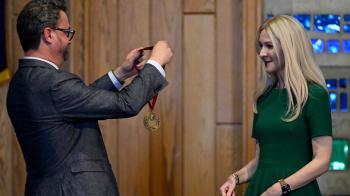
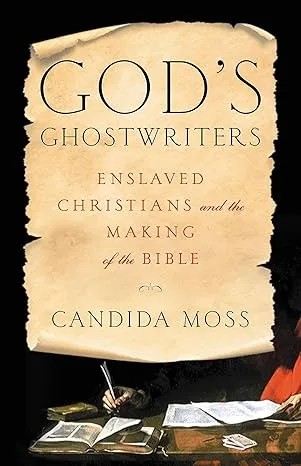
LOUISVILLE — Dr. Candida Moss, the winner of the 2026 Grawemeyer Prize in Religion and the author of “God’s Ghostwriters,” likes to lift up some of the lesser-known heroes of the Bible: enslaved people whose talents helped bring us important texts, including Paul’s letter to the Romans.

Moss, the Edward Cadbury Professor of Theology at the University of Birmingham in the United Kingdom, delivered her Grawemeyer Lecture on April 16. It’s available here.
Each year the Grawemeyer Awards honor the power of creative ideas to improve our culture via music composition, world order, education, religion and psychology. Business executive and philanthropist H. Charles Grawemeyer established the awards in 1984 at the University of Louisville.
Academics and community members choose among nominees from around the world to ensure that each winning idea is both innovative and accessible. The University of Louisville and Louisville Presbyterian Theological Seminary announce the winners in December and present the awards at a ceremony the following April. The five award winners receive $100,000 each, which they may use, if they choose, to develop and accelerate the spread of their powerful ideas. Learn more here.
Speaking at LPTS’ Caldwell Chapel, Moss said her book “is about invisible labor and the many enslaved and formerly enslaved people who helped produce the New Testament and nurtured an embryonic religion that would change the world.”
She initially focused on Tertius, the scribe of Paul’s letter to the church in Rome, a letter that’s “widely regarded as the most theologically sophisticated and influential book in the New Testament,” Moss said. “There’s no questioning its importance, and unlike so many other books in the New Testament, no scholar has ever doubted that Paul himself wrote it.”
That last point is “demonstrably untrue,” she said. “Paul did not write this letter — or at the very least, he did not write it alone. Tucked into the conclusion of the letter is a simple but striking interruption: ‘I, Tertius, the writer of this letter, greet you in the Lord.’”
Tertius was at minimum Paul’s secretary, Moss said, “one of the many erudite enslaved people who acted as stenographer or secretary. What we have forgotten, sometimes deliberately, is that the people who worked as ancient secretaries were not part of some ambitious, well-educated middle class. They were people whose freedom had been stolen.” Tertius means “third,” she noted, and “he was almost certainly enslaved.”
Paul frequently collaborated with secretaries, noting in Galatians 6:11, “see what large letters I make when I am writing in my own hand!” The implication is the rest of the letter has been written in a smaller hand by someone else. “That is how most people in the first century wrote,” Moss said. People who were illiterate or had visual impairment, were elderly or had arthritis or gout, “dictated almost everything that they wrote. Those with means routinely dictated to their enslaved workers simply because it was more comfortable.” Writing hurts, she said. “You have to wring out your hand to get rid of the cramps,” and so Roman writers “educated enslaved workers to do their literary work.” Their work “was almost never credited.”
Dictation could be taken by the enslaved person’s knowledge of shorthand, which captures up to about 70% of what the speaker says. “What that means is the secretary supplied information, probably from memory, from the event, improving upon the speech of the speaker,” Moss said. Shorthand “was developed and used exclusively by enslaved workers,” she said, which meant that “once it was written in shorthand, Paul himself could not read what had been written down.”
In the case of Christian texts, “even small tweaks have an outsized impact,” Moss said. “For almost 2,000 years, readers of the New Testament have agonized over every detail of the Jesus story. Christians have excavated participles as if they were precious relics. Any modification, however small, has affected the course of Christian theology.”
“An excellent secretary or copyist is usually undetectable, but they were always there, actively working and making decisions that have affected some of the most important texts in ancient history,” Moss said. If writing is hard work, “copying is even worse.” It was “relentlessly demanding, and not even the kind of manual labor that the Romans seem to have respected.” She called the work of the copyist “blue-collar literate work, something like data processing or clerical work.”
“Copyists were responsible for duplicating, organizing, repairing and preserving ancient literature,” Moss said. “Though copyists have often been blamed for the mistakes that crept into ancient manuscripts, they are as likely to have repaired and preserved them as to have corrupted them.” They were “textual curators and physicians,” she said. “Their work was indispensable for the survival and dissemination of Christian texts.” Good copyists “were and are invisible. They performed their work so perfectly that they wrote themselves into nonexistence. Bad copyists, on the other hand, leave traces of themselves.”
But this “conceptual binary is much too simplistic,” she said. “Of course, originals were full of errors. Even a final draft of a text was considered to have been tolerably imperfect.” Both ancient and modern readers “tend to credit copyists only for their ‘corruptions’ rather than for their contributions. We speak of ‘scribal error’ and rarely of ‘scribal knowledge.’”
Copyists not only duplicate material, “they also preserve and organize it,” Moss said. That is where the paratext — the material surround the main text, such as the table of contents or index or lectionary — “can become subversive and liberating,” Moss said. “More often than not, those responsible for the creation of paratexts were enslaved or formerly enslaved workers.”
Among contemporary Christians, “this kind of nonlinear reading is particularly utilized in the case of the gospels,” Moss said. “Though we often read them as we do novels — from beginning to end — we also consult them, as we would a recipe book, cross-referencing different versions of the stories.”
“The evangelists are all telling the same story,” she said, “so pausing our reading to compare it to another makes a certain amount of instinctive sense.”
Once a text was copied, it had to be read aloud, Moss noted. “In a gathering of Christians where most people were functionally illiterate, it was a servile reader who brought the gospel alive,” she said. “The work of these readers was active and responsive and involved an ability to translate texts into different cultural registers.”
Just as today, “as ministers guide the impenetrable or confusing biblical passages, so too in ancient times did readers serve as interpretive guides for audience members,” Moss said. “They were not just couriers — they were leaders who cemented emotional ties. They conjured the presence of the authors with their voices, expressions and hand gestures. In a very real sense, the messenger was the message.”
For many Christians in the ancient world, “it was in these moments of communal interpretation that the Bible sang, came to have meaning and became relevant to their lives,” Moss said. Reading was “thus never a simple act. The reader was not just an authority figure; they were an author. While enslaved readers are invisible in modern histories of the gospel, they were to ancient audiences the face of the gospel.”
In one well-known gospel story “that has captured popular imagination since late antiquity,” Jesus was at probably Peter’s mother’s house in Capernaum, Moss said. As Jesus spoke to a large group who had gathered, four men arrived carrying a portable bed. The man on the bed is identified as a paralytic. “Having hoisted themselves and their charge onto the roof, they began to tunnel their way through it,” Moss said. “They removed a web of supporting reeds to create an opening between the wooden beams and they lowered the paralyzed man down into the room.”
Noting the faith of the four men, Jesus forgives the sins of the paralyzed man. After “a brief but tense exchange with the assembled scribes, Jesus plays his trump card and instructs the paralyzed man to stand up, take up his mat and go home,” Moss said.
Most noteworthy for Moss in Mark’s account is the identities of the four men who carried the paralyzed man. Are they friends? Not in the Greek, she said, but we can consider the possibility that the paralyzed man was wealthy. “The social logic of the passage might suggest that the four were enslaved workers,” Moss said, “and so it is especially significant that Jesus’ focus is on them rather than on the man they have brought.”
Their trustworthiness or loyalty, translated here as faith, “is one of the idealized traits of the good slave in antiquity,” she said. “The authors of this story want us as readers to notice these men are here, and that either through loyalty to the enslaver or trust in Jesus or perhaps both, they have distinguished themselves.”
Jesus tells the now able-bodied enslaver “to do his own work,” Moss said. “He resists the social convention that would have permitted the man to hop back up on his litter. This is one interpretation that intends to make enslaved collaborators narratively visible.”
It is the work of the four “that is seen and acknowledged by Jesus,” she said. “Reparative work is in the gaps.”
Not everyone reads the Bible as a historian does, Moss said. “It is possible to read the New Testament for the benefit of marginalized groups without thinking about enslaved authorship and history. But historical reconstruction has merit, and as some of the New Testament’s co-authors were invisible and servile, then those who do care about history should read the literature and the Jesus Movement with this in mind.”
“It may not be possible to credit low-status collaborators with specific interventions,” she said, “but just as with tunneling through a roof, agency should be ascribed to everyone in the group.”
You may freely reuse and distribute this article in its entirety for non-commercial purposes in any medium. Please include author attribution, photography credits, and a link to the original article. This work is licensed under a Creative Commons Attribution-NonCommercial-NoDeratives 4.0 International License.