Ministering in natural and unnatural disasters
The Rev. Dr. Gini Norris-Lane urges presence, preparation and resilience in crisis response
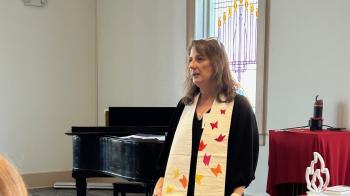
DECATUR, Georgia — Disaster ministry is never linear, and effective pastoral response requires preparation, visibility and theological grounding, the Rev. Dr. Gini Norris-Lane told clergywomen gathered April 15 at Columbia Theological Seminary.
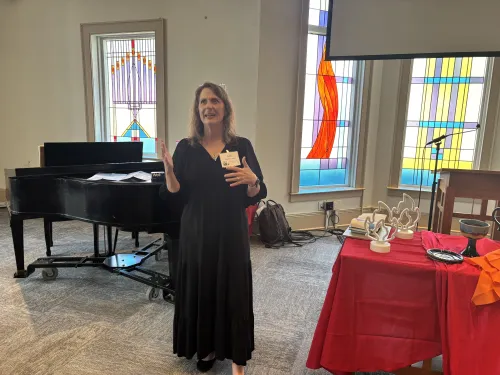
Presenting “Ministering in Natural and Unnatural Disasters” at the National Association of Presbyterian Clergywomen conference, Norris-Lane, executive director of UKirk Collegiate Ministries, spoke from lived experience accompanying communities through both mass violence and catastrophic weather. Global Language Resources arranged interpretation services for this event
“In a natural disaster, there’s a pre-disaster, the threat, the warning, hopefully of some kind,” Norris-Lane said. “The impact, then there are heroic efforts to try to save lives, property, etc.”
She contrasted that pattern with what she called “human-caused disasters,” where grief, information and judgment converge instantly. “With a human-caused disaster, everybody has a video,” Norris-Lane said, referencing a book she received at a Presbyterian Disaster Assistance (PDA) training. The book, “Recovering from Un-natural Disasters” was co-written by the Rev. Dr. Laurie Krauss, director of Humanitarian and Global Ecumenical Engagement in Presbyterian Life & Witness.
Norris-Lane explained that shootings unfold in a media-saturated environment where footage circulates immediately, shaping public narrative even as communities are still in shock. “There comes the low point, and then reforming and then the new normal,” she said, noting that unlike natural disasters, interpretation of human-caused disasters begins before facts or meaning can settle.
Norris-Lane was serving as the part-time pastor of First Presbyterian Church of Uvalde, Texas in 2022 when there was a local mass shooting at Robb Elementary School. She described the long arc of grief following such violence, noting that recovery can stretch years beyond the initial tragedy. “For an unnatural disaster … I've been told it can take as long as 15 years,” she said.
She also emphasized the sudden public exposure clergy face in these moments. “Every state and national government person, leader will come to your town, and so will every media outlet,” Norris-Lane said, recalling “168 voicemails in the first 24 hours asking for us to make a statement.”
From those experiences, she urged church leaders to decide early how and whether to engage the media. “Your session or leadership team has to make a decision immediately about if you’re going to speak to the media or not,” she said.
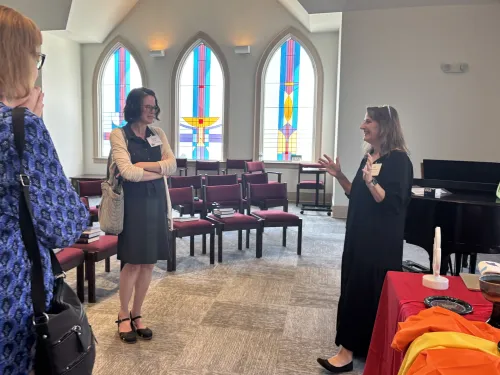
Norris-Lane addressed the importance of visible pastoral identity, particularly for women clergy navigating community meetings where male pastors may dominate. Wearing clerical collars, she said, can establish authority and access. When a workshop participant shared a story of being dismissed at a clergy gathering after a disaster, Norris-Lane agreed. “Wearing it was able to let other people identify who I was,” she said, adding that “it does keep you in the room.”
She underscored that presence extends beyond press conferences. “Showing up can be physical, but showing up can also be a text,” Norris-Lane said. “Gathering is incredibly important.”
She gave examples of gathering in recent campus shootings: “In Uvalde and after campus shootings at Michigan State University and the University of Virginia, congregations and faith leaders held prayer vigils which were places for the community to come together to grieve, pray and lean into the stories of our faith.” In her role as executive director of UKirk, Norris-Lane accompanies campus ministers who find ways to be present in the midst of un-natural disasters.
That lesson reemerged during the flooding in Central Texas near her home and church in Kerrville, Texas, in July 2025. “All we knew is that the river that goes through our town was up to the bridge,” she said. “And then it rose.”
As floodwaters disrupted communication, Norris-Lane described how many organizations were fielding calls from families searching for loved ones and trying to locate congregation members. “Communication had, in some cases, been knocked out,” she said.
Drawing on that experience, Norris-Lane cautioned against people beyond the community assuming they know what those affected by disaster need. “The local pastors where the disaster happened should be the center of gravity and communication,” she said.
She pointed to well-meaning aid efforts that become burdensome when timing and context are ignored. “The flood happened on Friday, and people from all over the country were sending cases of bottled water, clothing, etc. … and the community area businesses, churches and aid groups were inundated with so much stuff as we were trying to figure out what we really needed.” She described how the water supply in central Texas was fine — which had not been the case in Western North Carolina a year before, so water bottles were not actually needed. Other examples weren’t about need but timing. “We found out that flood buckets were coming our way the Tuesday after the flood and because of all of the other aid groups that had arrived on Saturday to begin helping homeowners clear mud and debris, the buckets were no longer a need.” As a result, an area church then had to store the buckets.
Instead, she emphasized, “Donating money to a local congregation or aid organization is the number one best thing that people can do in response to any disaster.”
Across both disasters, Norris-Lane lifted up the importance of working across theological boundaries with groups offering immediate help. She encouraged churches to “suspend your theological differences” because relationships help with short-term pragmatics. She noted the opportunity for the long-term theological healing when Presbyterians are present in the mess from the beginning and remain over the long haul.
Her work with UKirk Collegiate Ministries has also shaped her response framework, particularly given the frequency of shootings on college and university campuses. Through the UKirk board, Norris-Lane has worked to develop liturgies for immediate use after traumatic events, creating space for prayer when, she said, “people do not have the capacity” to find words on their own. For the prayer vigil the day after the shooting at Robb Elementary, Norris-Lane used some of the liturgical resources found in Recovering from Un-Natural Disasters.
Throughout the workshop, Norris-Lane returned to theology as the foundation for sustaining leaders. “Our theology matters,” she said, urging clergy not to minimize death or grief. Drawing on a theology of the cross, she named “Christ being in solidarity with us in suffering” as essential to faithful accompaniment.
She acknowledged the toll of this ministry. “Everyone in the system is traumatized,” Norris-Lane said. “This is where our connectional system can offer some of the greatest support as teams from Presbyterian Disaster Assistance or the Board of Pensions can offer spiritual, emotional, and financial support,” said Norris-Lane.
Still, she lifted up resilience forged through shared faith. “There’s also a thing that’s called post-traumatic resilience,” she said. “The resilience comes from this understanding that we have navigated this difficulty, and you cling to your faith.”
Norris-Lane closed by pointing to the quiet witness of consistency and trust. “When pastoral leaders and congregants respond to a disaster, that builds trust in the congregation and in the community,” she said. “Your presence will be a witness for how Christ is walking with people.”
You may freely reuse and distribute this article in its entirety for non-commercial purposes in any medium. Please include author attribution, photography credits, and a link to the original article. This work is licensed under a Creative Commons Attribution-NonCommercial-NoDeratives 4.0 International License.