Online Innovation Network event offers church leaders space to imagine a faithful future
The interactive gathering from the Office of Faithful Innovation introduced participants to practices around 'episodic future thinking'

On April 15, the Office of Faithful Innovation convened a group of faith leaders — including mid council staff and parish ministers — for an online experiential lab focused on “episodic future thinking.” The event was the second in a new monthly series of Innovation Network “immersion” gatherings, designed to provide leaders with an ongoing rhythm of support as they seek to faithfully address the major issues currently facing their ministries.
Over the course of 60 minutes on Zoom, participants were introduced to foresighting methods from Dr. Jane McGonigall and the Institute for the Future, and then invited to apply these learnings toward their own ministry contexts.
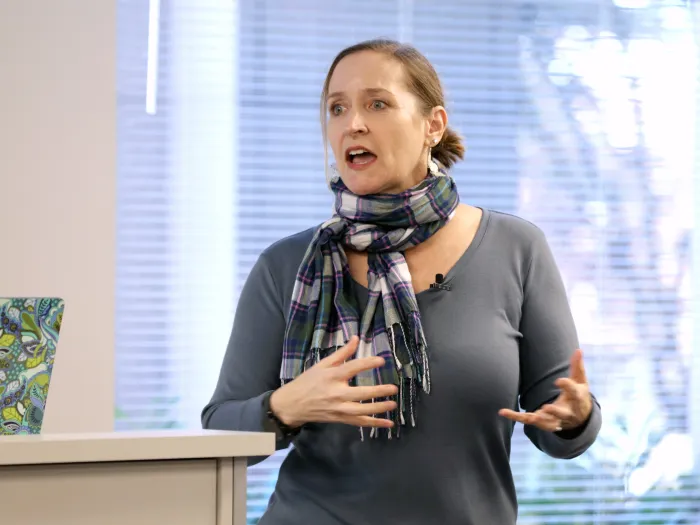
At the outset, facilitator DeEtte Decker emphasized that this event was not about predicting the future, but rather anticipating long-term drivers and signals so that pastors and churches can respond faithfully instead of reactively.
“Anticipating the future and the problems and challenges that might appear helps us start problem-solving earlier, and it helps us to be a little bit more creative in our problem-solving,” Decker said.
After leading the group in an embodied centering exercise, Decker introduced a brief five-question poll that allowed attendees to express their own perspectives about what the next 10 years are likely to hold for the world at large and their own ministries, as well as the impact of technology on that future.
Collectively, the group’s answers indicated a belief that the world would get worse and less equitable. The majority of participants also expressed a lack of preparedness on the part of their faith communities and empowerment on their own part in facing the challenges the future may hold.
With that baseline established, Decker led the group in a short exercise on episodic future thinking. She first had participants identify three significant changes in their own lives over the past 10 years. Then she had them imagine 10 years into the future, considering three potential significant changes they may experience in that time.
Decker went on to explain that MRI results suggest that when we try to imagine our future selves, our brains operate as if they are thinking about a stranger. The further into the future we try to imagine, the more brain power it takes. When we engage in imagining the future in detailed ways — called “episodic future thinking” — we develop new neurons and increase our ability to think in this way, Decker said.
Quoting James Baldwin, Decker said, “Not everything that is faced can be changed, but nothing can be changed until it is faced.”
With that, she introduced participants to the concept of “drivers” of change. Drivers can be sudden and unexpected major events — such as Covid — or more subtle incremental shifts, like demographic changes. Drivers of change were broken into five categories represented by the acronym STEEP, which stands for social, technological, economic, environmental and political.
Using this framework, the group was challenged to identify concrete drivers of change currently impacting the future. Together, they lifted up AI, declining institutional trust, job displacement, climate impacts, and an aging baby-boomer cohort.
When asked to imagine likely impacts on their ministry contexts, participants identified closures and funding shifts tied to mortality, new leadership and organizational models (youth leadership, satellite/network congregations), hybrid and online worship norms, and emergent roles like “digital deacons.” The group’s discussion also raised distinctions between various contexts, such as rural and urban.
Finally, participants were divided into breakout groups and tasked with “flipping some enduring assumptions” about how things should be, and justifying those flips based on the drivers the group identified.
Decker was thrilled to have several new faces join for the April event and said that five of the attendees reached out afterwards for more information and to join the Innovation Network.
The next Immersion event hosted by the Office of Faithful Innovation will take place on Zoom at 2 p.m. Eastern time on Wednesday, May 20. The gathering will be structured around conversation and connection and will consider the question “What does faithful leadership look like in a world that feels increasingly volatile, uncertain, complex, and ambiguous?”
The workshop will explore how ministry can remain grounded, responsive, and imaginative amid constant change, introducing five key pathways of influence: Moral Voice, Pastoral Guidance, Communal Embodiment, Spirit-Led Innovation, and Liberative Action. No prior registration is required. Those interested in participating can learn more at the Office of Faithful Innovation’s webpage.
You may freely reuse and distribute this article in its entirety for non-commercial purposes in any medium. Please include author attribution, photography credits, and a link to the original article. This work is licensed under a Creative Commons Attribution-NonCommercial-NoDeratives 4.0 International License.