A path forward in Cuba
A former Obama advisor and a Cuban-American political analyst and writer deliver perspectives and prescriptions for easing enormous human suffering 90 miles from the US
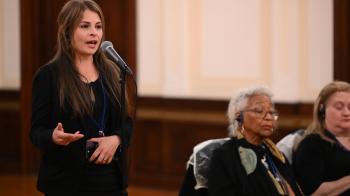
LOUISVILLE — On Wednesday an informative discussion on the current suffering the blockade is having in Cuba and what might be done to make things better there was hosted by Catherine Gordon, Representative for International Issues in the PC(USA)’s Office of Public Witness.
Gordon’s guests were Ben Rhodes, deputy national security advisor and speech writer in the Obama administration and the author of two New York Times bestsellers, and Harold Cárdenas, a Cuban-American writer and political analyst and the co-founder of La Joven Cuba, a leading platform for debate on Cuban society and politics. Cárdenas has written extensively on economic reform, civic participation and U.S.-Cuba relations.
When the Trump administration added fuel to the list of sanctions on Cuba, it meant that “Cuba is facing a profound and rapidly deteriorating situation,” Gordon said. “Many are making the painful decision to leave, and others are finding ways to endure and support their communities under incredibly difficult situations.”
Rhodes, who served in the White House from 2009-17 and whose counsel helped lead to a short-lived normalization of relations between the two countries in December 2014, said that no one in the U.S. cares more about Cuba “than the faith communities in this country.”
What’s different about this moment, Rhodes said, is “this is the most complete and utter economic devastation wrought by U.S. policy in history.”
“There’s nothing left,” Rhodes said. “If you can’t get fuel, you can’t have power, and hospitals can’t function.”
He said Cubans aren’t sure what the Trump administration is asking them to do — whether it’s to transform the economy or “open up Cuba for real estate investment from Miami, allowing Cuban-Americans to control the economy.”
Or maybe Cuban President Miguel Díaz-Canel “has to go,” Rhodes wondered. “It’s the Venezuelan model with real estate instead of oil.”
Late last month, the Rev. Jihyun Oh, Stated Clerk of the General Assembly of the PC(USA) and Executive Director of Presbyterian Life & Witness, and the Rev. Jimmie Hawkins, PL&W’s advocacy director, joined an ecumenical solidarity visit to Cuba, where they witnessed some of the suffering — as well as the faith and determination — of the Cuban people.
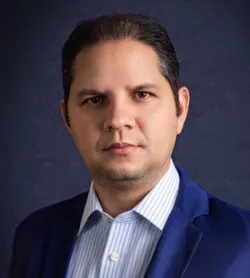
Cárdenas said Cubans “are trapped between a system that needs reform and an external strategy that is causing them to suffer. It is much worse than a decade ago, when Ben was leading a policy that was changing the country for the better.”
There is “constant improv” in Cuba, Cárdenas said, with people enduring sustained daily power outages, shortages, inflation — even the uncertainty of buying groceries. “The Cuban people see U.S. policy every day through the harsher economy and the fewer options they have day by day.”
Rhodes called Secretary of State and acting National Security Advisor Marco Rubio “the driving force” behind the administration’s policies in Venezuela and Cuba. “It’s partially driven by Cuban-American constituents” who “see this as a moment of opportunity.”
In his second term, President Trump “wants to be seen as doing something all his predecessors couldn’t do.” But “it’s not like there’s a groundswell of support for this policy,” Rhodes said.
If you look at Cuban history, “we probably have eight years of democracy,” Cárdenas said. During the rest of the time, the Cuban government was under the influence of either the former Soviet Union or the United States. “Sovereignty is not something we have practiced a lot,” he said.
The communist party there includes both hardliners and reformers, Cárdenas said. “What Trump has done — and what [President] Biden did — was to encourage the hardliners. A wiser approach is normalization, what Ben did.” During those years, the hardliners disappeared for a while and reformers came forward. “Now we have seen the hardliners re-emerge because of U.S. policy,” Cárdenas said.
Because Biden left in place the state-sponsored terrorism designation that Trump implemented in his first term, “anyone who invests in Cuba is subject to U.S. sanctions,” Rhodes noted. To Rhodes, the next most important sanction to remove is the one that reduces travel to Cuba.
Passed into law 30 years ago and signed by President Clinton, the Helms-Burton Act has “built a gigantic web of restrictions — not just what Cubans can do, but what Americans can do,” Rhodes said, including “American philanthropic organizations providing charity to Cubans.”
“Why is the government telling a U.S. charity you can’t give aid to malnourished Cubans?” Rhodes asked. Americans can travel to countries around the world that are led by repressive governments, Rhodes noted, but not to Cuba, just 90 miles from Key West, Florida.
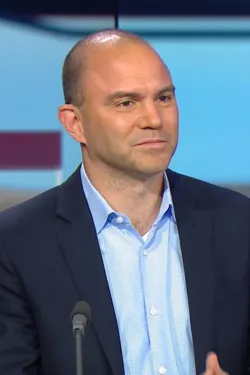
Rhodes said he’s been willing to be self-critical “about things I was a part of,” but not the so-called Cuban Thaw. “This is a moral issue, more than a policy issue,” he said.
There is no national security threat from Cuba, as there was during the Cold War, Rhodes said. “This is about an internal feud between elements of the Cuban-American community and the people governing in Cuba. Our approach was, if you open Cuba for travel and investment, that will make life much better for the Cuban people.”
“Opening things up,” Rhodes said, “is far more likely to bring political change to Cuba.”
Had that policy been in place longer, “you would have seen bigger changes,” Rhodes said. “We need to advocate for policies of maximum engagement and openness.”
People in Cuba “are most concerned with surviving the [current] crisis,” Cárdenas said. “The political discussion is a luxury, pretty much.”
Rhodes said that Congress has “strong voices” for supporting a different approach, although some, including Senator Patrick Leahy, a Vermont Democrat, and Senator Jeff Flake, an Arizona Republican, have retired. Libertarian members of Congress aren’t keen on sanctions, he noted, and current members including Rep. Pramila Jayapal has traveled to Cuba several times, and Sen. Chris Van Hollen “has been good on the issue.”
“There are faith-based arguments that can be made about the human suffering,” Rhodes said. “I was talking to a journalist who said there are people dying there because of these shortages. That’s not fully understood in Congress.”
“If you see the poverty,” Rhodes said, “it becomes a moral issue, not a policy issue.”
Asked by Gordon about effective ways to help Cuba’s roughly 10 million people, Cárdenas said that “we have to do as much as possible here in the U.S., where the policy comes from.”
“If you travel to Cuba, give company and give comfort to the people there. Stay with a family to support them and give them some company. You will see the blackouts they have and the life struggles they have. I think company is the most important thing right now.”
The easiest legislative vehicle would be to lift the travel ban, Rhodes said. “It’s possible that after the [November] midterms, you will see these bills move quite fast,” he said. “These bills often have majority support, but they’re never prioritized. They are down the list.”
The Catholic Church “is well-placed to be a mediator and an advocate for humanitarianism” in Cuba, Rhodes said. Catholics and other faith groups “have ties there.”
“One thing that would make a difference is we have to end the logic that civilian suffering is useful for policy,” Cárdenas said.
If the Trump administration cuts a deal that’s economic in nature, “that’s great,” Rhodes said. “I don’t think it was necessary for all that suffering to happen to get to that deal, and it would probably prioritize Cuban Americans in Florida, but it’s far better than the alternatives.”
“If Trump wants to build hotels and golf courses, I’d much rather he do that than invade the place,” Rhodes said.
“This is a very risky moment, but it can become an opportunity,” said Cárdenas, who has family members still living in Cuba. “My concern is that the expectation of the Cuban-American community in Florida is not very realistic. They expect total overhaul, and that’s not how change happens.”
“We need some kind of dialogue. The stakes are super high, and it’s time to engage with policymakers,” Cárdenas said. “Bombs are not going to make a difference on the political preference of the people they’ll fall on.”
Look here for past and future Action Alerts issued by the Office of Public Witness on the humanitarian crisis in Cuba.
You may freely reuse and distribute this article in its entirety for non-commercial purposes in any medium. Please include author attribution, photography credits, and a link to the original article. This work is licensed under a Creative Commons Attribution-NonCommercial-NoDeratives 4.0 International License.