
We mend with gold
Author Kristin T. Lee speaks with the hosts of ‘A Matter of Faith: A Presby Podcast’ about her faith journey, which has included a fair amount of repair work
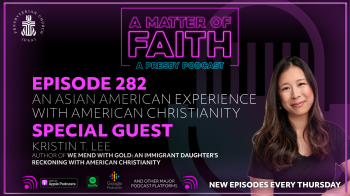
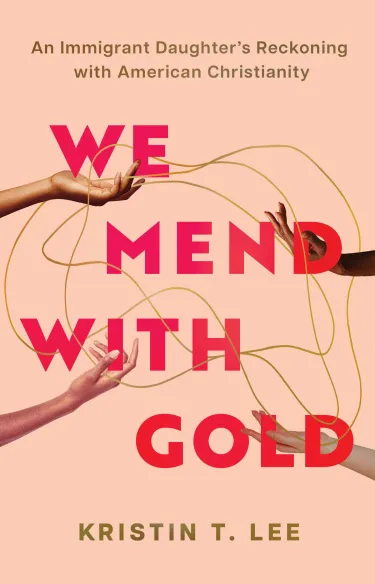
LOUISVILLE — Kristin T. Lee joined the hosts of “A Matter of Faith: A Presby Podcast” in part to discuss her new book, “We Mend with Gold: An Immigrant Daughter’s Reckoning with American Christianity,” and in part to share her faith journey. Listen to her 56-minute discussion with hosts Simon Doong and the Rev. Lee Catoe here.
Here’s the question the hosts posed to Lee to open the discussion: Immigrant families may (understandably) focus on “fitting in” with the culture, values or expectations of the country they move to. But what is lost in the process of trying to fit in and “make it” with the new culture in terms of faith and identity?
“I love that question so much,” Lee said. “There are so many pressures on immigrants to assimilate, trying to fit in in the workplace or in school — but also in church spaces.”
What can get lost for immigrants “is our ability to recognize the gifts of our own heritage and cultures,” Lee said. Growing up in Iowa, Lee didn’t discover until adulthood “that we have such a rich history in China, for example, of great literature that I had never heard about — these rich celebrations of folktales and stories that are in our culture.”
“Now, as an adult, I seek those out with curiosity and I want to teach my own kids those things,” she said. Dr. Daniel D. Lee at Fuller Seminary puts it this way, she noted: Any parts of our identity and histories that we don’t bring to God, we can’t have transformed by God.
“For so many years, I was not interested in exploring those parts of myself. I wanted to hide those parts of myself to fit in,” she said. “But we can’t let God into those spaces if we don’t bring them to God.”
Lee acknowledges that as a second-generation Chinese American, “I have a lot more privilege than my parents did. I don’t critique our elders for not focusing on [Chinese heritage],” she told the hosts, “but I do think it is our privilege as second generation with more stability to get to explore those things.”
In college, Lee began reading “from much more theologically diverse voices” in part because the churches she’s attended “have been culturally white dominant, even though they’re multi-ethnic in composition.”
She was blessed “when I started reading Black Christians and women who were able to help me see God and faith in a new light that wasn’t this monochromatic and very homogenous faith,” she said. “There’s rich, diverse historical Christianity that we can learn from.”
Black Christians in particular “had to do so much standing up for themselves in the face of enslavement and segregation done to them by Christians, people who claimed to follow Jesus — and yet [Black Christians] were able to maintain a very authentic faith,” she said. “They said, ‘No, actually you guys are wrong.’ They had that confidence. They knew that what those folks were doing to them was wrong.”
“I didn’t have that in my tradition,” Lee said. “I didn’t know that you could critique the church. I learned a lot from them.”
Seeing paintings of biblical characters — including God — portrayed as something else than European men was also powerful, she said. “I remember the first time I saw paintings of Jesus and Mary and Joseph as Black or Latino or Asian — it was transformative,” she said. “It touched me deeply to know that God doesn’t belong to one race or one culture. We can have those other representations of God exist more fully.”
White supremacy culture “taught my parents that anything Chinese was suspicious, and that definitely got passed down to me. It’s something I resist now a lot,” she said. “I read a lot of book reviews, and I see how there are certain narratives in what’s published these days that fit categories or tropes. There are easy ones, like intergenerational family tension or interracial dating.”
“Those tropes get really tiring and annoying because they don’t capture the full range of the immigrant experience or the Asian American experience and they pigeonhole us,” she said. “It’s become this digestible way for white people to understand us.”
“One thing I push back against in the book publishing culture is this reliance on, ‘Oh, this is a recognizable story for our audience, so we’re going to celebrate more of these stories,’” she said, “when there are so many other stories that could be told.”
In her upbringing, particularly in her faith community, “everything was dichotomized as good or bad. You’re in or you’re out. There was a right answer to every question, and there was this emphasis on apologetics,” Lee said. She learned “there was no mystery to God. We’ve solved it, and if you don’t believe what we believe, you’re out.” Mainline Protestants and Catholics were seen as having gone astray, she said, “which is wild to me.”
“That stifled my authentic faith because it made me fear asking questions and my doubts and even my own intellect and my own conscience, which was saying, ‘How can we treat our queer brothers and sisters this way?’”
“I had to learn that there are lots of areas we don’t have answers for, and it’s OK to come to God with those questions, and it’s OK to wrestle with God,” she said. “God invites that.”
Where her evangelical siblings were more helpful was “seeing how faith can be an active part of life,” she said. “There are active strands of evangelicalism that are trying to address global poverty. … I have seen lots of models of how to take faith very seriously out into the world and for us to really love our neighbor.”
Doong asked Lee about the Japanese art of Kintsugi, which is alluded to in the title of her book. It’s the process of repairing broken pottery by joining pieces back together and filling the cracks with lacquer dusted with powdered gold, thereby highlighting the flaws in the mended project.
“The finished product is this stunning piece where you have these gold seams throughout that are arguably more beautiful than the unbroken piece of pottery,” Lee said. “I find this to be a helpful spiritual metaphor on many levels.
In her own life, “I was scared to let my faith break because I didn’t think I could put it back together again,” she said. “What I found was no, you let it break and you turn to Jesus with these pieces and Jesus puts it back together with what’s true and what’s good and what’s beautiful.”
On a communal level, “Asian American culture and the American church tend to be triumphalist or try to hide the hard things and talk about only the good things and celebrate the easier parts of our faith or our histories,” she said. “I find that to be not helpful for interpersonal healing and also communal antagonism.”
“It’s important we know our history and bring to God and to one another the difficult parts and the pain,” she said. “Only when we’re honest and transparent can the mending process start.”

“It’s not easy. That process is meticulous and painful,” she said. “Healing those wounds takes time and effort, but it brings us to a more authentic place, both in terms of faith and relationships.”
Lee said she sometimes gets the sense “that people treat immigrant communities or marginalized communities as projects rather than as people to learn from.”
“We need you to be humble and open, and to listen, but you need us to break free from the bubble you live in and see the reality these immigrants bring, because we come from all over the world and we have rich history to provide and different cultural lenses with which we can read and interpret scripture and interact with God,” Lee said. “All of those things bring so much to the faith journey that people are missing out on when they don’t seek it out and don’t embrace immigrants.”
“My encouragement to listeners,” she told the hosts, “is to realize your need for immigrant relationships, stories and friendships — people to teach you different ways to live a life of faith.”
“There is so much resonance to the immigration experience — migration, exile — a lot of richness to be explored spiritually.”
Alongside two others, including the resident theologian at her church, Lee has embarked on a podcast called “Beyond Simple Answers.”
“I’m so thankful to have this church community where I’m allowed to explore these questions publicly,” she said. “Pieces of faith will always break off and there will be mending that needs to be done.”
“I feel like I now have the courage to speak out when I think things aren’t right, and I have others alongside me on that journey, which I’m really grateful for,” Lee said. “I still have a lot to learn from people I disagree with but who are just kind, loving people and who partner with me in other ways to serve the world.”
New episodes of “A Matter of Faith: A Presby Podcast” drop every Thursday. Listen to previous editions here.
You may freely reuse and distribute this article in its entirety for non-commercial purposes in any medium. Please include author attribution, photography credits, and a link to the original article. This work is licensed under a Creative Commons Attribution-NonCommercial-NoDeratives 4.0 International License.


