Catching up with the inimitable Tom Trenney
The composer, conductor, organist, preacher and teacher is the most recent guest on the Presbyterian Association of Musicians’ ‘Sounding Board’
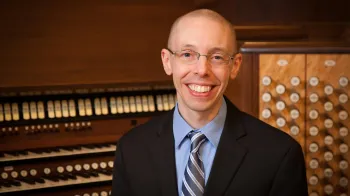
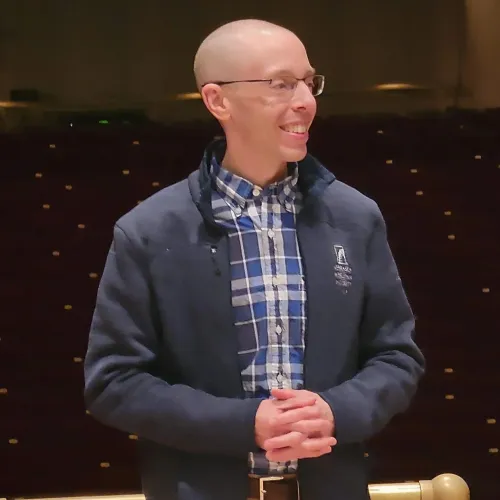
LOUISVILLE — Tom Trenney, a composer, conductor, organist, preacher and teacher who has blessed and wowed attendees of the Presbyterian Association of Musicians’ Worship & Music Conference during multiple appearances over the past 20 years, was the most recent guest of “Sounding Board,” hosted twice each month by Sarah Abushakra and Jeremy Roberts. Watch their 73-minute time together here on YouTube or listen on Spotify or Apple Podcasts.
Trenney is minister of music at First-Plymouth Church in Lincoln, Nebraska, which Roberts also serves, and is an assistant professor of music at Nebraska Wesleyan University, where he also conducts choirs.
Asked about his faith formation, Trenney said he’s not sure if he fell in love with church early in life, “but I did fall in love with making music and worship at church.” He recalls aligning his stuffed animals into a choir, putting on a record of a choir singing, and conducting the makeshift choir — all while wearing a Batman cape as his choir robe.
In fourth grade, he joined a church choir for both boys and men that was affiliated with the Royal School of Church Music. As a result, celebrated conductors would come to town to do summer choir camps for young singers in the region.
“Those experiences connected me with the thrill of church music and how it makes you feel and the way your spirit can vibrate in it,” Trenney said. “I could sense that was something I wanted to be a part of for the rest of my life and career.”
“It’s a reminder,” Abushakra said, “that music draws us in and gives meaning to a lot of people’s lives.”
It was music “that brought me into the environment” of faith, Trenney said. “I started my career as a musician who happened to work in the church. I feel certain now that I am called to ministry and happen to be a musician.”
“The cart and the horse can go in different ways, it seems to me,” Trenney said, “and the Spirit will decide how that works for each of us.”
Among his mentors, Trenney cited the children’s television pioneer and Presbyterian pastor, Fred Rogers.
“I loved [“Mister Rogers’ Neighborhood”] as a child, but I didn’t understand all the gospel I was learning in those moments. That was revealed to me later,” Trenney said. “That idea of neighboring and caring for people, allowing yourself to be creative and explore your talents rather than just comparing them to someone else’s — all of that had a strong influence on the particular way I go about being and doing the things I am and do.”
He said he remembers sneaking into his home the music his children and men’s choir was working on to practice and improvising with the anthem. “My parents thought I was getting ready for my piano lessons,” he said with a grin. “It was clear to me I was being drawn in a certain way.”
“The profession we’re in has for centuries been one that benefits from mentorship. You don’t necessarily know where Bach went to college, but you have an idea of the people he admired and sought out to help him grow and learn his craft,” Trenney said. Some people see a college degree as a signal that “you know everything,” he said, “but if we have an attitude instead that you go out and seek the people who can help you expand and grow, I think that’s why an organization like PAM can benefit us. They help us meet people who see things in a different way, who have eyes that are maybe bigger than ours and can challenge us to live into skillsets we didn’t know we needed to have at the time we went to college.”
He also relies on the work of Maya Angelou, who “had this pithy way of getting to the core of things that was really powerful,” he said. One of Angelou’s teachings is, “People will forget what you said, people will forget what you did, but people will never forget how you made them feel.”
“I think about that in how we relate to each other in ministry and music-making,” Trenney said. “People won’t remember your fancy repertoire … but they won’t forget what it felt like to be in that room when they sensed that presence of the people who gathered.”
The first time Trenney offered an organ recital during the Worship & Music Conference, a man came up to him the next day with Brent, a friend of his from church. “My friend really enjoyed your concert last night and he wondered if he could get a picture with you,” the man told Trenney. The two stood at the organ in Anderson Auditorium and had their photo taken. It was the first time Trenney would meet the man he would later marry. The couple went on to adopt two children.
“We have been back several times” with their two children, Trenney said. “I have delighted in returning to Montreat over the years.”
Trenney said he started preaching about 15 years ago, roughly the same time he began composing.
“I don’t think that was a coincidence,” he said. “I realized I’m not the greatest preacher ever. But there is a way I can see a story in Scripture that’s unique to me and could be valuable to somebody else. Similarly as a composer, I’m not the greatest. But there’s something I can choose to say that no one else can say in the same way.”
One thing he’s clear on is that “God is as much in the rehearsal as in the [Sunday worship] service. Some of the most holy moments I’ve had have been in dusty, dingy choir rooms. That’s often where the Spirit is revealed to us.”
“I don’t feel there’s a hard choice between having an intentional and meaningful musical experience and also doing an excellent job,” Trenney said. “To me, those two things are the same.”

Abushakra asked Trenney about the Abendmusik concert series that First-Plymouth Church and its partners put on every year. Partners have helped turn it into a free series, and events support “small but impactful organizations,” Trenney said.
“The music inspires service and greater empathy and awareness,” Trenney said.
For First-Plymouth Church’s Sing Your Faith choral and spiritual retreat, being held this year July 17-19, people come to Lincoln “to rehearse a lot, and there are breakout sessions for people to go a little deeper” in their spirituality or in their musicianship.
“It’s a great benefit and a boost for our own musicians, and it gives people the chance to come and feel what it’s like to be here,” he said. “We think of it more as a retreat than a workshop. It’s not so much to learn how to do stuff as it is to remember why you’re doing stuff. Also, how does remembering why you do stuff inform what you you’re doing? It’s become my calling as a clinician.”
Asked about his own self-care regimen, Trenney mentioned putting in daily workouts and listening to the Great American Songbook, especially artists like Ella Fitzgerald.
“I don’t feel burned out by the work I do with people,” he said. “There are times when layers of planning can be dangerous, but the work of making music with people almost always makes me feel better than I did before.”
“It’s always a gift,” he said. “It’s metaphysical that we pour ourselves into that and it lifts us up somehow.”
You may freely reuse and distribute this article in its entirety for non-commercial purposes in any medium. Please include author attribution, photography credits, and a link to the original article. This work is licensed under a Creative Commons Attribution-NonCommercial-NoDeratives 4.0 International License.