A PC(USA) network for innovators
The Office of Innovation launches its ‘Innovation Network’ gathering, with the Rev. Trey Hegar as the inaugural guest

LOUISVILLE — “Innovation Network,” a new online gathering designed for innovators offered by the Office of Innovation, launched its initial installment last week with the Rev. Trey Hegar, pastor of First Presbyterian Church in Mount Pleasant, Iowa, sharing that congregation’s innovative approach to ministry.
The Rev. DeEtte Decker of the Office of Innovation is hosting the gatherings, which are scheduled for 2 p.m. Eastern Time on the third Wednesday of each month. She said it's designed to “help mid council and congregational leaders think differently about the challenges you’re facing and develop the skills and capacity to lead faithful innovation.”
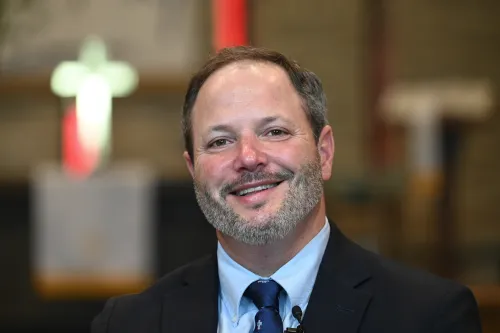
Hegar, who was called to First Presbyterian Church 11 years ago, called Mount Pleasant, a community in southeastern Iowa, “Norman Rockwell-ish.”
“It is family centered, and the church has a place of primacy for about half the country residents,” he said. “We attend each other’s chili cookoffs and rummage sales and fall festivals.”
It’s also typical “of a lot of middle America towns, where the young people graduate and then move away,” Hegar said. Over the past decade, two Fortune 500 companies have left Mount Pleasant, and a meat-packing plant and Iowa Wesleyan University closed in the past few years.
“I have learned to ask, ‘What are the greatest needs in the community and how can churches partner to meet those needs?’” he said. “Can the church become a job creator? How can we help create jobs that have meaning and are flexible and empowering?”
Hegar said he began developing skills for innovation while serving a church in South Carolina, which after a study opened a farmer’s market co-op in an old stable. Folks in the community would market their wares, food was available and a band played on Saturday mornings.
Organizers planted community gardens and gave away what grew there. “It was God’s abundance, like in the Garden of Eden,” Hegar said. “People would ask, ‘How is that benefitting the church?’ and I would say, ‘That’s not the point. We are making a proclamation about the kingdom of God, that their work has value and worth.’”
They’d talk about “the economy of grace vs. the economy of scarcity,” he recalled. “But you’ve got to monetize it. You can’t have a failure of nerve to say, ‘The church gets 10%.”
If a church’s attendance is in decline, it won’t have “the volunteer power and the financial power” to grow the food pantry and offer other services, such as childcare, Hegar noted.
“But we think those are necessary and good” ministries to offer the community, he said. “When we dream up a ministry, I tell people we have to incentivize it.”
One example is IowaWINS, a ministry originally established at the church with the help of community partners to aid Syrian immigrants. IowaWINS grew in 2018 to serve 32 factory workers working in Mount Pleasant who’d been detained following a raid by Immigration and Customs Enforcement.
As Iowa WINS grew, Hegar and others pushed for the church’s administrative costs to be covered by part of the $1.8 million raised for the local immigrant ministry.
“We have to stand our ground so we will have the resources to do the next big thing,” he said. “You have to have contracts and you need them included in your bylaws … so you can keep doing ministry. It’s an investment in the next helping ministry.”

First Presbyterian Church also played a leading role in founding the All God’s Creatures animal shelter and its partnership with incarcerated individuals at the nearby Mount Pleasant Correctional Facility.
“We called the warden, and she was so happy we’d even thought of them,” Hegar said. “We started small, but the biggest thing was, we started. That sets a successful ministry apart.”
The volunteer base is now around 100 people, “and most of them are not members of this church,” Hegar said. “The lesson is the dogs don’t care if you’re a Democrat or Republican, white or Black, young or old, rich or poor. They only care how you treat them. It’s taken on a life of its own because of the spirit behind it.”
For those practicing adaptive challenge ministry, Hegar recommends MaryAnn McKibben Dana’s book, “God, Improv and the Art of Living,” “even just the first chapter,” he said. As with improvisation, the answer in ministering in adaptive ways is “yes, and,” he said.
“What kind of imagination do we need to bring to this?” Hegar asked. Challenges “aren’t roadblocks — they are avenues to more partnerships.”
When you apply improv techniques, “you can ask people who aren’t warm [to a new idea] to invite others in,” Hegar said. “You bless us, and we will bless you as you continue your knitting and quilting ministry.”
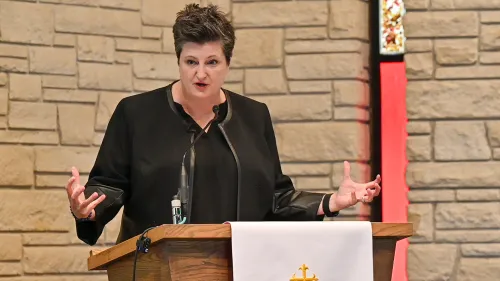
And, as Decker pointed out, “innovation and tradition need each other.”
During a question-and-answer session following their conversation, Hegar was asked about the wisdom of creating a nonprofit that’s separate from the church. It depends, he said.
IowaWINS remains a ministry of the church, which includes it for liability insurance purposes. For All God’s Creatures, “when we bought the building and asked for an insurance rider,” the insurer said no, “and so we spun that off. We found we could raise more money by having it spun off.” All told, All God’s Creatures raised $1.3 million with an eye toward its grand opening.
“We couldn’t have done that if we had kept it as a ministry of the church,” Hegar said. “It also makes it easier to get grants when you’re not associated with a church.” Many donors “will give to nonprofits but not churches,” he said.
Another person on the call asked if the discernment process Hegar was describing is replicable.
“Yes and no,” Hegar responded. “I love the missional network process where you listen, look outside [the church] and name who your community is. Start with the eyes and ears, then meet your neighbors and converse.”
“Where I hesitate is, moving from listening and seeing to doing” can take time, “and you can lose energy. Take some action and pick some low-hanging fruit early.”
From idea to ribbon-cutting, it took seven years — including a long interruption brought on by Covid — to open All God’s Creatures.
Along the way, “we got a significant estate gift, and then we formed a new board and hired a consultant to help with fundraising,” he said. “The idea was to spend 10% of what you want to raise. We learned so much from [the consulting firm]. They helped us be task-oriented and organized.”
Hegar suggested that others interested in a similar pursuit of adaptive ministry “find friends and encourage people with that ‘yes, and’ type of ministry. When they are passionate about something, send them, like Luke 10 says, and then invite them back in to share what they have seen and heard.”
You may freely reuse and distribute this article in its entirety for non-commercial purposes in any medium. Please include author attribution, photography credits, and a link to the original article. This work is licensed under a Creative Commons Attribution-NonCommercial-NoDeratives 4.0 International License.