Presbyterian Disaster Assistance webinar examines recent changes in the nation’s immigration system
Guests from the National Immigration Forum lay out the administration’s policy changes and offer ways Presbyterians can help meet the challenges

LOUISVILLE — Troubling changes in the nation’s immigration system — and how Presbyterians and their congregations can use their voices to help minimize further damage — was the subject of a Tuesday webinar offered by Presbyterian Disaster Assistance.
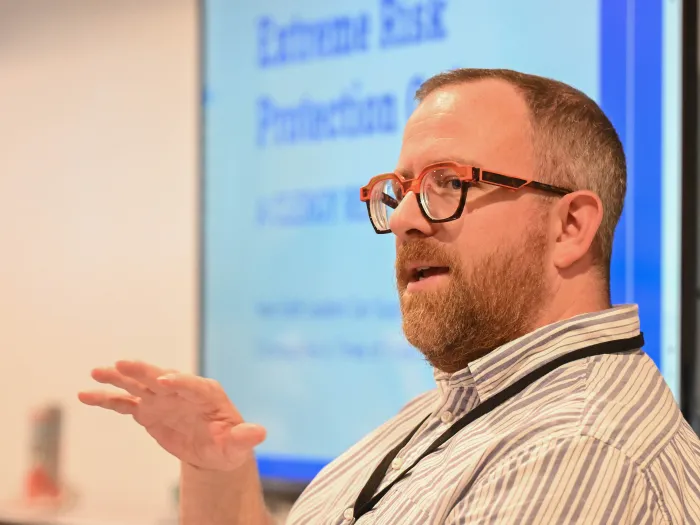
Omar Salinas Chacón, PDA’s mission specialist for Immigration Accompaniment Ministries, hosted the most recent installment in the Migration Education Series. His guests were Nicci Mattey, senior policy and advocacy associate at the National Immigration Forum, and her colleague Arturo Castellanos-Canales, NIF’s policy and advocacy manager.
“We follow closely the great work the Presbyterian Church (U.S.A.) is doing to protect migrants,” Castellanos-Canales said. “We are big fans of your work.”
He said the NIF tries to be a bridge between people on several sides of immigration issues. “The DNA of our strategy is ‘BBB’: Bibles, Badges and Businesses,” he said. It can be powerful, he said, to go to a meeting on Capitol Hill with the support of clergy, law enforcement and business leaders.

“An important part of our work is advocating for refugees, and 2025 was a tough year for refugees,” Mattey said. For fiscal year 2026, which ends Sept. 30, the Trump administration has set the ceiling for refugee resettlement at 7,500 people, the lowest level in the program’s 45-year history. The number of displaced people around the world stands at more than 123 million, with more than 36 million of those identified as refugees.
“To arrive in the U.S., [refugees] go through an incredibly thorough vetting process,” Mattey said. “The U.S. has a long history of welcoming refugees. I’m sure many of you know them in your community.” She urged those on the call to contact their congressional delegation to advocate for legislative reform.
The United States differentiates between asylum seekers and refugees, Castellanos-Canales said. Refugees live outside the U.S. and request protection from abroad. An asylum seeker is already in the United States and requests protection for fear of returning to their country. Last month, the Rev. Jihyun Oh, Stated Clerk of the General Assembly and Executive Director of the Interim Unified Agency, signed an amicus brief in support of refugees and asylum seekers.
According to Castellanos-Canales, last year saw a number of unfortunate changes to the nation’s asylum system, including:
- In 2025, the percentage of successful asylum applications was cut in half compared to 2024’s result — 38% in 2024 and 19% in 2025.
- The administration has fast-tracked deportations without a hearing before an immigration judge.
- It’s also eliminated the CBP One mobile app, which was used to set up appointments on asylum cases at U.S. points of entry.
- It’s paused adjudicating affirmative asylum applications, the process for asylum seekers who are present in the United States, regardless of how they entered the country within one year.
- The Department of Homeland Security has proposed a new rule doubling the time it can take for asylum seekers to seek a work permit, from 150 days to 365 days. Comments on the proposed rule can be made here.
Mattey noted that 2025 was also devastating for those holding Temporary Protected Status, which is granted by the Secretary of DHS to eligible foreign-born individuals who are unable to return home safely due to conditions or circumstances preventing their country from adequately handling the return. Of the 17 countries where immigrants enjoyed TPS status, 11 have seen their status terminated, “and we are worried about the other six,” she said.
One of the 11 countries is Ethiopia, where TPS status was terminated in December. “In the District of Columbia, we have a lot of Ethiopian folks who say they can’t wait to get home, but worry that it’s safe to do so,” Mattey said.
“I know this is a lot of bad news, but there’s a little good news too,” she said. Federal courts “continue to be a block against these oppressive designations,” she said, asking those on the call to contact their elected officials to work on legislation ensuring permanent protections for immigrants.

Castellanos-Canales mentioned another helpful development: In January, DHS published an interim final rule reforming long-standing restrictions on R-1 religious worker visas by eliminating a mandatory one-year foreign residency requirement before returning to the U.S. after reaching the five-year maximum stay of the R-1 visa. Comments on that proposed rule can be made here through March 17.
On detention, the story is much bleaker. “It’s happening in our backyards, and it’s receiving increasing national news coverage,” Mattey said. Immigration and Customs Enforcement is currently detaining about 73,000 people — a historic high — and at least 32 people died in ICE custody last year.
Across the country, ICE has purchased 24 warehouses with funds included in the One Big Beautiful Bill.
One bit of good news, Mattey said, is that federal courts have ruled ICE cannot detain people without a bond hearing. At present, more than 70% of detainees don’t have a criminal record. “The courts remain an active check on ICE detentions,” she said. She encouraged webinar participants to make sure a detention center is not proposed near them.
One webinar participant asked this question: How do I speak out about the topic of justice for immigrants without people in the church being angry about mixing church and politics?
“It’s a tough one,” Mattey said, adding she’d recently had a conversation with a friend who was asked a similar question and is establishing a three-week study, “What Does the Bible Say About Immigration?”
“Her earnest advice was, ‘Start with the women,’” Mattey said. “Women are open and ready to receive and to serve.”
“More broadly, more people are on your side than you realize,” Mattey said. “We don’t have to agree on everything to agree on this one thing.”
“Don’t be preachy,” Mattey suggested. “Just meet people where they’re at.”
“I hope this is just the beginning of a fruitful relationship with the Presbyterian Church (U.S.A.),” Castellanos-Canales said, adding the National Immigration Forum has a social media presence here, here, here and here.
Read PDA’s guide to migration worldwide and in the United States here.
You may freely reuse and distribute this article in its entirety for non-commercial purposes in any medium. Please include author attribution, photography credits, and a link to the original article. This work is licensed under a Creative Commons Attribution-NonCommercial-NoDeratives 4.0 International License.