The true value of small church ministry
Emily Sajdak of Partners for Sacred Places speaks during a PC(USA) Office of Faithful Innovation gathering

LOUISVILLE — Emily Sajdak knows the true value of ministry by small and rural congregations.
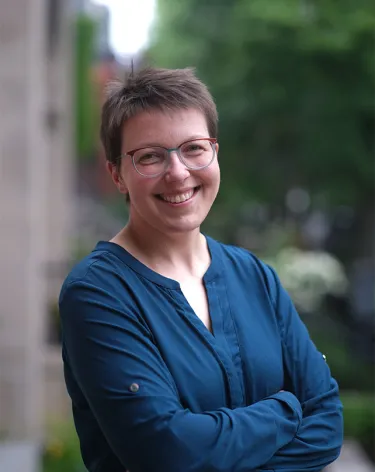
Sajdak, Director of Rural Initiatives for Partners for Sacred Places, was the guest Wednesday for a helpful online gathering put on by the Presbyterian Church (U.S.A.)’s Office of Faithful Innovation.
After being introduced by DeEtte Decker of the Office of Faithful Innovation, Sajdak cited two statistics clarifying the value that small churches bring to their communities: more than 4 in 5 people who use a sacred place are not members of the congregation, and fully 93% of U.S. congregations are opening their doors to the wider community for such services as food pantries, AA meetings, Girl Scout gatherings and the like.
“These findings demonstrate that older sacred places are vibrant places that benefit the public,” she said, but might be “at risk because of their age and their physical condition.”
Partners for Sacred Places’ “The Economic Halo Effect of Historic Sacred Places,” served to “demonstrate that congregations contribute to community and economic life” by sharing space that subsidizes the work of nonprofits, including supporting early childhood education, business incubators and other services dedicated to the public good.
Among the study’s eye-popping findings was the average congregation has a $1.7 million annual impact on the community, with nearly $700,000 coming through educational offerings and more than $500,000 in direct spending.
“Research offers an alternative to common myths,” Sajdak said. “One is that all rural churches and America are in decline. That is actively not the case.” Many of the churches Partners for Sacred Places studied “are stable community anchors,” she said.
A second myth is that congregations are no longer relevant to their communities. In a follow-up study in 2021, “we looked at 87 congregations that are doing an excellent job caring for their rural members and their communities,” Sajdak said.
One congregation studied, Franklinton United Methodist Church in North Carolina, had an active membership of 25 in 2021. The pastor was serving two congregations in shared ministry, and yet Franklinton’s annual economic impact on its community of 2,000 people was $1.2 million. The church operates an early childhood education program that serves 40 families, has a youth group, and hosts a Girl Scout troop at no cost.
Another North Carolina congregation studied was FaithBridge United Methodist Church in Blowing Rock, which operates Casting Bread food ministry, now in its 20th year. “Over 20 years, the church developed a reputation for compassionately providing to families experiencing food insecurity,” Sajdak said. Now a separate nonprofit agency, Casting Bread has three employees and offers people in need both a self-choice market and bakery. It generates $300,000 in annual economic impact and serves about 1,100 households each year.
“We study and advocate for the real intangible value of small and rural congregations,” Sajdak said, urging those gathered on the call to “think of your property as having a mission to explore new and creative uses for your space.”
“What role does your property play as you engage the community?” she asked. “If you’re looking to partner to share your space, having a sense of this can help you find those partners.”
West Denmark Lutheran Church in Luck, Wisconsin, is one such place. “They lean into their culture” through participating in the Nordic Churches Project, Sajdak said. These churches, all in the Upper Midwest, receive training, support for repair planning, and capital grants.
“The impetus for these churches is they are deeply embedded in their communities, their buildings are significant assets and they provide services to their community,” Sajdak said. West Denmark Lutheran Church hosts a week-long fiddle school “that is internationally known,” she said, and fiddlers travel from Nordic countries to teach there.
She also told he story of Harshaw Chapel in Murphy, North Carolina. Its building fell into disrepair and church leaders wanted to bring the building back in order to widen its use in the community. A cupula that threatened to collapse the roof was removed, and the church landed modest grants from Partners for Sacred Places and another source, but raised $130,000 on its own to “put the building back into community use,” she said.
It can also be a good idea to research families who donated historic fixtures in church, such as stained-glass windows. “Bring them along as you tell your story about what you’re doing and casting a vision for who you want to be,” Sajdak advised. “These people might be interested in joining you in whatever it is you’re trying to do.”
“If you’re up for a research project,” she said, “they can be a good base of supporters.”
You may freely reuse and distribute this article in its entirety for non-commercial purposes in any medium. Please include author attribution, photography credits, and a link to the original article. This work is licensed under a Creative Commons Attribution-NonCommercial-NoDeratives 4.0 International License.