During an anxious presbytery meeting, moderators can rely on the PC(USA)
The Rev. Dr. Kris Schondelmeyer, Co-Moderator of the 227th General Assembly (2026), offers a well-known acronym to describe compassionate moderating
LOUISVILLE — The Rev. Dr. Kris Schondelmeyer, Co-Moderator of the 227th General Assembly (2026), put the PC(USA) acronym to use last week during a workshop he offered during the Moderators Conference, held at the Presbyterian Center in Louisville, Kentucky.
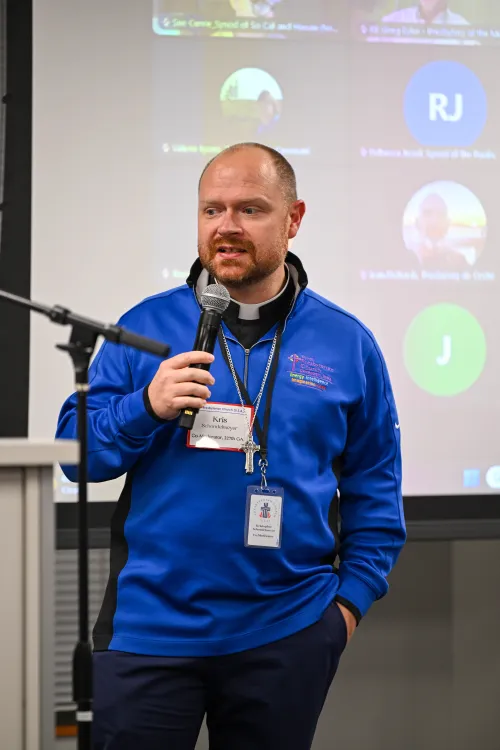
Schondelmeyer, pastor and head of staff at First Presbyterian Church of Davenport, Iowa, called his workshop “Leading from the Inside Out: Moderating Difficult Conversations the PC(USA) Way.”
Schondelmeyer noted the movie “Inside Out” featuring the personified emotions living inside the mind of the central character, Riley. When he played the trailer, Schondelmeyer asked moderators to “pay attention to what happens when one emotion takes over the controls of our minds.”
“We like to think we’re rational people, especially as Presbyterians,” he said. “We like to believe we’re making thoughtful, reasoned decisions, and sometimes we are.” But then he asked moderators to think of that presbytery meeting “where someone challenges your leadership, or fear imagines all the things that can go wrong in the meeting.”
Schondelmeyer noted that we all have different parts of ourselves within us, according to the principles of Internal Family Systems therapy:
- The Defender, who says, “I need to prove I am right.”
- The Pleaser, who says, “Everyone needs to be happy.”
- The Avoider, who says, “Please let this end.”
- The Fixer, who says, “I need to solve this now.”
“If my Avoider is running the meeting,” Schondelmeyer said, “I may allow harmful behavior to continue.” The goal, he said, is to recognize with curiosity and compassion that we play these parts. “I believe our true self is a compassionate self,” he said.
Then he laid out the central idea of the workshop: Before I can moderate the conversation around me, I must moderate the conversation within me.
That’s where PC(USA) comes in. For Schondelmeyer, those letters can stand for:
- Prepare, or pause for PEACE
- Covenant to engage with compassion
- Understand with empathetic listening
- Share your own experience
- Act with compassion.
The goal is not agreement at any cost, he noted — it’s faithful engagement grounded in compassion. “Sometimes the most compassionate thing we can do is to name something that is wrong, or set boundaries and hold someone accountable,” he said. “Can we do that without losing sight of the humanity of everyone involved?”
The “PEACE” in “Pause for Peace” was, of course, another acronym, for:
- Pause and personify any emotional reactivity
- Embrace the personified emotion as a friend or comrade
- Acknowledge, appreciate and assure your personified part
- Calm your comrade with compassion
- Ensure and embody peace.
When someone says something provocative during a mid council meeting, “we pause. We take a breath,” he said. “We can say, ‘I feel the emotions in the room and I think it’s appropriate we pause.’” Lead the body in prayer, Schondelmeyer suggested. “Recognize what’s happening inside of us, and name it. It’s an important skill for a moderator to have.”
“We learn to hold those feelings with the compassion they deserve.”
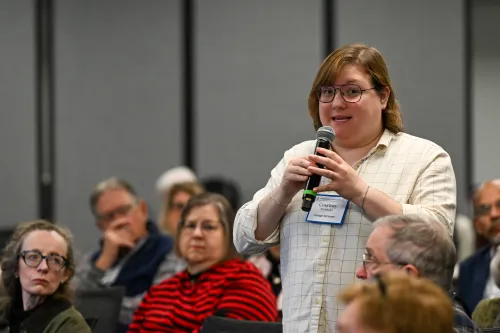
The covenant we make as a body matters most when we disagree, he said. “Belonging and accountability are not opposites. Our denomination and our councils are only as healthy as the people serving within them.”
Consider, he said, a ruling elder who says that the church “is changing too much.”
“What is underneath that statement of grief?” he asked the moderators. It could be that the congregation has felt like home to that elder.
Or what if someone says, “We need to change everything about the way this presbytery operates.”
“What if that’s a deep longing for a church that will be relevant for their children and grandchildren?” he asked.
The role of the moderator is, of course, not to manipulate the outcome, he noted. “Our role is to help the council engage in faithful and compassionate discernment and decision-making.”
He asked moderators to use the PC(USA) framework to deal with this comment hurled during a presbytery meeting: “The whole process is a sham! The moderator and leadership have already decided what they’re going to do. Nobody cares what the rest of us think!”
“That may or may not be a real story,” Schondelmeyer said.
The goal of compassion-based moderating, he said, is “not to make every difficult conversation comfortable,” but to “lead a process where each person can feel seen, heard and valued, even when we disagree.”
“What is happening inside of us,” he said, “will inevitably influence what happens between us.”
Schondelmeyer gave moderators a bit of homework. It’s to consider “what will help me become a healing and hope-filled presence rather than amplify the anxiety?”
“The invitation is to keep practicing this,” he said.
You may freely reuse and distribute this article in its entirety for non-commercial purposes in any medium. Please include author attribution, photography credits, and a link to the original article. This work is licensed under a Creative Commons Attribution-NonCommercial-NoDeratives 4.0 International License.