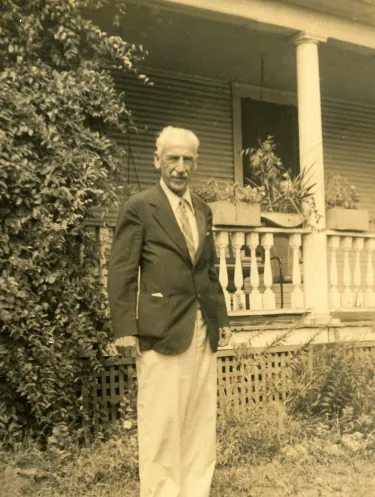
When Dr. Edward Haymaker (1858-1948) stepped off the boat with his young bride Esther to take over the Presbyterian mission in Guatemala in 1888, he scarcely could have known the extent to which mission life in Guatemala would become his life. Haymaker followed missionary John Clark Hill, who was only in Guatemala for a short time before taking a call in China. Now Haymaker had arrived to this young mission eager, steeped in Social Gospel, and ready to make his mark. He would spend the next fifty years ministering to the Ki'che' Maya and Guatemala City peoples and building a mission system that still stands today.
But this story is not just the story of a missionary life—it is also a story of colonialism, of politics, and of knowledge. They are "monuments to particular configurations of power" (Stoler, 89). Was Haymaker on a heroic journey, an "epic quest" for Christianity (Comaroff, 238), or was he on a mission of white supremacy, or is the truth somewhere in the middle of this complex tale?
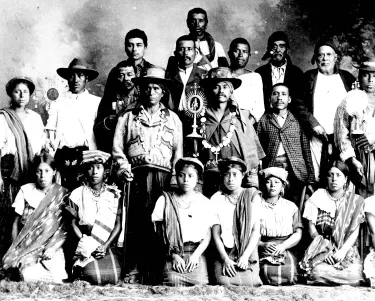
While Haymaker is central to the story of the mission, the Ki'che' people are at least as important. It was for the Ki'che' that the missionaries were called, and with the Westernization of their culture in mind. The Ki'che', who are still a proud and important people in Guatemala, are central to this story. Did they wish to be missionized? How were they exploited, and how were they attracted to the mission? Why did the mission achieve such success? What role do local and indigenous people play in the stories we tell about missions? When Haymaker stepped off that boat, the Ki'che' were about to undergo a forceful change. An assimilative push. The colonial system and its reform positioned the indigenous people as the problem, and the mission system was a colonial project (Tabor, 123-124). The "benevolent posture" of the missionary, however, made men such as Haymaker seem like heroes for the Christian movement. One scholar referred to this as the "missionary halo," the selfless missionary doing God’s work on Earth (Farrell and Khyllep, 8-10).
I was lucky enough to receive a Research Fellowship for 2025 at the Presbyterian Historical Society. My project is focused on the Haymaker mission and creating a reparative history of the Ki'che' people at this time. This is not an easy story to tell, because the record is written by those with power and authority—the missionaries and their counterparts. But within those records are the Ki'che', embedded in words and objects and images. As Director of the McClure Archives and University Museum at the University of Central Missouri, I have curated the Haymaker Papers and Material Culture Collections for nearly three decades. At PHS I focused on the official record of Haymaker’s mission tenure, including documents from the Board of Foreign Missions.
My project is to coordinate a single narrative that uses all records and collections to tell the Ki'che' story of the mission with missionary as informant, an anthropology of the Ki'che' in the first half of the twentieth century. Much of what we think and write about missionaries today springs out of a movement to deconstruct and better understand the tension between the missionary and the indigenous people being missionized. As professionals in archives and museums, scholars like me seek today to unpack that relationship and better represent the lives of the indigenous peoples and the impact that the mission had on their culture(s).
Indeed, part of today's work is dismantling white supremacy in the missionary record, and means recognizing that the mission movement came with unwelcome change and continues the falsehood that indigenous peoples ceased to exist as independent, unique and important cultures. These relationships were complicated and intertwined, but remembered and presented as a missionary's story. As Whitehouse wrote: "In short, the simplistic opposition between indigenous and missionary breaks down in the face of a far more complex reality"(Whitehouse, 297).
Presbyterian missionaries did not come to Guatemala by intention, but by invitation. The country’s new President, Justo Rufino Barrios, had just won election as a reformer. He sought to do what he termed modernization—a Westernization of Guatemala that would include public schools, Christian churches, and a new scheme for control of the indigenous Ki'che' Maya. Barrios appeared in person before the Board of Foreign Missions to request a Presbyterian missionary in Guatemala that Barrios saw as a lynchpin in his plan to wrest the country out of the control of the Catholic Church, which had exerted religious control over the country since the the time of the conquistadors. John Clark Hill answered the BFM call to minister in Guatemala begrudgingly; he had hoped for a posting in China. Instead, Hill found himself in the tropical climes of Guatemala, accompanying Barrios home and working to build the foundation of a mission. He never gained a foothold, made only twenty-four converts in five years, and soon the BFM was searching for a new person to take the call.
Edward Haymaker was a lifelong Presbyterian. The son of two Missourians, he was raised by his uncle Andrew McElwain. McElwain was himself a Presbyterian minister, serving at churches across Pennsylvania and as Synod Stated Clerk before retiring. Haymaker grew up in the church, went to Lafayette College in Easton, Pennsylvania, for his bachelor’s degree, and then went on to his Doctor of Ministry at Princeton Theological Seminary. Haymaker, though raised by a strict evangelical Scotsman, was a follower of the Social Gospel movement he was introduced to at Princeton. As he wrote in his BFM Registration Card, Haymaker was influenced by Social Gospel leader Dwight Moody. Haymaker believed in the concept of uplift—that by bringing Christianity and doing good works through missionization, one could convert the "natives" and lift them out of their cultures which were seen as less than civilized. The result is a cache of documents, collections, and books that portray people such as the Ki'che' as backwards, "savage," and disappeared. Haymaker’s ideas of uplift meant massive change aimed at Westernization, and the Western world was white, wealthy, and powerful. He collected objects to use in church lectures to raise money for uplift.
Haymaker traveled the Guatemalan countryside with his Bible and a walking stick with a carved cross at the top, forcing conversion on locals and indigenous people. And he left behind a body of work—books, papers, pamphlets, letters—that tell the story of the mission, his life and work, and the Ki'che' as the force of the mission took over. These collections move through contexts, they do not live in one simple story or reality (Dudley, 4). Rather, they occupy a liminal space of "suffering, loss, and habit" that informs the many stories they tell (Dudley, 9-10). These collections, especially the material culture objects, represent a spectacle: it gives the illusion of missionary control, involves the state, and provides a "permanent" display of power that is taken for granted (Bennett, 128). Haymaker took the uplift of the Ki'che' seriously, and believed that was best accomplished by drawing them away from their own lives and into the life of a modern American village.
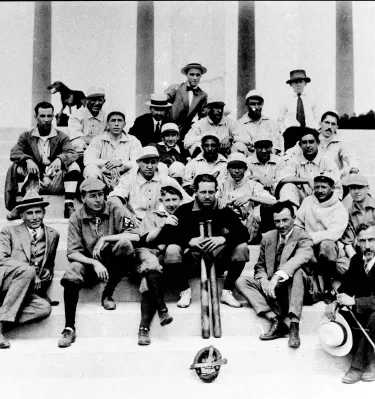
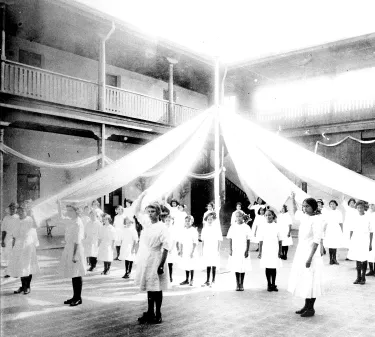
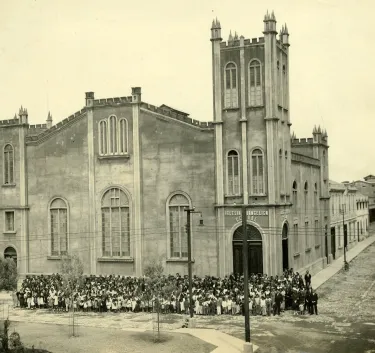
He began by creating the Central Church in Guatemala City. That was quickly followed by a printing press and the first English language newspaper in the country. Then a girl’s school, an orphanage, a boy’s school, a nursing education program, a hospital. This was in concert with his translation of books into Spanish and Ki'che', beginning with the Book of Mark. He even established a men’s baseball team to give the Ki'che' healthy recreation. Finally, Haymaker donned his straw hat and cane to travel to Quetzaltenango, the traditional center of Ki'che' culture, to found mission stations and convert locals. It was, as he stated at a 1920 mission meeting his "duties to native brethren" (RG 157 B1 F9). Haymaker even wrote a short booklet, "The Indians of Guatemala," to educate other missionaries about the indigenous peoples and uplifting them. Originally given as a lecture, it became the introduction to the mission in Guatemala.
Haymaker left the full-time mission when his wife died in 1928. Thereafter, he visited for six months every year and lived at his house in the Ki'che' controlled hills that he called "El Ranchero." He died in 1948 in a Kansas City hospital, leaving behind a large family of eight children and a missionary legacy institutionalized in records and artifacts.
There is much work that remains to be done on a reparative study of the Haymaker mission: comprehensive photographs of the material culture collections, interviews with today’s mission leaders and Ki’che’ representatives about the history of the Presbyterian church in Guatemala, and a deeper dive into church records. As this story develops, however, it can become a prime example of how to repair relationships between missionary church histories, today's mission work, and the indigenous peoples who survived through early 20th century missionization.
Check out our other Fellows' projects and learn more about the Research Fellowship Program at PHS by visiting pcusa.org/rf
Works Cited / Further Reading
Board of Foreign Missions, Presbyterian Church U.S.A. Meeting minutes of the Guatemalan mission May 1920. RG 157, Box 1 Folder 9, Presbyterian Historical Society.
Comaroff, John and Jean. Ethnography and the Historical Imagination. Boulder, CO: Westview, 1992.
Dudley, Sandra H. Displaced Things in Museums and Beyond: Loss, Liminality, and Hopeful Encounters. London: Routledge, 2021.
Farrell, B, Hunter and S. Balajiediang Khyllep. Freeing Congregational Mission: A Practical Vision for Companionship, Cultural Humility, and Co-Development. Downers Grove, IL: IUP Academic, 2021.
Stoler, Ann Laura. “Colonial Archives and the Arts of Governance.” In Reconfiguring the Archive, eds Carolyn Hamilton et al. London: Springer, 2002: 83-100.
Tabor, Charles R. The World Is Too Much With Us: ‘Culture’ in Modern Protestant Missions. Series The Modern Mission Era, 1792-1992: An Appraisal, series ed. Wilbert R. Shenk. Macon, GA: Mercer UP, 1991.
Whitehouse, Harvey. “Approximated and Monolithic Christianity in Melanesia.” In The Anthropology of Christianity, Ferella Cannell ed. Durham: Duke UP, 2006: 295-307.
You may freely reuse and distribute this article in its entirety for non-commercial purposes in any medium. Please include author attribution, photography credits, and a link to the original article. This work is licensed under a Creative Commons Attribution-NonCommercial-NoDeratives 4.0 International License.