Two PC(USA) pastors ‘privileged’ to spend a week in the Arctic National Wildlife Refuge
The Rev. Andrew Black and the Rev. Courtenay Willcox share what a ‘trip of a lifetime’ taught them
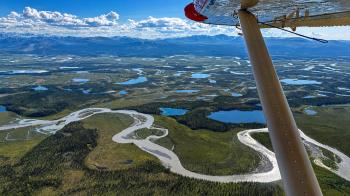
LOUISVILLE — Two Presbyterian Church (U.S.A.) pastors said they were privileged to spend nearly a week in June in the Arctic National Wildlife Refuge (ANWR) as part of a pilgrimage of faith leaders following a recent oil and gas lease targeting the Refuge’s Coastal Plain.
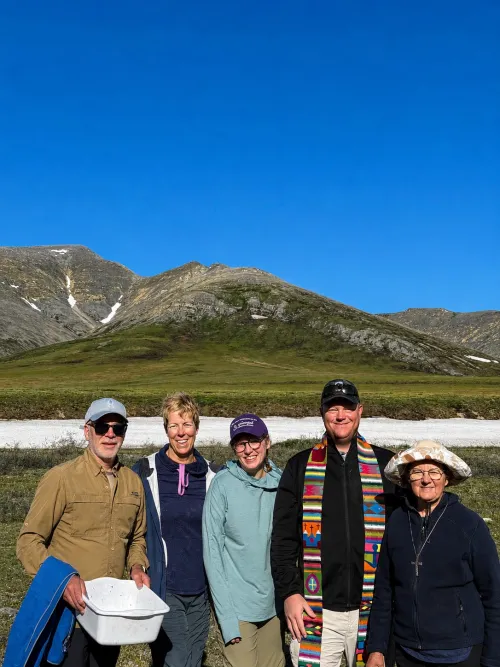
The Rev. Courtenay Willcox, transitional pastor of Northampton Presbyterian Church in Holland, Pennsylvania, and the moderator of Presbyterians for Earth Care, and the Rev. Andrew Black, associate pastor of First Presbyterian Church of Santa Fe, New Mexico, and the founder of EarthKeepers 360, were among the delegation of faith leaders. American Lands Project paid their expenses.
“As one of the few places left on Earth that is untouched, the Arctic is a modern-day Eden where the wonder, beauty and splendor of God’s Creation are on full display,” Black said. Its importance “from a climate, biodiversity and spiritual perspective cannot be understated, which is why we are asking faith leaders from across America to join us in protecting and conserving the Arctic.”
“I am compelled by the early Genesis account of our call to till the Earth and keep it,” Willcox said. “In Hebrew, ‘till’ (avad) means to work or serve and ‘keep’ (shamar) means to protect or preserve. This is humankind’s first and clearest directive to steward Creation rather than commodify it. Keeping the Earth is hard work, but Creation care lies at the intersection of all that benefits and sustains the Arctic.”
“The post-trip hope is this would be a wake-up call to churches of why the Arctic is so critical,” Black told Presbyterian News Service. The Refuge features “very little to no human impact whatsoever.”
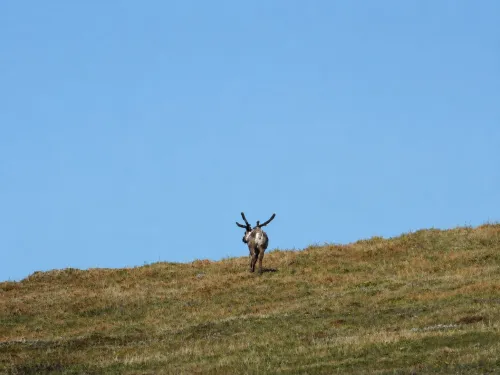
“The caribou we encountered had never seen a human being. The fingerprints of the Creator are still on [the Refuge],” Black said. “It’s a ‘Lion King’ ‘Circle of Life’ image that appears as the tundra thaws.”
Birds including sandhill cranes that begin their fall migration in the Refuge end up in places in the Lower 48 including New Mexico. “I don’t think a lot of people know how connected they are to the Arctic,” Black said.
“I went into the trip thinking it would be a highlight,” Willcox said. Instead, “it was a trip of a lifetime” with multiple themes finding their way into her preaching.
“We walked alongside our Gwich’in siblings, who translate in a way to Indigenous people in the Lower 48,” she said. The Gwich’in people refer to ANWR as “the sacred place where life begins,” she noted. “I think we all need to do better to preserve that and other lands in danger of being desecrated.”
The group, which included Sister Joan Brown, a Franciscan nun; author and podcaster Dr. Jim Stump with BioLogos; and Susie Faria, a policy advisor with the Episcopal Church’s Office of Government Relations, also heard from the woman who created the “Molly from Denali” animated series that airs on PBS. “It talks about the hardships indigenous people face that I as a white person had no idea of,” Willcox said.
The Gwich’in Steering Committee said in a statement that “as Gwich’in people who have been engaged for decades in the work to protect the Arctic Refuge and those whose work is grounded in prayer, we understand the significance of working alongside a broad coalition of groups, including faith leaders.”
“We hope that seeing these lands and waters in person helps people feel a deeper spiritual connection and understanding of how we are all connected through the Arctic,” the committee said. “We also hope the public understands that the rights of the Gwich’in people to continue stewarding these lands is critical to the overall protection of the Arctic National Wildlife Preserve.”
On June 5, the Bureau of Land Management held an oil and gas lease sale targeting the Coastal Plain of the ANWR. According to a news release from American Lands Project, this sale is the first of four lease sales required under the One Big Beautiful Bill Act. It generated only nine bids on five tracts representing less than 10% of the acres offered. Lease sales in the Refuge in 2021 and 2025 similarly yielded almost no interest from major oil companies due to high costs, public backlash and reputational risk.
American Lands Project said that while major banks have historically refused to finance drilling in ANWR, “the Refuge remains under constant threat of new drilling and development.”
Later this year, companies will begin conducting seismic testing, the industrial process of running heavy equipment across the Arctic tundra to map what lies beneath for drilling. Such testing “causes lasting physical damage to delicate tundra and permafrost, disrupts caribou migration corridors and polar bear denning areas, and opens the door to full-scale industrial development,” American Lands Project said.
What Willcox, Black and others saw was a long way from that scenario.
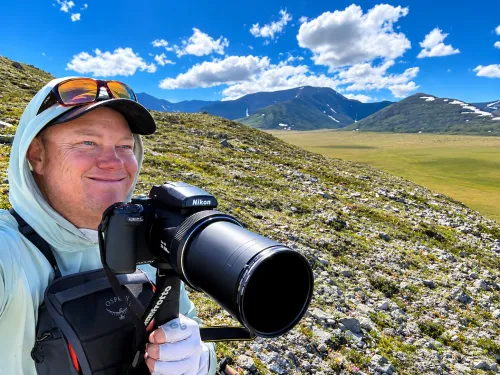
“Everything is in super-productive mode in the summertime,” Black said. “You’ll find wildflowers by your tent that weren’t there the night before.”
ANWR “plays a huge role moderating climate change and reducing the severity of what we are seeing [with climate change],” Black said. “By drilling, we will unleash devastating amounts of climate change.”
“They don’t know if there’s oil there,” Willcox said. “It is so expensive to get equipment into places where there are no roads.”
“These are our neighbors in the biblical sense,” Black said. “We need to figure out the challenges they face in their villages,” including $18-per-gallon diesel prices.
“I think the church is well-situated to find the balance between loving our neighbors and helping to find a solution,” Black said, “to help them have energy independence and help them survive for generations to come.”
“Sacred places so critical for indigenous populations are important not just to those ancestral communities, but part of who we are as the American people,” Black said. “The communities I work with in the American West — and those in the Arctic — talk about land as a relative, not a resource, places of solitude and silence.”
Black and Willcox will discuss their time in the Refuge during a Presbyterians for Earth Care webinar at 7:30 p.m. Eastern Time on Sept. 8. In the coming weeks, they’re willing to speak to congregations and mid councils. Email Black at [email protected]. Reach Willcox at [email protected].
You may freely reuse and distribute this article in its entirety for non-commercial purposes in any medium. Please include author attribution, photography credits, and a link to the original article. This work is licensed under a Creative Commons Attribution-NonCommercial-NoDeratives 4.0 International License.