From the archives: Art is for everyone
Need a new hobby for the new year? Find inspiration in the Presbyterian Historical Society archives
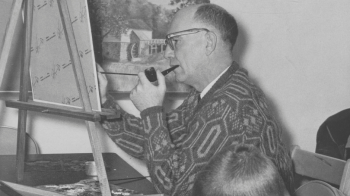
A congregation in York, Pennsylvania, made the papers in 1964 when word got out about their new social organization.
“The birth of the Spry Sketch Club was no accident,” W. Ralph Dilling wrote in the correlating press release. “The tremendous increase of interest in painting, and the realization of many people that they have some latent artistic talent, have led the congregation to form an organization which caters to one of man’s more modern needs — creative art.”
Members of the organization would meet weekly at Christ Lutheran Church of Spry, Pennnsylvania, for a sketching and painting session. There was no membership roster, no dues, and no elected officers. Membership wasn’t even confined to members of the congregation. Rather, the Spry Sketch Club sent out an open invitation to the community and drummed up ample interest among young and old, even drawing in members from out of town who made their way to the sanctuary each week.
Dilling concludes by sharing that “True, all of the work turned out in the club is not polished art. But the neophyte artists don’t let that dampen their enthusiasm.”
And you shouldn't let it, either. If you're on the hunt for a new hobby this year, look no further than the realm of the creative. There are so many methods of making, so many paths to choose from, and the beauty is in the eye of the beholder. Let these stories of artists past inspire you to pick up a brush, a chisel, a needle and thread or whatever tool you might require for your craft, and take a leap into the unknown. Who knows what art you might make?
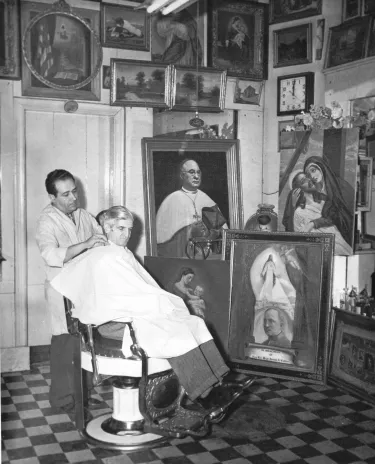
The paintings adorning the walls of this barbershop aren’t antiques, or a part of a collection — they were made by the barber himself. Snapped in 1950, this Religious News Service photo was taken in a barbershop in the Bronx. It shows the barber tending to a client’s scalp in a room laden with art.
Augustino Vincenzi spent his days snipping hair and, in between clients, smearing oil paint onto canvas. His finished artwork was then framed and hung along the walls of the shop, so that Vincenzi might be comforted by his own creations, even when he was tending to an appointment’s hairdo. Painting was his chosen and favorite hobby, and it shows — his crowded Bronx, New York shop shares closer resemblance to a museum hallway than a hair parlor, its walls and floors riddled with frames.
Perhaps you're hoping to find a craft of a smaller scale — one that won't threaten to overtake the walls of your home. Bernard Solomon would recommend you try your hand at the "forgotten art" of wood-block-engraving.
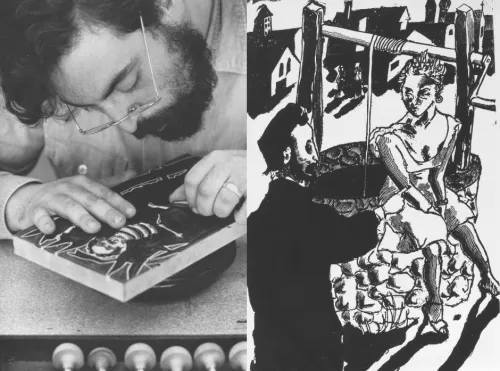
"With a block of wood, a set of carving knives and his ancient printing press, he creates exciting pictures," the caption of Bernard's RNS profile reads. Solomon had just finished up printing 1,000 copies of his latest series, called "the Zaddick Christ," when this photo was snapped.
"Wood engraving is fun to Solomon. But it is slow, tedious and difficult," the caption continues. It's art on a smaller scale, but it still takes dedication and devotion. Apparently, a single picture can require 35 to 50 hours of work before it can be reproduced. "And then the blocks easily crack, twist, and warp. Delicate linework, typical of wood engraving, is easily over-inked and slightly excessive printing pressure will squeeze ink into the fine white lines, blurring the picture," the caption states.
Because of these intricacies, the focus and dedication they require, wood engraving has been "cast aside" by many as a forgotten art. "But to Solomon, instructor of art and printing at Georgia Southern College, wood engraving is alive and affords one of the truly artistic methods of printing."
This tedious and difficult process of creation brings Solomon joy, and allows him a new venue through which to communicate. For him, the art is worth the time put into it — and as one of only three wood-engraving instructors left in the United States, he strove to inspire in his students his ceaseless desire to create.
If painting or wood-engraving is too intimidating, pick up an old digital camera instead. That was Sister Adele Rowland's first step — learning to wield a lens. Then she took it a step further and pioneered her own form of photomontage.
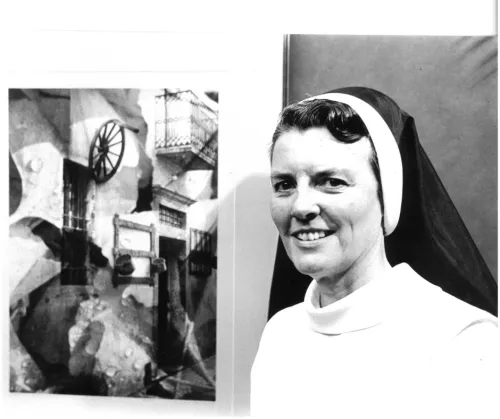
A pioneer in the artistry of “Haiku Photography,” Sister Rowland was named Artist-in-Residence at Dominican College in San Rafael, California, in the early 1970s. Prior to this residency, the Dominican Sister of San Rafael had studied with renowned photographers such as Ansel Adams and Imogen Cunningham. She'd spent a decade teaching English at California State University before entering the Dominican Convent in 1950. At the university, she taught humanities, English literature, and photography until being named the university's Artist-in-Residence in 1974.
"Haiku Photography" is a method of photomontage using 35 mm color slides in a particular focus, superimposing the images atop one another. "Today what is done on computer was done with painstaking precision to get just the right image," the caption explains. Sister Rowland shared the intention behind her artmaking, remarking: "I strive to alert people to the beauty and the excitement in the world, because there is too much negativism. I’m trying to fracture the original image so that it can be seen anew, seen afresh." We're taking Sister Rowland's advice and fracturing the atypical image of the artist. You're welcome to step into the frame, to make something new.
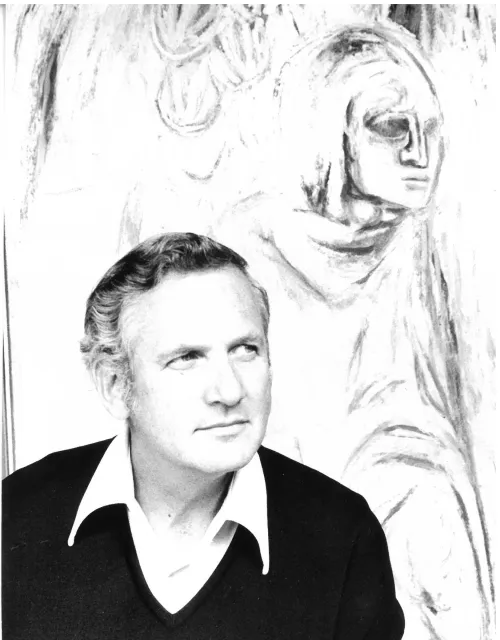
Still unsure if making art is the best use of your time? Perhaps the Professor will persuade you.
Dr. Robert David Ramsey believed that "art is basically a religious activity." The professor of fine arts is shown in this 1977 photo with one of his recently-finished paintings, "The White Angel." Ramsey taught and lectured at a variety of institutions, including Holy Names University (where this photo was captured) and Russell College.
In between teaching, serving as chairman of the art department at Notre Dame College in Delmont, and the other responsibilities of his life, Ramsey carved out time to tend to the spiritual — in other words, time to create.
After completing "The White Angel," he had begun work on a second painting, which he called "The Dark Angel." During his life, his artwork was exhibited in Mexico, Missouri and California, and he penned a number of articles on the visual arts and the sacred. Six years after this photo was taken, Dr. Ramsey would lead in the creation of The Archives of Modern Christian Art, established on the Notre Dame College campus in California in 1983.
In this busy world, it's easy to lose ourselves in the stress and overwhelm of the everyday. The violence and joy we see alternating on the news, the unknown future, the fluctuation of economy, all that we cannot control — one could drown in the heady currents of today. Artists like Ramsey and Solomon were not exempt from this, living as they were in the mid-to-late-20th century. They channeled their energies into making, into connecting with the divine through art. Old or young, trained or self-taught, paintbrush or pen — may 2026 be the year that you carve out time, whether it's five minutes or five hours, to tend to your spirit and pick up a tool of creation.
You may freely reuse and distribute this article in its entirety for non-commercial purposes in any medium. Please include author attribution, photography credits, and a link to the original article. This work is licensed under a Creative Commons Attribution-NonCommercial-NoDeratives 4.0 International License.