A real pro teaches PC(USA) mid council moderators about parlia pro
At the Moderators Conference, the Rev. Dr. Melissa Allison of Denver Presbytery offers a fun and helpful talk on parliamentary procedure

LOUISVILLE — Only someone who enjoys and respects parliamentary procedure can effectively teach others how to use it well.
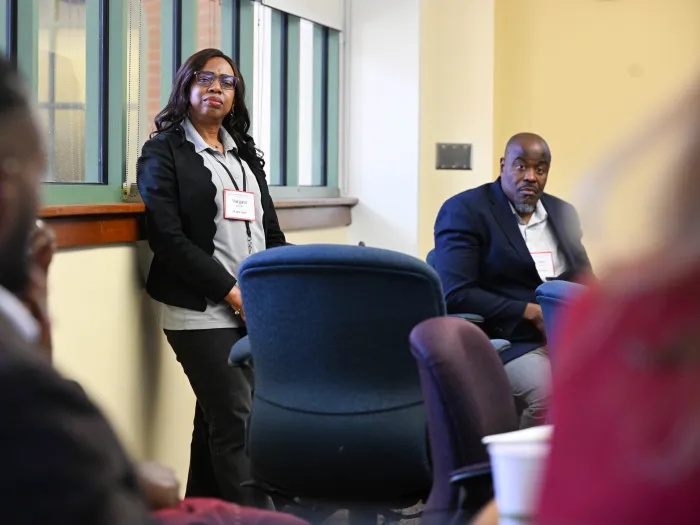
For the 130 or so moderators from around the country who gathered online and at the Presbyterian Center last week for the Moderators Conference, that person was the Rev. Dr. Melissa Allison, the interim Stated Clerk of Denver Presbytery.
“Why are you here?” Allison asked the moderators, answering her own question this way: “A group of people spent time in discernment and prayer, and your name came to them.”
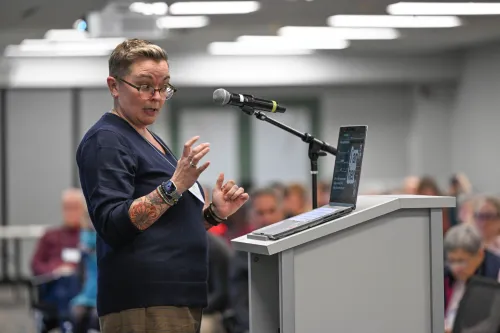
Then she told moderators why she was there: “I bring my gifts and passion for polity, governance, conflict transformation and organizational change to support accountability, equity and sustainable leadership practices in the church so that everyone can joyfully participate in Christ’s ongoing work in the world.”
Allison said that the guiding question for any moderator is this: How can a group listen well and then decide together?
She had another question moderators might want to consider: why do people attend presbytery meetings?
Possible answers include fellowship; mutual learning; out of a sense of obligation; connection; unity in diversity; worship and prayer; “to fight and debate and vote”; mission; connection and support; and care and encouragement, she said.
She called “Robert’s Rules of Order” an “organized method of decision-making,” noting that its author, Henry Martyn Robert, was an army officer in the Civil War who after the war was asked to moderate a church meeting.
“One can scarcely have had much experience in deliberative meetings of Christians,” Robert wrote, “without realizing that the best of [people], having wills of their own, are liable to attempt to carry out their own views without paying sufficient respect to the rights of their opponents.”
“Keep in mind that people of color were not [then] allowed in white spaces,” Allison said. “Marginalized people are often not the majority, and their voices have historically been stifled.”
In Presbyterian circles, “some voices tend to dominate,” she said, including those of men, teaching elders and white people over those of women, ruling elders and people of color. “Work to disrupt that,” she encouraged moderators. “When used as a tool and not a weapon, ‘Robert’s Rules’ can provide support in discerning the will of the Holy Spirit.”
Allison noted that the basic principles of parliamentary procedure include equal rights, with every member having the same right to speak, move and vote; one topic per motion; minority rights, with dissenting members being heard and their rights protected; and majority rules.
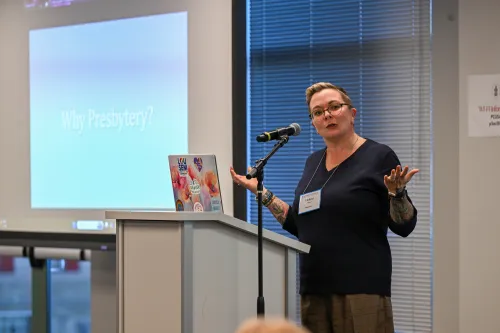
She led moderators through this made-up case study: A pastor from a congregation no one has seen at a presbytery meeting for ages steps to the microphone to make a motion: “On behalf of the congregation of First Presbyterian Church of the Grass is Greener, I move that our congregation be dismissed to that other denomination where their churches are growing and everyone thinks like us.” A ruling elder from the church seconds the motion.
“The presbytery doesn’t care about us,” the pastor says, “so obviously you aren’t responsible for us. Therefore, we will quietly take our building and live out God’s mission where we are wanted.”
Other churches in the presbytery have been considering a similar move and see this as a possible test case. An amendment is made to add “and retain ownership of the building.”
The body erupts, calling “point of order” and “motion to refer to an administrative commission.”
Allison asked: How do you proceed as moderator?
Moderators had some ideas. Depending on the presbytery’s bylaws, it may not be possible to add to the meeting agenda. The presbytery may not be the appropriate body to start the process. Then there’s the idea that Allison stressed throughout her talk: Pause. “It’s your friend,” she told moderators.
“You can invite the body to discern in small groups,” she said.
Another way forward is discernment and consensus, the practice of the World Communion of Reformed Churches. Last year, Allison was parliamentarian during the WCRC’s 27th General Council held in Chiang Mai, Thailand.
“Is this permitted? It is, per the Book of Order,” Allison noted. “A vote can still be the outcome, but it’s not how we begin the process.”
She called discernment a posture, while consensus is a process that “gathers every voice, tests the sense of the group and moves on with shared ownership.
“Discernment asks, ‘What is right for us?’” Allison said. “Consensus asks, ‘Can we move forward together?’”
“We are on this journey together. Do it in community with collaboration,” Allison recommended. “Swap emails and learn together. It’s what all of us are doing here in the church.”
Read previous reporting on the Moderators Conference here and here.
You may freely reuse and distribute this article in its entirety for non-commercial purposes in any medium. Please include author attribution, photography credits, and a link to the original article. This work is licensed under a Creative Commons Attribution-NonCommercial-NoDeratives 4.0 International License.