The truth about conflict
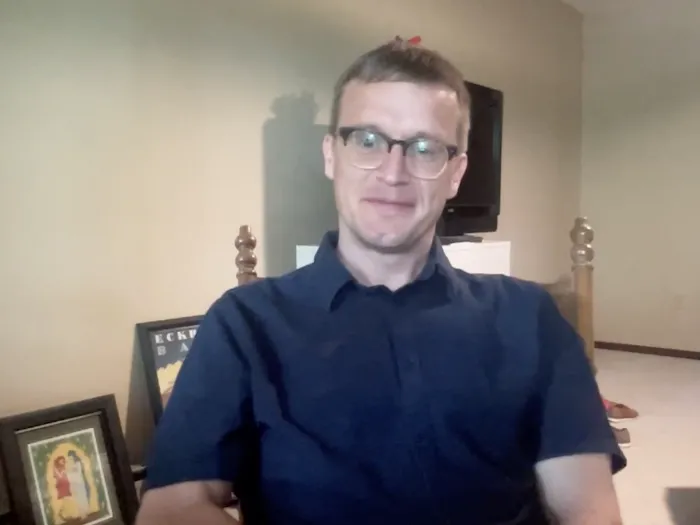
The Rev. Dr. Aimee Moiso is the most recent guest on the ‘Sounding Board’ podcast
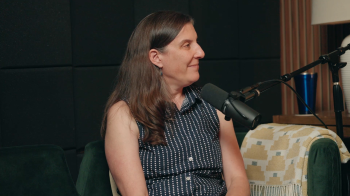
LOUISVILLE — The most recent edition of the journal “Call to Worship” includes “The Truth About Conflict: Preaching When We’re Divided,” by the Rev. Dr. Aimee Moiso, Manager of Social Witness Policy in Presbyterian Life & Witness. The article proved so illuminating that Sarah Abushakra and Jeremy Roberts, the hosts of the Presbyterian Association of Musicians’ podcast, “Sounding Board,” were keen to have Moiso sit for an interview. Watch their conversation here or listen to it here or here.
Moiso spoke about her role managing social witness policy in PL&W, including collaboration with the Advisory Committee on Social Witness Policy, an approach that she appreciates. “It’s not just one person making a statement,” she said. “It’s an elected committee that’s brought in to do this work on behalf of the Church, which can affirm it or not. It’s a collective vision.”
She spoke at length about her recent article in Call to Worship.
“Writing about conflict emerged from ecumenical work,” Moiso told the hosts. “I was always curious about balancing my strong conviction with your strong conviction. What does preaching and worship do in times of conflict? What is possible in preaching in situations of conflict,” especially in a polarized time. “When you get to that level of conflict,” she said, “you start seeing the other as the enemy.”
Roberts noted that in her article, Moiso differentiates between prophetic preaching and pastoral preaching, “although they may not be as different as we think they are,” he said.
In fact, the dichotomy between the two “is sort of a trope,” Moiso said. “You’ll feel good after a pastoral sermon, and your heart will be strangely warmed,” she said. “Then there’s the prophetic, which will call you to action and potentially make you feel guilty, and will be loud and boisterous.”
“The reality is we rarely see sermons in those ways, but we talk about them in those ways,” she said. Neither one is fully accurate, “and neither one is a good response to conflict.”
In her article, Moiso looks at what relational preaching looks like. “What if preaching was not designed to deliver a message in a prophetic way or bring everyone together, but to say, ‘What is the nature of the relationships we want to have as a body and how can preaching embody that way of being together?’”
“How do you construct a whole worship service that is honest and truth-telling and holds that space for conflict within the situation of worship?”
Those who are learning how to preach often “look at preaching as what a pastor does to the congregation as opposed to something the pastor does in the congregation or with the congregation or through the congregation,” Moiso said. But “the preacher can think of this as a collaborative act, especially in times of conflict.” Her doctoral advisor, the Rev. Dr. John McClure, talks about the preacher “as the host of a conversation whose authority comes from being granted that role,” she said. It’s a “rotating position,” with other people in the congregation taking on the role as well. “The preacher goes back and forth between host and guest.”
She asked: “What is the expertise we want our leaders to bring, and what are the other forms of expertise that are present in the room that we also want to be part of worship?”
Those in worship of course want their preachers to have biblical and theological knowledge. But “everyone has a form of expertise that can be part of what worship is,” she said. “How might we hear more voices and more experiences in ways that can bring us to better collaborative discernment of what God has in mind?”
“We need the whole to discern God’s will,” Moiso said. “None of us has the whole, the completeness of God’s vision for the world.” However, “you can’t engage in building relationships with folks who don’t want to build relationships with you. That’s the thing I don’t know how to solve right now.”
Preachers who feel compelled to offer up a prophetic sermon or two will do well to consider the values that might underlie the things that parishioners are interested in. “What might I tap into to understand where they’re coming from?” preachers can ask. Then, “if we don’t agree about the topic, can we agree on the kind of relationship we want to have?”
“My word in the pulpit is not the final word,” Moiso said. “We’re going to engage in conversation together and try to continue to learn.”
To be sure, preachers bring a theological and biblical background to their sermons, “and there’s some particular authority you’re going to bring. But maybe you can bring a variety of voices and values to the pulpit. That means it’s not totally on you,” she said. “It lives into that idea that we are in this together.”
Roberts asked Moiso to discuss the difference between harm and discomfort.
In preaching and in congregational life, the harm comes from “seeing someone as not as human as you are or feeling like you’re not treated as human as others are,” she said. She cited some churches’ accessibility challenges. “Most churches would love to be [more accessible],” she said. “It’s usually about money and capacity.” It can mean that part of the congregation “doesn’t feel fully part of this thing. It can be intentional and unintentional.”
“We need to be listening to folks saying how something is making them feel as a person. Am I fully included here, and what does that look like?” she said. “There’s discernment we need to do about what’s harm and what do we need to wrestle with.”
It’s important to listen to conflicts “within our own sense of discomfort because it may be God saying, ‘We need to do something different,’” Moiso said. “‘We weren’t listening, and now we can do that.’ It’s part of our redemption.”
When there’s “repeated resistance to addressing harm that has been named or a problem that needs to be fixed, that’s where I’d point out that harm is happening,” Moiso said. “It’s always a discernment. If the discomfort is glossed over, it’s going to become harm over time.”
What if church were a place, Moiso said, “where we stopped every so often and thought, ‘Am I uncomfortable right now, and why?’”
“I don’t mean to therapize worship, but what if that were a normal way of operating?” she said. “I think some churches are better at this than others.”
“As much as we can be people who hold conflicting ideas together, I think that’s a good place for us to be.”
You may freely reuse and distribute this article in its entirety for non-commercial purposes in any medium. Please include author attribution, photography credits, and a link to the original article. This work is licensed under a Creative Commons Attribution-NonCommercial-NoDeratives 4.0 International License.