Leafing through the hymnal
Noted hymnwriter and scholar Dr. David Bjorlin is the most recent guest on the ‘Sounding Board’ podcast

LOUISVILLE — Growing up in a Pentecostal church, hymnwriter and scholar Dr. David Bjorlin would pass the time during “interminable sermons” leafing through the hymnal to discover, for example, how many hymns it contained written by Fanny J. Crosby.
“Sometimes being bored in church can open new avenues,” Bjorlin told Jeremy Roberts and Sarah Abushakra, the hosts of “Sounding Board,” a podcast offered twice each month by the Presbyterian Association of Musicians. “Church music was all my life.”
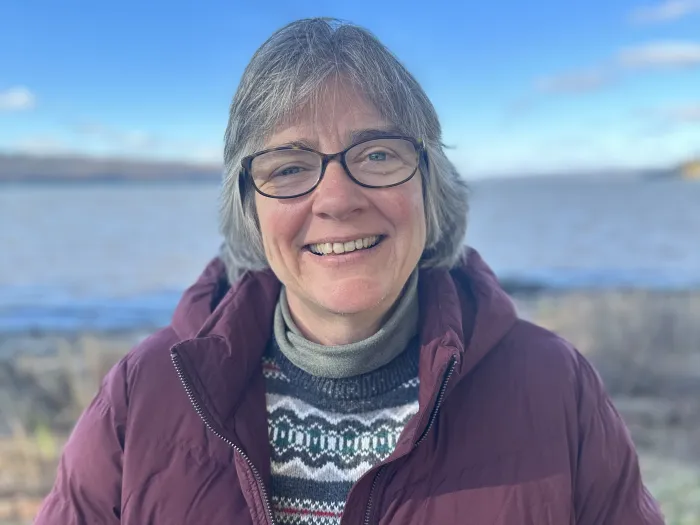
Bjorlin is also a pastor and the Associate Professor of Worship at North Park Theological Seminary in Chicago. He co-authored “Incorporating Children in Worship” and has two collections of hymns, “Protest of Praise” and “Hope Will Not Fail.” The most recent edition of “Sounding Board” can be seen here or heard here or here.
Bjorlin told the hosts he tries not to spend more than an hour each day grappling with writing a new hymn. The process “can be cathartic, to say, ‘How can I respond in ways that are consonant with my tradition’” and “give people who don’t feel they have words to sing words to sing,” he said. “I think there’s a real need in our churches to not only sing the things we feel we’re supposed to, but also express our true feelings.”
“Lately,” he added, “I have been thinking about writing hymns of justice where you’re not preaching to the choir.”
He pointed out that Romano Guardini’s “The Spirit of the Liturgy” talks about how liturgy should be less of a gymnasium and more of a forest.”
“I go to the gym to work a specific muscle,” Bjorlin said, and Guardini argues that approach has only one function. Guardini says that “liturgy is more of a forest. We are creating an ecosystem in which we live and move and have our being.”
“So lately, I’ve been thinking about how we sing songs of justice that create more of an ecosystem that are more than a ‘gym hymn,’ where this thing has happened, I am responding in this way, and everyone who sings this hymn should do this, as opposed to how is this connected to the narrative of God? How does it allow for multiple responses?”
“It’s less preachy and hopefully more humble on my part,” Bjorlin said. “I am having a ‘both/and’ moment in my own writing.”
It’s easy to focus on what’s wrong in the world, he said. But the poet Jack Gilbert teaches that “to make injustice the only measure of our attention is to praise the Devil.”
“When we focus only on the bad, it’s easy to lose the sense of what we’re fighting for and what makes life worth living,” Bjorlin said.
In a book he’s publishing next year, “Attuned to Christ,” Bjorlin argues that attunement is a better metaphor than resistance. “We still need to resist things,” he told the hosts, “but it’s because we’re attuned to something better.”
“Praise needs to be the driving factor in a Christian’s life,” Bjorlin said. “You’re Presbyterians. ‘The chief end of humanity is to glorify God and enjoy God forever.’”
Asked to offer advice to first-time hymnwriters, Bjorlin replied, “I hope people realize the writer is writing aspirationally.”
“’Take my silver and my gold, not a mite would I withhold.’ That’s not true. ‘I surrender all.’ That’s not true either, at least for me. We are trying to get closer,” he said, likening the creative process to turning a car’s radio knob incrementally to locate a distant signal.
“We need to be honest about where we are and sing hopefully about where we want to move toward,” he said. “The only people who can write hymns are imperfect people, because here we all are.”
What separates “OK hymnwriters from excellent ones is the editorial process,” Bjorlin said. “You have to ‘kill your darlings’ when they don’t work.”
“The process can be intense, incredibly annoying and frustrating,” Bjorlin said. “You have to learn to embrace the inefficiency of writing.” That means, as Pierre Teilhard de Chardin taught, “trust in the slow work of God.”
“One of the things artists help us do is trust the slow work of the church, the slow work of God, rather than to think that quickness equates with excellence,” Bjorlin said. “Inefficiency is a gift we bring rather than a vice to be avoided or something that just gets in the way of progress.”
Asked how he embodies hope in his hymn-writing, Bjorlin reminded the hosts that hope is “one of the three theological virtues,” along with faith and love.
“Like any virtue, it’s a practice, and so we’re called to practice hope,” he said. “To me, hope is not a feeling, but an ongoing action that suggests we don’t know what the future will bring.”
“Swords beaten into plowshares. God wiping away every tear. No more death. It seems impossible,” he said. “Hope gives us a vision we can live in the light of.”
Roberts noted that Bjorlin’s work in “Incorporating Children in Worship” includes this statement: “Worship is the place for faith in the making.”
Bjorlin said it was Martin Luther’s insight that infant baptism “is being given clothes that are too big for us, and that we slowly grow into. I think of that with worship.”
“When I sang ‘Come, Thou Fount of Every Blessing’ as a 5-year-old, it’s not like I knew what an Ebeneezer is. That language didn’t mean anything to me at the time.”
“But as you get older, ‘Prone to wander, Lord I feel it’ takes on new meaning,” he said. “If we believe that worship is the work of all the people gathered, children too, as image-bearers of God and part of the priesthood of all believers, who have just as much right and responsibility to worship the Triune God.”
Children “teach us specific things about faith and hope and love in ways I think we as adults have grown out of,” he said. “To become like little children, we need children in our midst.”
David Bjorlin’s holiday playlist is loved by many. Learn more here.
You may freely reuse and distribute this article in its entirety for non-commercial purposes in any medium. Please include author attribution, photography credits, and a link to the original article. This work is licensed under a Creative Commons Attribution-NonCommercial-NoDeratives 4.0 International License.