Can AI bear the Imago Dei?
Summit explores moral responses to artificial intelligence and secular movements to preserve human dignity
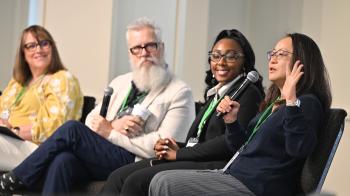
“Did the Pope make a mistake by writing about AI too soon?”
“No,” Catholic technology ethicist, Brian Green answered. “We’re talking about an exponential growth curve, and anything done before the exponential curve seems like too much too soon. Anything done after the exponential curve is too little, too late.” Green is a member of the AI Research Group, a group of theologians, philosophers, and ethicists, organized at the invitation of the Dicastery for Culture and Education of the Holy See.
The question of how to respond and how soon framed one of the central debates at the third annual AI & Church Summit in Nashville, Tennessee. Hosted by Discipleship Ministries of The United Methodist Church in partnership with the Presbyterian Life & Witness’s Office of Innovation, TryTank Research Institute and the Evangelical Lutheran Church in America Innovation Lab, the ecumenical gathering spent the week discussing attitudes and applications of AI in ministry as well as examining whether religious institutions and advocacy can still shape AI's future or whether technological development is already moving too quickly.
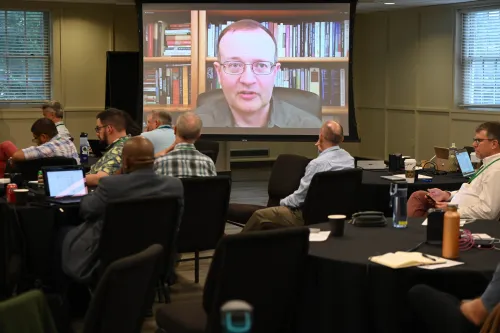
Green's August 26 presentation followed two markedly different plenary sessions and a ecumenical panel of denominational leaders. Green, co-author of Reclaiming Human Agency in the Age of AI, expanded ethical and environmental concerns raised by Monday night's plenary speakers, Mackenzie Roberts and the Rev. Chebon Kernell, who warned that AI infrastructure projects often reproduce patterns of extraction and colonialism. Tuesday's plenary featured Chloe Lubinski, who leads research partnerships with wisdom traditions for Anthropic, in a closed session. Participants later said the presentation largely reflected publicly available Anthropic materials explaining how modern AI systems work and why they increasingly appear human.
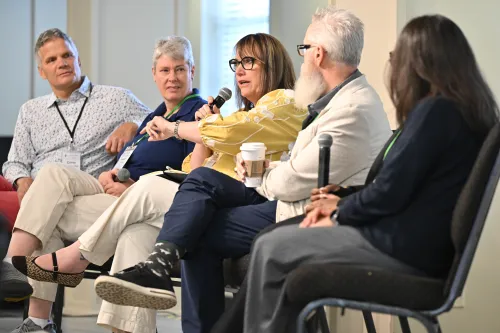
Attendees left pondering how today's AI models are less "coded" than cultivated, trained on vast quantities of human-generated language until patterns emerge. As these systems scale, they begin to mirror aspects of humanity itself, reproducing patterns associated with honesty and deception, cooperation and conflict, empathy and manipulation. That insight left many asking not whether machines can bear the image of God, but how human beings created in the image of God will be changed by the tools being creating in humanity’s image. If AI can imitate humanity without sharing humanity's created nature, participants wondered over meals and in hallway chats whether the greater theological challenge is not what AI is becoming, but what people are becoming as AI increasingly shapes relationships, decision-making and even visions of human-machine integration. On Wednesday morning, attendees heard similar themes related to what humans are becoming in an A.I.-shaped world from a panel of denominational leaders in the Evangelical Lutheran Church of America (ELCA), the United Church of Christ (UCC), the United Methodist Church (UMC), and the Episcopal Church and the Presbyterian Church (USA) on their technical and theological understandings of A.I. and what conversations and policies are taking place in their respective denominations.
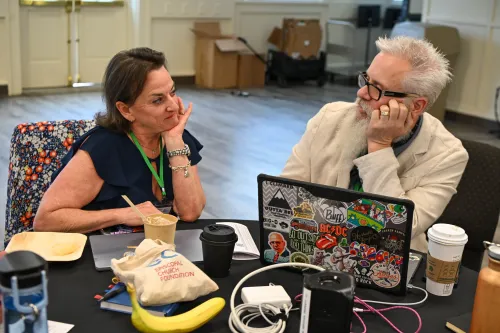
Drawing on “Magnifica Humanitas,” Pope Leo XIV's encyclical on safeguarding the human person in the time of artificial intelligence, Green highlighted three pillars of Catholic social doctrine: human dignity, solidarity for the common good and subsidiarity. Human dignity begins with the conviction that every person bears the Imago Dei and must never be reduced to a data point, consumer or unit of production. Solidarity and the common good recognize humanity's responsibility to pursue conditions in which all people, especially society's most vulnerable, can flourish. Subsidiarity insists that decisions should be made at the most local level possible, preserving human agency against increasingly centralized technological power. Green argued that these principles provide a theological framework for evaluating AI not by what it can do, but by whether it strengthens human flourishing.
Green repeatedly returned to Pope Leo's comparison between AI development and the Tower of Babel. Humanity, he said, faces a choice between constructing a new Babel built on power, efficiency and control or building a society where technology serves human dignity and communion. He also warned against transhumanist visions popular in parts of Silicon Valley. Describing proposals for direct human-machine integration, Green recalled touring facilities where brain-computer interfaces were being tested in sheep’s brains and joked about the sales pitch behind such technologies: "Who wouldn't want to have the internet living in their brain?"
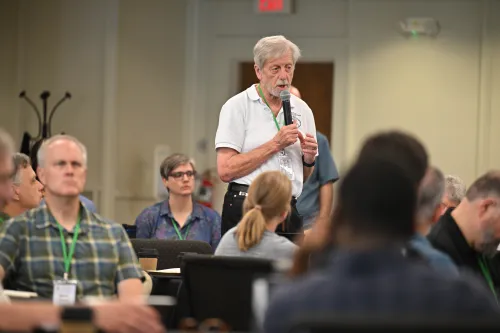
The theological discussion became especially pointed when attendees asked whether AI could bear the Imago Dei. Referencing research by Anthropic interpretability researcher Chris Olah, Green acknowledged that neural networks contain recognizable "emotion features" and patterns associated with human emotional expression. Because AI systems are trained on human-generated data, they inevitably reflect aspects of human language, emotion and behavior. Yet Green insisted that imitation should not be confused with personhood. Comparing AI to a mirror, he argued that a mirror may reflect the image of God without possessing it. AI systems may simulate empathy, grief, love or anger, but they do not experience conscience, suffering, relationships or moral responsibility from within. For Green, mirroring human emotion is not the same as bearing the Imago Dei.
The afternoon shifted from analysis to discernment. During AI Quick Talks and an "Output Session," participants discussed whether churches should align with groups such as the Future of Life Institute, the Center for Humane Technology and The Human Movement, which advocate slowing AI development and strengthening regulation. Debate centered on proposals for a Pro Human Sunday celebrated in May, resources for sermon series, educational initiatives and fasting from technology. Concerns about repeating theological and ethical harm with a term like “Pro Human,” were met with alternative names like “Human Dignity Day,” “Slow Down Sunday” or “Connection Sunday.” Concerned with the cost of pausing to parse particular words at a time when large language models seek to control the narrative, one participant urged the gathering to "be missional not attractional” towards the secular groundswell in favor of the flourishing of earth and humans. He compared the advocacy moment to periods when churches joined civil rights movements already underway rather than creating parallel efforts of their own. The participant argued that the church should join existing efforts while there is still time.
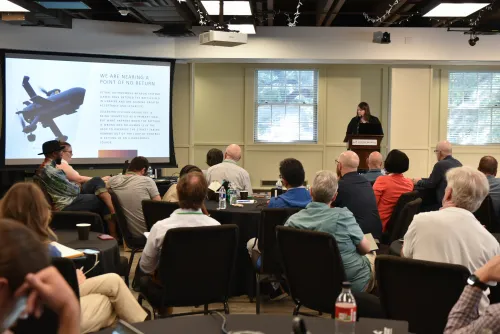
Concerns about human dignity and preservation of life extended beyond AI chatbots. Kristen Opalinski, manager for ecumenical and interreligious relations with the ELCA, warned about autonomous weapons systems already appearing on battlefields. "We are nearing a point of no return," she said. "This is our nuclear moment. We are standing at a crossroads, and there is an urgency in this moment."Participants also cautioned against focusing solely on future AI risks.
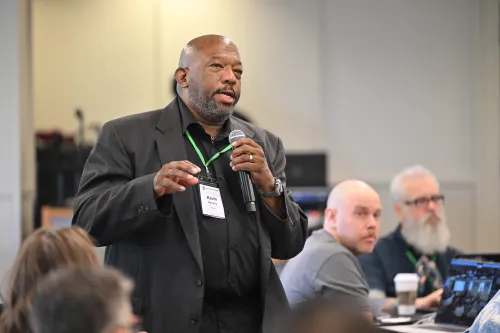
PC(USA) ruling elder, Kevin Hyrams advocated that churches address the technological-aided injustices of the present not just future concerns and pointed to AI's current use in immigration enforcement and surveillance, arguing that churches should respond to harms already affecting vulnerable communities while continuing to engage broader questions about AI safety, regulation and human dignity.
The day concluded with a question from the Rev. Dr. Lorenzo Lebrija, who asked whether church leaders like the Pope were actively encouraging AI companies to slow development. Green pointed to growing support for the Pacing the Frontier movement among researchers and technology leaders. While he did not cite any formal Vatican intervention, he suggested that bishops and other religious leaders sign on and add their voices to calls for greater caution.
By the end of the summit, participants had reached no single conclusion about whether churches should advocate for regulation, launch a Pro Human Sunday, join existing advocacy movements or pursue other forms of witness. Yet as debates about consciousness, emotion and the Imago Dei unfolded, the gathering's focus increasingly turned toward the church's own agency. If artificial intelligence is reshaping society, labor, natural resource use, warfare, communication and human relationships, what witness should Christians offer? For the pastors, theologians and church leaders gathered at the AI & Church Summit, the challenge was no longer whether the church should respond to artificial intelligence, but how and how soon can it do so.
You may freely reuse and distribute this article in its entirety for non-commercial purposes in any medium. Please include author attribution, photography credits, and a link to the original article. This work is licensed under a Creative Commons Attribution-NonCommercial-NoDeratives 4.0 International License.