‘Though it’s uphill, they never give up’
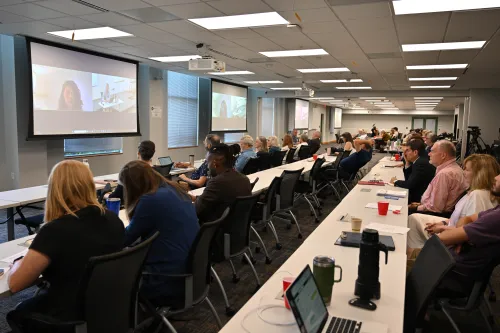
Palestinian Christians the Rev. Dr. Mitri Raheb and Muna Nassar appear via Zoom during the PC(USA)’s Christianity without Christian Zionism conference

LOUISVILLE — Once they’d heard from keynoter the Rev. Dr. Robert O. Smith, those attending the Christianity without Christian Zionism conference heard directly from two Christian leaders who have suffered the direct impacts of Christian Zionism: the Rev. Dr. Mitri Raheb and Muna Nassar.
Raheb is a theologian and author who founded and leads Dar al-Kalima University in Bethlehem. Nassar is Executive Secretary for Mission and Advocacy for the World Communion of Reformed Churches. Both joined Friday afternoon via Zoom. Luciano Kovacs, a PC(USA) global ecumenical liaison focused on partnerships in the Middle East, moderated the online panel from the Presbyterian Center in Louisville.
“Settler colonialism directly affects my people. It’s a constant everyday journey tracing how Christian Zionism has affected Palestinian Christians,” Nassar said. “Colonial theology teaches you to experience yourself in pieces — Palestinian in one drawer, Christian in another.”
“Zionism has cost Palestinian Christians enormously,” she said. “Christian Zionism doesn’t just have an opinion on the land. It impacts who counts. … Every young Palestinian who leaves because [they perceive] there is no life to live here, that’s fragmentation. The church has to answer this.”
It’s difficult, she said, “to be one integrated person being forced to survive as two fragments. Theology has room for only one at a time.”
“I keep arriving at the same question: What is it to be a Christian Palestinian?” she said. “The real question isn’t who owns the land. It’s what does it mean to belong to the land, to practice faith from a place of powerlessness and still call the faith whole? It’s about recovering what was always ours: faith, land and identity.”
“What does it mean,” she asked, “to stop asking a fragmented people about their own fragmentation?”
Kovacs thanked her for her “prophetic witness and challenging words” before turning to Raheb, who’d just attended a graduation ceremony at Dar al-Kalima University as well as a board meeting there.
Raheb said many people think of the variety of Christian Zionism typically exhibited by what he called “crazy evangelical and end-time obsessed people. I know there are many in the [United] States who are like that, but this is just one version of Christian Zionism, and I would say it’s the least dangerous.”
He said that liberal Christian Zionism is practiced by people “liberal on everything except Israel and Palestine.” Their writing “sounds sophisticated, except when it comes to Palestine, where they become evangelicals.”
Cultural Zionism is the most dangerous variety of Christian Zionism, according to Raheb. “These are not bad people, but they are exposed to [Christian Zionism] 24/7” through their consumption of news and social media, he said. “This cultural Zionism keeps defending the State of Israel. If you are exposed to just that, you are by default a cultural Zionist.”
Unlearning that “is the most difficult thing,” Raheb said. “It’s very easy to learn and difficult to unlearn.”
“Even as a Palestinian Christian, a theologian and someone with a critical mind, I was also exposed to this kind of cultural Zionism when I spent seven years in Germany,” Raheb said. “It took me more years than that to unlearn it. It is very hard work.”
Other forces include Islamic Zionism, which he said is promoted by countries such as United Arab Emirates, and Hindu Zionism, where India’s prime minister, Narendra Modi, “blends Hindu nationalism with Zionism.”
“These are not purely theological ideas,” Raheb said. “Zionism is connected to empire and to political power. That’s the second struggle we have, that we are up against empire.”
Raheb said he’s begun to look at Christian Zionism as a Christian lobby. “It has a huge lobby through Christian nationalism,” he said. “In the United States, the metanarrative is Christian nationalism.”
Raheb likes to point out that Jesus was born in Bethlehem, Palestine and not Bethlehem, Pennsylvania. “Western Christianity has hijacked the Christianity that came out of Palestine,” he said. In this view, “Jesus becomes the savior of the soul, not the liberator of people who are oppressed. Not only has Palestine been re-imagined in a Western way in the West, but the people were erased — first culturally and then physically.”
“Our role is not only to fight Christian Zionism. We have to understand all the layers — the ‘what’ of Christian Zionism — and, most importantly, reclaim Palestinian Christianity. I am happy to see young theologians emerging in Palestine who are doing exactly that,” Raheb said, “reclaiming the original Christianity that came out of Palestine, the original Bible meant as a liberator.”
“Geopolitics has always been an important part of Christianity,” he said, right alongside with “the message that Jesus came with.”
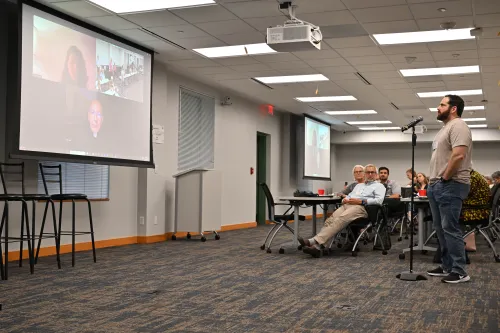
During a question-and-answer session following their talks, Nassar noted that “Western knowledge has been set up as the go-to. We need to distance ourselves from this. We need a second language.”
“There are theologians you have to learn, and then you go to the alternative ones,” she said. “As a Palestinian, I can’t say what works for the American audience.”
“Critical thinking these days is a rare commodity,” Nassar said, especially with “AI entering any space in the room.”
“Supporting Palestinian voices on the ground is something people can do,” Nassar said. “Coming [to Palestine] and seeing is more and more difficult, but it’s an important step.”
“We keep saying it can’t get any worse, and it does,” she said. “Voices are really needed.”
Such solidarity pilgrimages “change people a lot,” Raheb said. “You can also help us by figuring out how to be more effective within the U.S. today. Protestant churches have retreated from the political sphere. We cannot leave this sphere to the politicians.”
Raheb took heart from Friday’s graduation ceremony at Dar al-Kalima University.
“Seeing 140 young people graduating despite the difficulties and checkpoints and gates … this is resilience,” he said. “When I am emotionally low, I look at our students, who give me lots of hope.”
“With all the empires trying to destroy us, I see God raising new voices who take the torch and continue the struggle,” he said. “Though it’s uphill, they never give up.”
You may freely reuse and distribute this article in its entirety for non-commercial purposes in any medium. Please include author attribution, photography credits, and a link to the original article. This work is licensed under a Creative Commons Attribution-NonCommercial-NoDeratives 4.0 International License.


