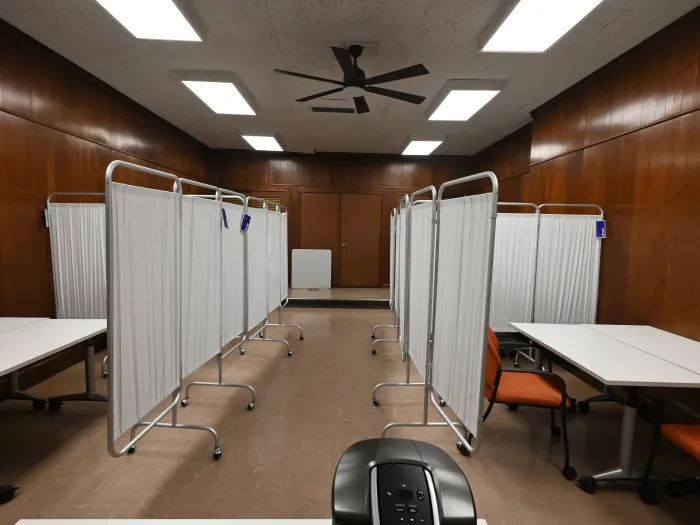
The PC(USA)’s Christianity without Christian Zionism conference opens with a powerful keynote address
The Rev. Dr. Robert O. Smith of the Lutheran School of Theology at Chicago shares wisdom sharpened by personal experience
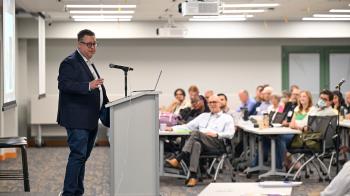
LOUISVILLE — The Rev. Dr. Robert O. Smith, the keynote speaker who opened the Christianity without Christian Zionism conference held Friday and Saturday online and at the Presbyterian Center in Louisville, Kentucky, told how he was awakened to the harms that Christian Zionism brings about during his first trip to Palestine/Israel. He defined Christian Zionism as “political action, informed by specifically Christian commitments, to promote or preserve Jewish control over the geographic area now comprising Israel and Palestine.”
As Smith and the others were set to head to the northern West Bank to participate in the olive harvest, they were trained in nonviolent direct action, “including what to do when an Israeli settler pointing an M-16 at your head is yelling at you in Russian,” said Smith, the vice president and dean of academic affairs and associate professor of authentic diversity, justice and public church at the Lutheran School of Theology at Chicago. “Things suddenly got really real. And yes, for the first week of our trip, right in the middle of Second Intifada, that scenario unfolded multiple times.”
Christianity without Christian Zionism came about after commissioners to the PC(USA)’s 226th General Assembly (2024) approved INT-05, “On Confessing our Complicity in Christian Zionism.” The conference also included worship, panel discussions and workshops.
Smith offered these insights into Christian Zionism:
- It’s a much older movement than many people realize, dating back nearly four centuries.
- It’s a Christian set of ideas and commitments. “We must own this,” he said, “instead of blaming someone else.”
- These ideas “are woven into foundational U.S. identity,” he said. “Christian Zionism is a permanent feature of our landscape.”
- Jewish political Zionism, a movement that can be dated to 1892, “could not have succeeded without the preceding centuries of Christian Zionist ideological development.”
- Its Reformation foundations “help us understand that it has no problem constructing both Jews and Muslims for Christian purposes to wage an intra-Christian battle over who is right about Jesus,” he said, “burning down the world to prove that I’m right.”
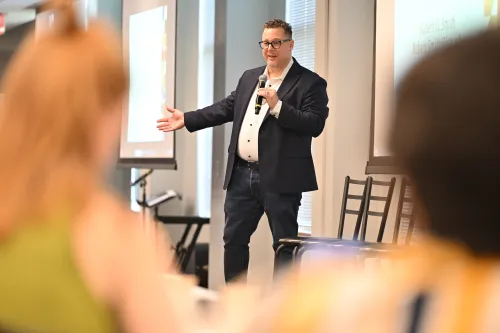
“Those are the academic insights,” Smith said. “But today, in light of the genocide perpetrated by the United States and the State of Israel in Gaza, we have to look more intently at the real-world implications of these ideas.” It’s even more important to answer this question, he said: How can we encourage a broad conversion of mainline churches toward confrontation with Christian Zionism?
Smith recalled early conferences hosted by the likes of the Palestinian theologian and university president the Rev. Dr. Mitri Raheb, who joined the Christianity without Christian Zionism conference via Zoom both Friday and Saturday.
“In those conferences, and in my more sustained engagement with the context, I began to understand intuitively that Palestinian experience since the rise of Jewish political Zionism during the 1948 Nakba and 1967 and beyond bore striking parallels to the experiences of the Native American nations of what is now the Southeast United States, including my own Chickasaw Nation.”
As Smith reflected on the parallels, three things became clear:
- Settler colonialism is a global reality, repeated again and again
- Christian Zionism is a narrative driver of that system in both North America and in Palestine/Israel
- Instead of something “over there, it is vital that we understand that we participate in the same web of historical processes, mutated at different times in different places,” Smith said.
The primary distinction between evangelical and liberal Christian Zionists “is that Palestinians are either gleefully or sadly marked for expulsion, eradication and death,” Smith said. Both forms “are equally responsible for the ongoing genocide in Gaza.”
Smith said he’s been asked why Christian Zionists “will gather on the National Mall for a pro-Israel rally while we liberals manage to gather only in small conferences. Why can’t we hold a rally that’s just as impressive to show support for Palestinian rights?”
The answer is simple, Smith said: “For Christian Zionists, support for the State of Israel is a tenet of faith. Liberal, mainline denominations, on the other hand, have committed to abstract notions of justice but haven’t yet adopted political liberation as a theological value.”
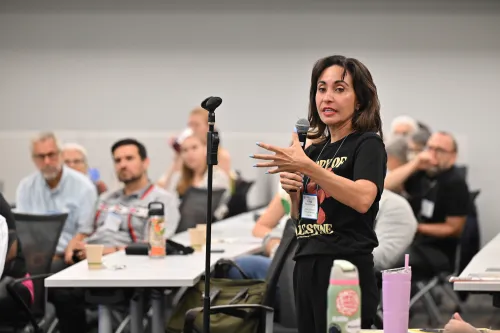
He said he “can’t begin to count the conversations I’ve had with Palestinians seeking to understand why Christians in the U.S. act the way we do when it comes to Palestine and Israel, why we seem so callously dismissive of their suffering.”
Liberal mainline denominations “have become practiced at committing to abstract notions of justice without committing to radical action,” Smith said. “What would it look like if the great moderate middle of this country were moved to action?”
Speaking in 1964 at the University of California Berkeley, the activist Mario Savio was asked what it would take to move people to mass action. “There’s a time when the operation of the machine becomes so odious, makes you so sick at heart that you can’t take part!” Savio said. “And you’ve got to put your bodies upon the gears and upon the wheels, upon the levers, upon all the apparatus — and you’ve got to make it stop!”
“When will our churches’ lack of full confrontation with Christian Zionism and the settler-colonial genocides it condones become so odious they can no longer be tolerated?” Smith asked. “Part of my continual surprise in the mainline liberal world is the apparent notion that churches don’t matter much beyond major life events and weekly social gatherings. We don’t often act like we are blessed to hold the secret for the healing and salvation of the world.
“We certainly don’t often act like we presume to have the power to change policy. As we know in interracial relations, however, if you don’t know the power you carry, you can bet it’s being used for unsavory purposes.”
“Three years into this genocide and over a hundred years into the war on Palestine, we must begin looking at ourselves and asking hard questions,” Smith said. “The fierce urgency of the moment demands that we commit not only to reminding states of their responsibilities but consider what it will take to [in the words of Lutheran theologian Dietrich Bonhoeffer] ‘not just bind up the wounds of the victims beneath the wheel but to seize the wheel itself.’”
You may freely reuse and distribute this article in its entirety for non-commercial purposes in any medium. Please include author attribution, photography credits, and a link to the original article. This work is licensed under a Creative Commons Attribution-NonCommercial-NoDeratives 4.0 International License.