Finding God in the prepositions
Author Varina Buntin Willse appears on ‘A Matter of Faith: A Presby Podcast’
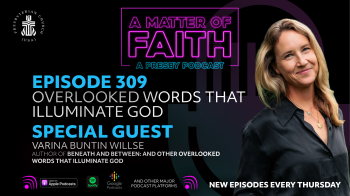
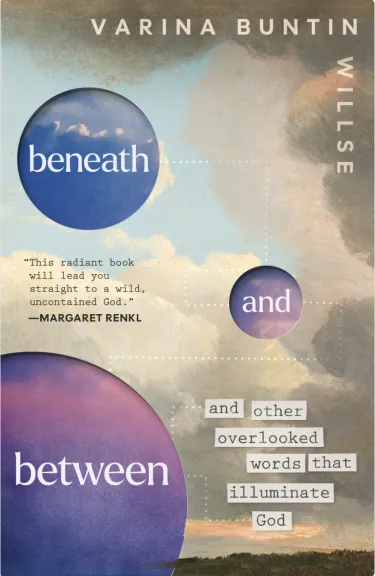
LOUISVILLE — Varina Buntin Willse, who wrote “Beneath and Between and Other Overlooked Words that Illuminate God,” said during a recent edition of “A Matter of Faith: A Presby Podcast” that her book came about as a result of “a deep spiritual dive” after she realized “I had let God get too small” because the language she’d been given for God “was putting God in a box.”
“If I could find some new language to articulate this God that I was really encountering, that would be transformative and really help me experience a God who was very much there,” Buntin Willse told “A Matter of Faith” hosts the Rev. Lee Catoe and Simon Doong. “I just hadn’t had the language to help me imagine it and talk about it.”
Listen to their 51-minute conversation here.
In her book, Buntin Willse spends a chapter each on 15 prepositions that speak to our relationship with God: above, beneath, near, with, alongside, before, for, through, into, within, throughout, among, between, around and beyond. A resource guide is here.
The book “weaves personal stories and texts I’ve been reading,” she said. “It’s 15 prepositions that help us to reimagine where God is, which also links to what God is and who God is and, really, I think, how God is. Someone said it’s like having a long conversation with a close friend.”
The book begins with “above” “because it’s the default locality,” she said. “When we default to a God above, it’s this sovereign Lord who’s presiding over and judging,” but “there is so much pain that comes out of that association.” The phrase that comes to her mind is “most high, which I think is absolutely beautiful. That ‘most high’ quality has to me a sense of wisdom and very much a long view.”
“When you’re above, you can see very far,” she said. “I think of the God above as being able to behold all time and space from that position above.”
“Beneath” is “so fruitful,” she said. “There are so many metaphors in the Bible that give us this God beneath,” including rock, wellspring and soil. Theologians including Paul Tillich call God “the ground of our being.”
“It’s taking a moment to feel the soles of our feet on the ground right this minute,” she said. “Your whole body settles. You feel like the ground you stand on is God beneath. It’s pretty simple and pretty powerful.”
Using prepositions “to articulate God is not new. Once I tuned into it, it was in all kinds of places,” she said. “When we say ‘God is love’ or ‘God is everywhere,’ it’s so abstract that it’s hard to absorb that and know what it means in my life. These prepositions give us a map of what it means that God is everywhere — before you, near you, alongside you and within and throughout.”
“I think bringing it into focus can reorient our faith and also be a path to a lot of unity and connectivity and move us away from ‘us/other’ and ‘this/that,’” she said. “It is paradoxical to say God is above and beneath, or among and within. Yes, yes and yes — because that is God’s multi-relationality.”
In response to Catoe’s question, Buntin Willse said she’s “wary of certainty, especially when it’s established as the goal of faith or religion. If we’re a disciple of anything, it’s mystery.”
That’s why she ends her book with a chapter on God beyond.
“We’re doomed to fail when we start to articulate God, because it’s not articulable,” she said. “Certainty does preclude curiosity and openness and growth. We want to continue to evolve in our faith and in our lives. If I’m certain, what do I have left to be wowed by? It’s experiential, even when it’s theological.”
An incarnational theology is of course woven throughout the New Testament. “That’s something we’re so used to that we forget how incredible it is that we think that God enters into flesh and matter and Creation,” she said. Father Richard Rohr teaches that “God loves things by becoming them,” she noted. “The Christian faith really reinforces this vocabulary when we shift our focus a little bit.”
While she used to think that joy is an elusive quality, “now I think of it as being a natural consequence of being open,” Buntin Willse said. “You’re presenting yourself with curiosity and vulnerability and therefore with a capacity to be delighted and stretched.”
Jesus used parables to teach his followers because “it was an invitation for people to listen and discern and think for themselves, to come to their own understanding,” she said. “The disciples never got it; they were always confused.” But “why would [Jesus] invite us to learn to think for ourselves if it weren’t an important aspect of this faith? It’s about growing spiritually and not being afraid to do that.”
As we co-author our lives with God and alongside God, “we have the authority to experience, to question, to follow, to seek,” she said. “All of these spiritual behaviors are our birthright, and it’s not always going to be comfortable.”
But we have the authority “to pursue God the way God is pursuing us,” she said, adding that another word for “that authority is freedom. The way I understand how God uses power is to offer it to us through freedom rather than through that ‘above’ stereotype.”
Buntin Willse closed her time with Doong and Catoe with a prayer she wrote for the chapter on God beyond: “Bless us, Almighty Mystery, as we yearn for you. Abide with us, Almighty Mystery, as we call off the search. Beyond all that we know, is you. Beyond all that is, is you. May we lie down soul-bare in the blithe air and unbind into the mystery of faith into that which is here and beyond. Amen.”
New editions of “A Matter of Faith: A Presby Podcast” drop every Thursday. Listen to previous installments here.
You may freely reuse and distribute this article in its entirety for non-commercial purposes in any medium. Please include author attribution, photography credits, and a link to the original article. This work is licensed under a Creative Commons Attribution-NonCommercial-NoDeratives 4.0 International License.