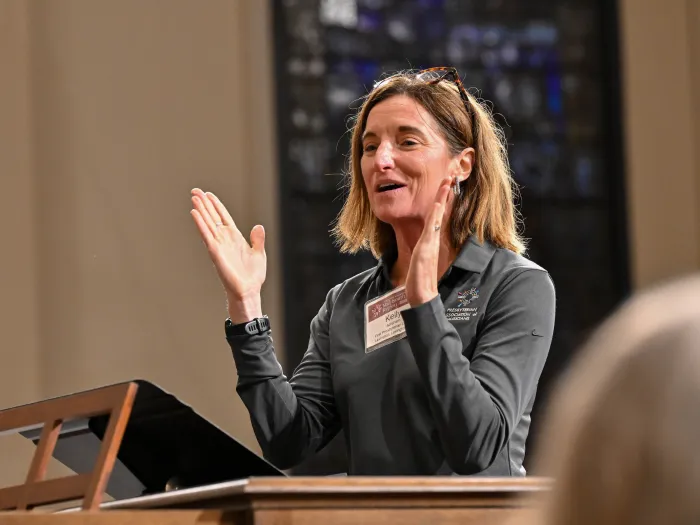
Composer, arranger, curriculum editor and children’s choir director Katie Houts appears on the ‘Sounding Board’ podcast
Presbyterian Association of Musicians’ podcast continues to feature accomplished and creative musicians and educators
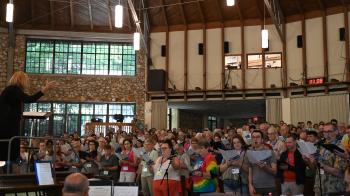
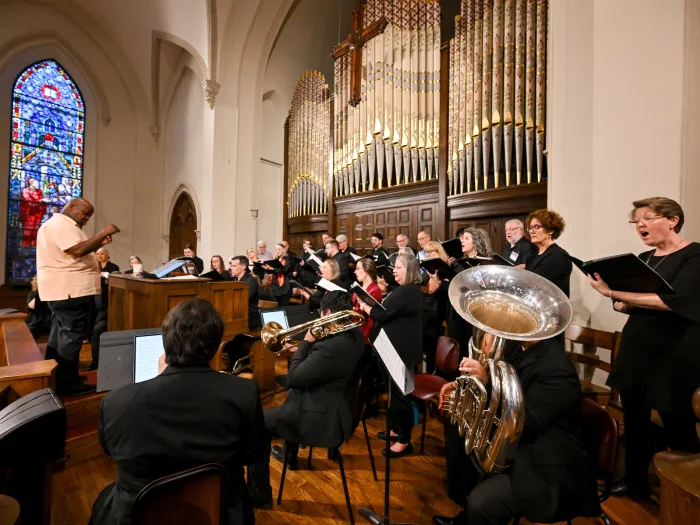
LOUISVILLE — Katie Houts, who directs a Salt Lake City children’s choir when she’s not busy composing and arranging music or serving as sacred choral and curriculum editor for Choristers Guild — not to mention her recent role leading the children’s choir at the Presbyterian Association of Musicians’ Worship & Music Conference held a few weeks ago at Montreat Conference Center — somehow found time for Sarah Abushakra and Jeremy Roberts and the podcast they co-host, “Sounding Board.” Their 65-minute conversation is available here.
Houts grew up in a small town in Northeastern Iowa. “I remember being so glad on Sunday because it meant we would be going to church,” she said. As a middle schooler, Houts, already a capable pianist, took up the organ and ended up playing at her church for every service, funeral and wedding.
“I remember distinctly going to college and thinking, ‘I’m never playing the organ again,’” she told the hosts with a laugh. “I loved it, but man, I was the only one, and so I was on for every event.”
Both at church and in school, “I felt so supported and encouraged by everybody I encountered, especially on my musical journey,” she said. Her high school teachers allowed her to take independent study. She spent part of that time “hanging out in the band room to try out all these instruments and learn them on my own. You could do that in a small school,” she said, “and I’m grateful now because I use that knowledge every day.”
She attended Wartburg College in Waverly, Iowa, where she learned she couldn’t get away without practicing on the piano, a habit she’d developed in high school. “I never thought I would be a children’s choir director. I thought I would be a high school band director,” Houts told the hosts. She switched her concentration from piano to organ and her major from music education to church music.
“At Wartburg, we talked a lot about vocation is where your gifts and passions meet the needs of the world. Children’s choirs or even directing choirs was never in my mind. I just wanted to be the person behind the scenes and playing the organ,” she said. After college she landed a job at a church. “It was the youths’ interest that led me to start this children’s choir program after school,” she said. The choir needed a benediction, so Houts wrote “May God Bless Us and Keep Us” borrowing from a charge the Wartburg chaplain used to recite at the end of worship, “to love and serve our enemies and our friends.”
“I enjoyed connecting with the children so much, building a little family and making sure they had another caring adult in their life to affirm them and to guide them through what they were going through,” she said. She kept up that work at her next church job, and then she and her husband were hired to serve a large Lutheran congregation in the Twin Cities. That’s where Houts connected with Choristers Guild, a nonprofit that enables leaders to nurture the musical and spiritual growth of children, youth and adults.
The organization’s workshops helped her learn to lead children’s choirs in a way that’s different from leading adult singers.
“I thought, oh my gosh, teach me all the things,” she said of all she was learning. “From then on, I counted on Choristers Guild to be my teacher.”
At workshops, she learned from other choir directors. “I think that’s the way we learn best — watching people do things, figuring out what works for us and taking it back to our context. I did a ton of that,” she said. “I felt like Choristers Guild was my college to teach me to be a capable children’s choir director.”
At Rise Up Children’s Choir in Salt Lake City, where Houts directs the Ignite Choir, she’s learned to use visuals during rehearsals. When singers “get comfortable with the music, they tend to lose some focus and get a little bit shouty,” she said, showing the hosts a laminated picture of a cute cartoon mouse. “I tell them, ‘can you please sing to this guy?’ Their tone immediately changed,” she told the hosts. “They lost all the weight from their tone because their focus was back and they had something to focus on.”
Houts said her goal for every rehearsal is that each choir member is seen and heard. She even wrote a “little theme” for the choir: “If you’re wearing blue, Stand up and sing/Rise up, Ignite!/Rise up, Ignite!”
“It’s a way for them to say, ‘I’m here and this is me,” she said. “My goal is to keep things moving” because “dead space is an invitation for chaos to ensue.”
She also teaches at a Waldorf School, where “we do a ton of listening and echoing, and then we work up to reading” the music.
“I’ll say to singers, ‘this is what I heard,’ and I’ll demonstrate” what the singers just did. “Maybe it was closed vowel or a word that didn’t have an ending consonant,” she said. “Then I’ll say, ‘how could we make that more musical? Can you show me?’ They will know exactly what to fix.”
When Houts hears a student’s suggestion she hadn’t anticipated, “as a teacher you say, ‘absolutely let’s try that,’ which empowers them to be their own musician and gives them confidence they have a voice,” she said. It also “shows the others they can be creative and that Miss Katie is not just giving us all the answers. We have our own answers to give.”
Roberts asked Houts about the similarities between faith formation and musical formation. “I didn’t magically wake up one day trusting in the goodness of God,” he said. Instead, it’s gathering around the font or table “and hearing you are a beloved child of God. It’s hearing those things within the ritual that ends up forming a faith within us.”
“One hundred percent,” Houts said. “We have learned that faith is caught, not taught. The more opportunities we offer to children of all ages to catch faith is a beautiful thing.”
As a caring presence in the life of a child, “we play such an important role in faith formation for these kids,” she said. “Are we picking music that asks them to imagine more, to look closer, to paint a picture of what God looks like for them and to see where God is at work in the world?”
“Children have deep thoughts and deep feelings,” Abushakra said, “and something profound to share if we give them the space to do that.”
“Sounding Board” drops twice each month. Listen to previous editions here.
You may freely reuse and distribute this article in its entirety for non-commercial purposes in any medium. Please include author attribution, photography credits, and a link to the original article. This work is licensed under a Creative Commons Attribution-NonCommercial-NoDeratives 4.0 International License.