(re)Considering the Body of Christ
At the 1001 New Worshiping Communities National Gathering, leaders explore how innovation grows through relationships, diversity and shared belonging

ESTES PARK, Colorado — Against a backdrop of golden aspens, mountain peaks and crisp autumn air, leaders of new worshiping communities from across the Presbyterian Church (U.S.A.) gathered Oct. 12-15 at the YMCA of the Rockies in Estes Park, Colorado, for the 1001 New Worshiping Communities National Gathering. Centered on the theme “(re)Consider Jesus,” based on the invitation in Hebrews 12:1-3 to consider Jesus, the event offered leaders space to step away from the daily demands of ministry, reconnect with one another, and reconsider their callings and how those callings shape the communities they serve.
As an innovator and incubator for new worshiping communities, Presbyterian Life & Witness’ 1001 New Worshiping Communities movement supports emerging expressions of church and the leaders who imagine them. Over the years, the movement’s national gathering has become a place to explore new ideas, heal from institutional hurt, learn strategic skills, nurture spiritual practices and envision fresh ways of worshiping, gathering and serving as communities of faith.
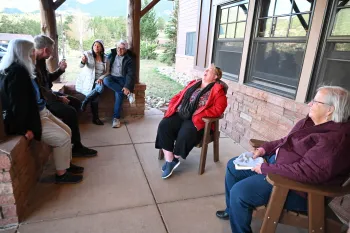
Shared meals, interactive worship experiences, accessible hikes in the Rocky Mountains and participatory workshops invited leaders to connect with their spiritual purpose, consider their local contexts, cultivate new possibilities, and collaborate with one another in a spirit of experimentation and encouragement. Some of the most important moments happened between scheduled sessions. Around dinner tables, along mountain trails, among communal art projects and in conversations on the porch, leaders discovered they were not alone. The gathering functioned as a living expression of the 1001 network itself, where relationships became catalysts for ministry, creativity and spiritual renewal.
“The portable in-between moments, the walks to places with friends and late-night conversations, the encouragement and the shared space that we ever just hold for one another,” was where Nathan Heimer, co-founder of A Stoked Life, a new worshiping community in Colorado, found hope and encouragement.
The annual gathering reveals why 1001 New Worshiping Communities is a network in the deepest sense of the word, rooted not only in innovation but also in relationships that sustain and strengthen leaders for the work ahead.
United but not uniform
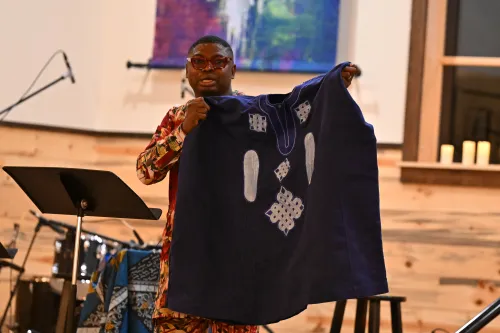
Opening worship on Monday evening framed the week around Paul's metaphor of the church as the Body of Christ in 1 Corinthians 12:12-31. Preaching on the passage, the Rev. Ebenezer Alonge challenged participants to see diversity not as a problem to solve but as a gift to receive. “Difference is not a disadvantage. Neither is it a disease,” he said. “It is our holy blessing that allows us to smell the aroma and flavor of others.” He reminded worshipers that “unity is not uniformity” and held up a traditional Nigerian Aṣọ òkè garment as an illustration. Like the fabric, woven by many skilled hands, the church is formed through the contributions of many people. “No one individual can take the glory for making this a reality,” Alonge said. “It takes a village to build a body.” He further noted that “honoring other people’s opinion and positions and place in the body is not necessarily endorsement. We can be united in purpose without being uniform.”
Those themes echoed throughout the week as leaders from different cultures, languages, generations and ministry contexts worshiped together.
A place at the table
Commissioned Ruling Elder Rachel Doll understands what it means to create spaces of belonging
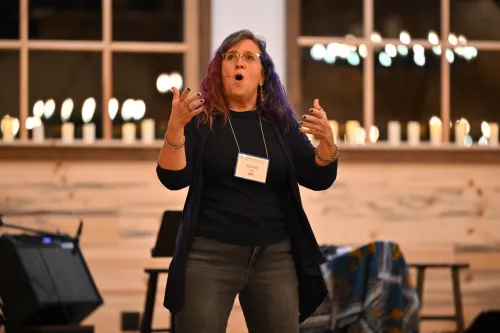
Doll founded The Table, a new worshiping community in Wilmington, North Carolina, that serves LGBTQIA+ people and others who have experienced harm within traditional church settings. Doll’s ministry reflects the conviction that every person has a place within the Body of Christ.
As part of the worship team, Doll did not merely read but memorized and embodied the week’s Scripture passages that grounded the gathering’s central theme. Using hands, wrists, knees and feet as well as her voice, Doll proclaimed in Monday’s worship that “the body does not consist of one member, but of many.” These words resonated throughout the week as leaders reflected on how communities thrive when diversity is welcomed rather than feared.
Weaving new possibilities
Working alongside each other to set up the worship space in Hyde Chapel, Ruth Lin Nakai and Alicia Anderson demonstrated the power of relationships within the 1001 network. Nakai founded The Weaving Table in Chicago as a spiritual community for people processing difficult experiences with Christianity and reclaiming their faith journeys.
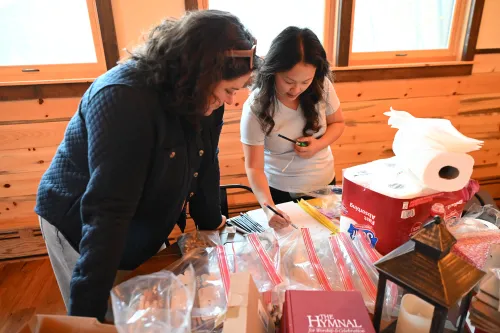
“We create space for people who have been gently or painfully shaped by Christianity and are processing, untangling, reclaiming and reimagining their spiritual lives after experiences such as deconstruction or serious trauma,” Nakai said.
Anderson first connected with Nakai at one of the Weaving Table’s art cohorts. She credits her relationship with Nakai with helping her discover 1001 New Worshiping Communities. Now in the first year of the two-year apprenticeship program of 1001 NWC, Anderson is developing a new ministry under the working title “The Aspen Grove,” inspired by the interconnected root systems of Colorado’s iconic trees.
"There’s a lot about aspen trees and the interconnectedness underneath the soil that kind of spoke to me while we were here,” Anderson said.
Like the communion table, the hand-woven garment and the interconnected parts of the body, the aspen grove image serves as a fitting metaphor for the network cultivated by the 1001 NWC movement. Though each community serves a unique context, leaders remain connected through relationships, shared learning and mutual support.
Building community through music and service
The gathering also highlighted the ways ministries supported by 1001 can bridge generations. The Rev. Sunny Kang and Taylor Kang traveled to Colorado from Los Angeles, where father and son lead distinct but complementary ministries.
Sunny serves United University Church, a congregation known for its significant community outreach efforts, social enterprise and affordable housing initiatives through redeveloping church property in downtown Los Angeles.
"We serve about 400 families a week," Sunny said, describing the church's food ministry on Thursday morning that expanded to meet the needs during the Covid pandemic.
Taylor leads Band Together, a new worshiping community that uses music as a pathway to belonging, creativity and spiritual connection for young adults.
“It’s using music as a creative expression to be able to give people an opportunity to express themselves who might not otherwise have the space to,” Taylor said. “And using that to build that relationship and foster a community from there.”
Many who participate have complicated histories with church, according to Taylor. “They’re the type of folks that otherwise might not feel included by churches or might have felt burned or traumatized by churches in the past,” he said.
The community's depth of connection is evident in the time members choose to spend together. “Sometimes going until 2 o'clock in the morning because people just don't want to leave,” Taylor said. Sunny described how many of the young adults who come to Band Together on Tuesdays also show up Thursday mornings to serve at the food pantry of United University Church because of their desire to give back. Recently, Sunny baptized young adults in the ocean near Redondo Beach, followed by a gathering at his home.
Gathering around stories
For Arelis Figueroa and Letiah Frasier of La Iglesia del Pueblo in New York City, ministry begins with listening to the voices of the marginalized.
Figueroa described how shared meals create opportunities for immigrants, volunteers and neighbors to learn from one another. Community members prepare traditional foods and tell the stories of immigration, survival and belonging.
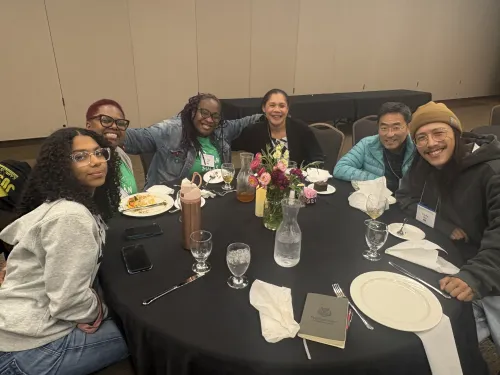
“"When we sit down at the table, they talk about the service,” Figueroa told Sunny and Taylor as well as others at her table. Participants share why they came and recount experiences that shaped their journeys. The conversations foster understanding and relationship-building among people who might otherwise remain strangers.
According to Figueroa, the Americans who are volunteers say, “you know, we don’t get to know them really well. So, it has been very nice when we sit down and they talk about why they came and we hear about the things that they went through in that desert.”
Frasier similarly creates spaces for spiritual reflection and community formation through literature. Describing one upcoming gathering, she explained: “I call it a novel Advent. So, we’re gonna read a novel during Advent.”
Over their dinner table on Monday evening, Frasier and Figueroa connected with the Kangs and others over how hospitality, storytelling and accompaniment can become powerful forms of Christian witness.
One body, many gifts
Throughout the week, participants worshiped in multiple languages, exchanged ideas across ministry contexts and formed relationships that may shape future collaborations.
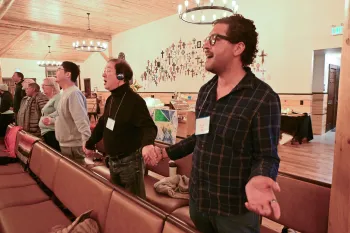
Alonge encouraged participants to recognize both the value and the limits of their own understanding.
"Your revelation may be genuine without it being exhaustive,” he said. “You may have a piece without having the whole loaf.”
That truth became visible throughout the gathering: in apprentices finding mentors, in leaders discovering unexpected common ground, and in friendships formed across cultures, generations and geography.
Eka Tawe, a participant in the 1001 NWC apprenticeship program, shared that the annual gathering opened up his understanding of ministry leadership. "It kind of shifted my view that there's no like right or wrong answer in ministry and ministry leadership, and it's kind of just opened my eyes to just new ideas and a whole now network of people,” said Tawe. “I've met so many amazing people here, so I really enjoyed that, and I'm excited to see what comes next.” In worship, participants joined their voices in song:
“Though we are many, we are one body. We are one body in Christ.”
For four days in the Rockies, those words became more than a hymn. They became a lived expression of the church God is continually creating through many gifts, many voices and one body.
You may freely reuse and distribute this article in its entirety for non-commercial purposes in any medium. Please include author attribution, photography credits, and a link to the original article. This work is licensed under a Creative Commons Attribution-NonCommercial-NoDeratives 4.0 International License.