Pastor and author makes the case for pacifism
The Rev. Ben Daniel, pastor of Montclair Presbyterian Church in Oakland, California, appears on ‘A Matter of Faith’
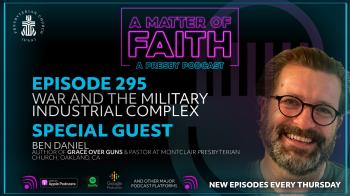
LOUISVILLE — The Rev. Ben Daniel, the pastor of Montclair Presbyterian Church in Oakland, California and the author of the recent book “Grace Over Guns,” made the case for pacifism last week during “A Matter of Faith: A Presby Podcast.” Listen to Daniel’s 62-minute conversation with hosts the Rev. Lee Catoe and Simon Doong, titled “War and the Military Industrial Complex,” by going here.
“We often hear about debates between military force occasionally being justified compared to true, full pacifism,” the hosts asked Daniel. “How are we to navigate this debate as Christians?”
It’s all about loving our neighbors as we love ourselves, Daniel said.
What’s a justifiable war? “Usually people say the defensive war — a country defending its territory against an invader is a justifiable war,” Daniel said. Another is “when one country intervenes to prevent some kind of atrocity that’s being committed by another country.”
Then Daniel asked: What if that justifiable war were being waged against the United States? How would we want those waging war against us to treat us? After all, in the past few months, the U.S. has invaded Venezuela, started a war alongside Israel in Iran, “and we’re talking about invading Cuba,” Daniel said. “If we were to invade Cuba, for example, would it be OK for Cuba to send ballistic missiles to bomb Miami in self-defense?”
What if Cuba’s allies — principally China and Russia — decided “that the United States was a danger to the world because we’re invading too many countries,” Daniel said, and responded with a nuclear assault on an American city. “Keep in mind that during World War II, which a lot of people considered to be a justifiable, necessary war, the Allies bombed Germany,” he said. “We bombed them mercilessly in large part to prevent Germany from advancing into Ukraine and Russia.”
“If the answer is we would not be OK with the United States being bombed and our fellow citizens being killed, then I think we have to say there are no justifiable wars — unless we’re willing to have justifiable war being waged against us,” Daniel said.
While some who believe there are just wars claim that if you want peace, you have to prepare for war, Daniel said he disagrees. “I think war creates more war,” he said, and an example is the war in Gaza, which started with Hezbollah attacking Israel, Israel striking back and killing tens of thousands of Palestinians in Gaza, “and pretty soon we’re attacking Iran because Iran supports Hezbollah. It snowballed,” Daniel said. “I think more often than not, that’s what happens during war.”
He cited the example of Ukraine as well. “Ukraine isn’t just defending its borders anymore. It’s also attacking civilian targets deep within Russia,” he said. “I don’t see war as something that can be contained. There are no guardrails. It’s one catastrophe leading to another catastrophe, and it’s the regular people who pay.”
“War simply doesn’t work, and I think we need to talk about how war doesn’t work,” he said. “That’s part of why I wrote the book.”
Like Leo Tolstoy, “I look to the Beatitudes” and what follows in Jesus’ Sermon on the Mount, Daniel said, “and what you see there is no room for aggression. ‘Blessed are the poor, the meek, the persecuted, the peacemakers, those who hunger and thirst for righteousness.’ These are not Beatitudes for warriors.”
“As someone who believes Jesus loves all the children of the world, I have to believe Iranian soldiers and Russian soldiers are children of God. I have to care about them as much as I do about American soldiers, who are also children of God,” Daniel said. “I can’t stand the idea that the United States spends $1 trillion or more each year [in military and arms-related spending] for the purposes of causing deep and abiding pain and harm and suffering. That’s not who I want to be, and it’s not where I want my tax dollars to go. It’s not how I want my patriotism to be defined. There’s nothing good about it that I can see.”
Catoe asked Daniel how churches can advocate better for peace.
“I think the first action we need to take is we have to have the conversation,” Daniel said. “I don’t think most Presbyterians go to church and have conversations about militarism.” Preachers ought to be preaching on the topic as well, he said.
“Once we’ve talked about it, I think congregations should consider declaring themselves to be peace churches,” he said. “Our denomination has a mechanism by which a Presbyterian can declare themselves to be a conscientious objector even though our church is not a historical peace church.”
In addition, “I think we should be speaking up and protesting because war is contrary to the gospel,” Daniel said. “The way we as Christians in the United States are asked to support war is idolatrous and runs counter to our faith.”
It’s also a fallacy to believe that war is generally good for the economy, Daniel said. For the U.S., the “real economic growth” occurred after World War II “when we rebuilt Europe and Japan.”
Daniel had a great uncle who made a lot of money manufacturing and selling military equipment during the war, including hydraulic pumps that opened bomb bay doors on aircraft.
“His money paid for my college. I am a beneficiary of war profiteering. It’s something I wrestle with,” Daniel said. “It’s a matter of profound grief.”
Daniel and his brother once visited Hiroshima, Nagasaki and Fukuoka, three Japanese cities that suffered catastrophic bombing. “To walk those city streets and see no building older than 75 years old in ancient cities, and realize my brother and I benefitted directly from the suffering of the people of Japan — it’s a painful thing to think about,” he said. “I want my children to have a legacy of peace.”
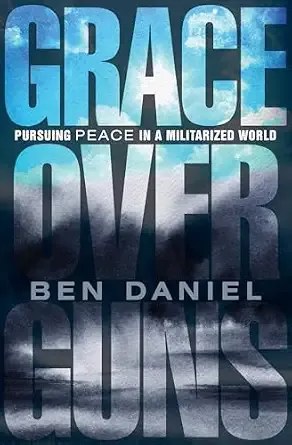
Doong asked Daniel to say a little more about his book, released last month.
“Even if people don’t come away as Christian pacifists, I think anybody who reads this book and thinks about war — whether they agree with me or not — if they go through the process of thinking about war and the morality of military violence, I think they will come away having a deeper and stronger faith, a faith that addresses the world in important and needed ways.”
New editions of “A Matter of Faith: A Presby Podcast” drop here every Thursday.
You may freely reuse and distribute this article in its entirety for non-commercial purposes in any medium. Please include author attribution, photography credits, and a link to the original article. This work is licensed under a Creative Commons Attribution-NonCommercial-NoDeratives 4.0 International License.