Meeting Jesus in the faces of new neighbors
Prayers are offered for immigrants who are oppressed as well as the people who stand in solidarity with them

LOUISVILLE — Midweek chapel service emphasized the importance of welcoming immigrants and recognizing their rights and dignity.

The service called “Splitting the Seas” was pegged to a recent Immigration Sunday and featured some fellows of the Presbyterian Office of Public Witness.
In a prayer of belonging, Wyatt Betler, a summer fellow for International Policy, asked God to “guide and comfort those who come to our lands due to circumstances beyond their control, forcing them to leave their countries in search of safety and freedom.” He went on to pray that a sustaining spirit “lift up all those who offer friendship and accompaniment and speak out in solidarity for the rights and dignity of all you call blessed.”
Betler, a junior at Davis & Elkins College in Elkins, West Virginia, went on to ask for forgiveness “for the xenophobia and racism that persists in our society, spurring acts of hatred and policies that demean us,” adding, “May your loving Spirit open our hearts and cast out fear and derision, so that we may meet Jesus in the faces of our newest neighbors.”
Betler also lifted up Leviticus 19:33-34, reading, “When a foreigner resides among you in your land, do not mistreat them. The foreigner residing among you must be treated as your native-born. Love them as yourself, for you were foreigners in Egypt. I am the Lord your God.”
Immigrants have been the target of oppressive policies and actions by the U.S. government and have suffered recent blows in U.S. courts, including last month’s U.S. Supreme Court decision to allow the Trump administration to drop legal protections for hundreds of thousands of Haitians and Syrians.
However, Wednesday’s service emphasized that “God’s love knows no borders” and can “bind us together as one people.”
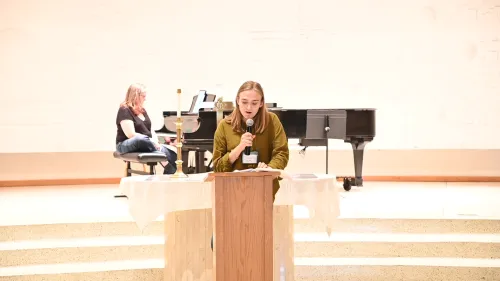
Isabella Shutt, a senior at Princeton Theological Seminary, spoke on Mark 4:37-41, the story of how Jesus miraculously quieted the wind and the waves after being awakened by disciples concerned about a storm threatening their boat.
Focusing on the setting of the story, Shutt noted that Jesus had been traveling back and forth, connecting people of different cultures and beliefs, but “it's in the middle, where no one can claim the land, where he demonstrates the power of God,” stilling the wind and waves.
She went on to say, “This week we have been thinking about places where we have attempted to split the seas as humans.”
She displayed a picture of a border wall between the United States and Mexico that extends out into the ocean at Border Field State Park.
“We have attempted to make the waves obey us in order to keep out people who are different from us, in order to search for a false sense of security,” she said. However, it’s clear that “people are regularly crossing” and “that our cultures and our food are constantly crossing" as are the water and wildlife.
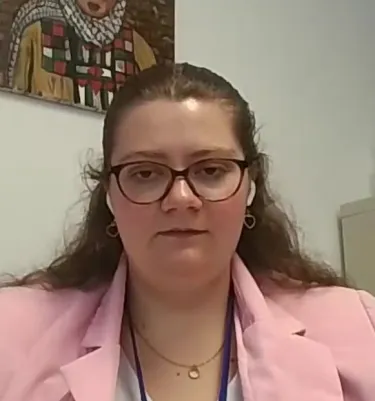
Brianna Pennington, a summer fellow for Immigration Advocacy, shared a poem by Chicana scholar and poet Gloria Anzaldúa, with vivid imagery of the pain that springs from border politics. The author speaks of a “1,950 mile-long open wound dividing a pueblo, a culture, running down the length of my body, staking fence rods in my flesh.”
After the reading, Pennington, a senior at Davidson College, prayed for those in decision-making positions to listen to God.
“God of justice and mercy, we pray for all our leaders in our congregations, in our church, and in our local, state and national political offices,” she said. “May they hear your call to do justice and to love kindness. May they learn to see you in all those whom they serve.”
Pennington also prayed for Creation and those who are suffering: “God of compassion, hear the cries of the oppressed throughout the world, from those languishing in jail without a trial in our own cities to those fleeing destruction abroad. We pray especially for immigrants and refugees within our borders who have escaped violence and lack of opportunity, only to face discrimination and fear here," where they sought safety. "May we remember that these are also children of God, our siblings.”
Find resources here as well as information about how the Presbyterian Church (U.S.A.) actively advocates for and works toward more just immigration laws and processes.
You may freely reuse and distribute this article in its entirety for non-commercial purposes in any medium. Please include author attribution, photography credits, and a link to the original article. This work is licensed under a Creative Commons Attribution-NonCommercial-NoDeratives 4.0 International License.