Presbyterians lament Thursday’s US Supreme Court ruling ending protections for Haitians and Syrians
About 300,000 people from Haiti living and working in the US are in danger of being deported to one of the world’s most dangerous places
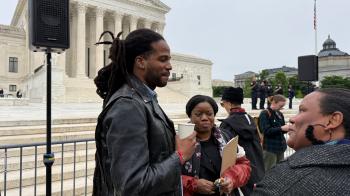
The U.S. Supreme Court on Thursday allowed the Trump administration to drop legal protections for 300,000 people from Haiti and another 6,000 from Syria. Temporary Protected Status is a legal framework that shields immigrants from being deported and permits them to work in the United States.
Thursday’s 6-3 decision along ideological lines foreshadow the ending of TPS for immigrants from 15 other countries.
The decision is devastating, said Catherine Gordon, representative for international issues for the Office of Public Witness in Presbyterian Life & Witness.
“TPS exists for moments exactly like this: when people cannot safely return home because of war, political instability, disaster, or humanitarian crisis,” Gordon said.
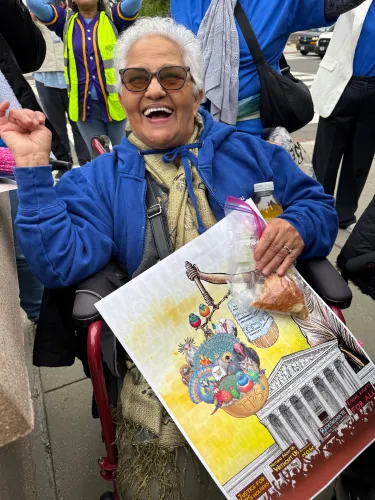
Attorneys for the Haitian and Syrian plaintiffs argued that then-Homeland Security Secretary Kristi Noem improperly terminated TPS for both countries. Both countries remain too dangerous for those who would be deported, attorneys said. Gang violence and political instability have crippled parts of Haiti, including Port-au-Prince, the capital city.
A year after the Assad regime fell in Syria, more than 90% of the people live in dire poverty, infrastructure is fragile and many people are internally displaced.
According to FWD.us, a bipartisan immigrant reform group, many Haitian immigrants on TPS work in agriculture, nursing care and as caregivers. The groups said in a statement that TPS holders generate an estimated $5.9 billion annually for the U.S. economy and pay $1.5 billion in federal and state taxes.
Few small communities will feel the loss of immigrants more than Springfield, Ohio, said the Rev. Jody Noble, pastor of Covenant Presbyterian Church there. When the community fell on hard times, Springfield officials said, it was TPS-holders from Haiti who came to fill jobs, create businesses and serve in the community.
“It is estimated that 1 in 4 of our community members are Haitian and here on TPS,” Noble said. “Our Haitian
brothers and sisters are our church family, friends, co-workers, classmates and neighbors. We pray for their safety and hold fast to God’s promises that ‘he is close to the brokenhearted; and rescues those whose spirits are crushed’,” she said, quoting Psalm 34:18.
Both countries remain too dangerous for those who would be deported, attorneys said. Gang violence and political instability have crippled parts of Haiti including the capital city.
“Haiti and Syria remain places where return would put many lives at grave risk,” Gordon said. “Stripping protection from our Haitian and Syrian neighbors does not make our country safer or stronger; it tears at families, communities, congregations, and workplaces across the United States.”
“These are not statistics: they are the nursing aides, the farmworkers, the children already gone from school rolls here on Maryland's Eastern Shore,” said Dr. Bernadette Fouché, a public health doctor who serves immigrants in Maryland.
“To send these families back is not policy; it is abandonment. The State Department forbids Americans from setting foot in Haiti. Gang violence has displaced more than a million people, kidnapping is routine, and four Haitian women deported in February were later found beheaded,” she said. “This is the danger we are being returned to.”
Gordon said that U.S. laws “should reflect our deepest moral commitments: to welcome the stranger, protect the vulnerable, and refuse to send people back into danger.”
After the Supreme Court decision, TPS-holders from South Sudan, Sudan, Somalia, Cameroon, and Ethiopia are in danger of losing their rights. The Rev. Princeton Abaraoha, a Global Ecumenical Liaison with Presbyterian Life & Witness who accompanies African churches in the U.S., said Thursday’s Supreme Court ruling is much larger than a legal decision.
“The question before us is not only, ‘What does the law allow?’,” he said. “The deeper question is, ‘What kind of community do we want to be?’”
“A nation’s greatness is not measured only by its strength, its economy, or its borders,” Abaraoha said. “It is also measured by how it treats those who are vulnerable, those seeking refuge, and those whose lives are caught between uncertainty and hope.”
Fouché said the news comes the morning after a great success for her home country on the soccer field. She said two goals on a FIFA World Cup stage remind us of the spirit of the people of Haiti.
“This Haitian team reached a World Cup field for the first time in 52 years and twice led Morocco, once with a goal so beautiful the stadium fell silent before it roared,” she said.
“You can revoke a document. You cannot revoke a people who, against every odd, still arrive and still sing.”
You may freely reuse and distribute this article in its entirety for non-commercial purposes in any medium. Please include author attribution, photography credits, and a link to the original article. This work is licensed under a Creative Commons Attribution-NonCommercial-NoDeratives 4.0 International License.