The PC(USA) is still home to more than 1 million members
Annual Church Statistics Report shows that membership declined in 2025, although at the slowest rate in a decade

MILWAUKEE — The Presbyterian Church (U.S.A.) remains a denomination of more than 1 million members.
Total reported membership for 2025 was 1,019,003, according to a report prepared for commissioners and advisory delegates to the 227th General Assembly by the Rev. Manuel D. Silva-Esterrich, manager for Call Process Support and Statistics, and Dr. Sean Payne, manager of Research Services.
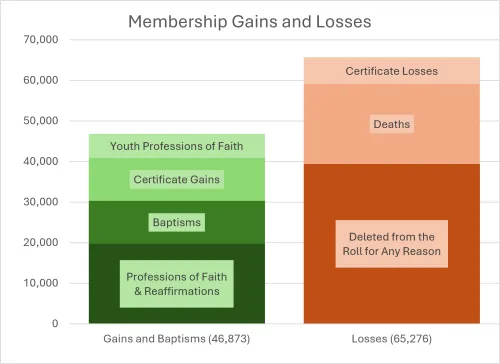
The report shows a loss of 26,845 members from 2024, a net loss of about 2.6%, a significantly lower rate of loss than in recent years, when the average annual loss of the previous 10 years was 4.6%.
In 2025, there were 8,304 PC(USA) congregations, 128 fewer than in 2024, a decrease of 1.5%. The rate of decrease is close to other rates of decrease in recent years. The net decrease came almost entirely from dissolutions, which rose to 127. There were 11 newly organized congregations and 12 dismissed to other denominations.
Certificate transfers were positive for the third year in a row, with almost 4,000 more certificate gains than losses. Youth making professions of faith held steady, while adult professions of faith and reaffirmations hit a three-year high.
Losses due to death stayed steady relative to the total membership, and there were fewer roll removals compared to 2024. Baptisms were slightly down overall.
Minister numbers drop slightly
In 2025, there were 17,250 PC(USA) ministers, a decrease of 222, or 1.3%, from 2024. The biggest factor in the loss was death, as the 350 recorded deaths were nearly three times the 128 pastors ordained in 2025. There was also a net gain of ministers by transfer, receiving 67 from other denominations and dismissing 33. Forty-four pastors were removed from office.
Candidates preparing for ministry held steady at 658, and there were 1,092 commissioned ruling elders in 2025.
Churches by size
Most churches are small, but most members attend larger churches, the report indicates.
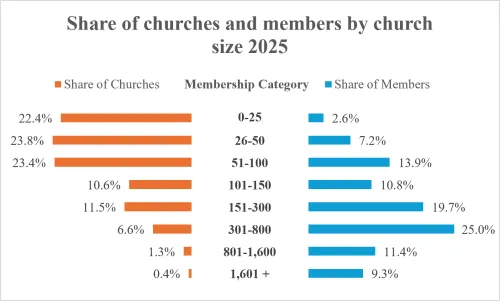
The combined membership of the 37 largest churches, 94,274, is almost equal to the total membership of all 3,832 congregations with 50 or fewer members combined, 98,990.
The median congregation has 53 members, meaning half of all congregations are that size or smaller. About two-thirds of all members, however, belong to congregations of 151 members or more.
If churches are lumped into categories of 100 and under, 101-300 and above 300, we see that:
- The smaller churches represent about 70% of congregations and have about 24% of the total denominational membership.
- The largest churches are 8% of congregations but have 46% of denominational membership.
- The middle category is about 22% of congregations representing about 30% of membership.
Member demographics
The reported racial and ethnic, gender identity and age demographics of members remains similar to those of recent years. Women comprised 59.1% of membership and men represented 40.7%. Non-binary or genderqueer was reported as 0.2% of the denomination.
3.5% were Asian/Pacific Islander/South Asian while 4.8% were Black/African American/African. 1.8% were Hispanic/Latinx. Middle Eastern/North African and Native/Indigenous were each 0.3%. 1.6% were multiracial. 87.7% were white.
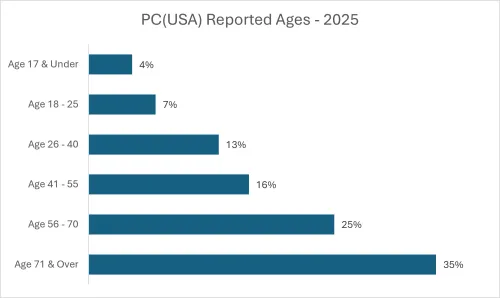
25% were between the ages of 56-70. 35% were over 70. 4% were 17 and under, while 7% were 18-25. 13% were between the ages of 26-40 and 16% were between 41 and 55.
Finances
Total reported receipts for 2025 were $3.376 billion, a 4.2% decrease from 2024. However, the average total receipts per member was $3,313, essentially level with the $3,370 per member in 2024.
As typical, regular contributions were the largest category of receipts, at $2.14 billion, an average of $2,100 per member.
Total reported expenditures were $2.725 billion, which was a 22.6% decrease from 2024. Most of this decrease was in capital expenditures and investment expenses, which were down 54% and 48%, respectively.
Reported per capita giving was 42% lower than in 2024.
Local program, the largest expenditure category, was down 6.3%. Local mission was down 11.5% while other mission was down 2.3%.
Reported receipts exceeded reported expenditures by $651.6 million in 2025. The net positive comes from a steep drop in expenditures, particularly capital expenditures and investment expenses.
You may freely reuse and distribute this article in its entirety for non-commercial purposes in any medium. Please include author attribution, photography credits, and a link to the original article. This work is licensed under a Creative Commons Attribution-NonCommercial-NoDeratives 4.0 International License.