Racial Justice Committee set to continue discussion on anti-racism efforts and consider new business on Wednesday
New business asks for the reinstatement of the Racial Equity & Intercultural Ministries office

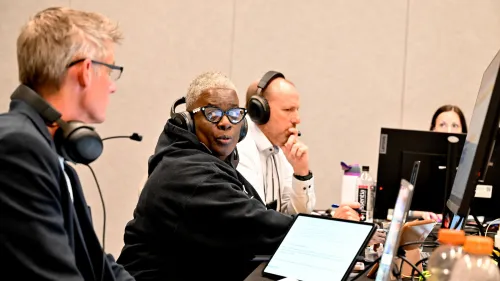
On day two of committee meetings on Tuesday, the Racial Justice Committee turned most of its attention toward RAC-04, which consists of recommendations from the Special Committee on the PC(USA) and Race on various items. Deliberation on this overture will continue into Wednesday and will be followed by the introduction of new business RAC-05, which was added to the docket over the course of the committee meeting on Tuesday.
Before RAC began tackling the various points presented in the Special Committee’s overture, it handled relatively straightforward business: the approval of the REAC minutes, RAC-MIN-01, as amended by the three commissioners who reviewed them. The motion passed with unanimous approval.
The committee then listened to presentations from two members of the Special Committee on the PC(USA) and Race, the Rev. Fran Lane-Lawrence and Ruling Elder Edgar Hayes, as well as a delegate from Peru who offered her testimony in Spanish.
During the information session that followed, questions were raised regarding the parameters of the anti-racism training mentioned in the overture as well as the financial implications of the tracking system suggested. Lane-Lawrence tackled the latter topic, stating that the Special Committee was aware of the concern over time and money spent, and ultimately decided that “financial implications of business items should not be more important than human impact, racial justice and the work of repair,” as is written in the overture’s rationale.
Lane-Lawrence added her own voice to this resolution, concluding that, “we understand the pricetag. We also understand that white supremacist culture makes decisions based on money instead of people. And we are hoping that we do not choose to do that.”
The bulk of the debate centered on the question of whether the anti-racism training ought to be a mandated requirement or a widely available universal resource for the church. There were questions asked about the nebulous nature of the Matthew 25 movement and discussion that centered on what exactly an anti-racism curriculum would look like, and how they could ensure that it would apply to every level of the church. The debating commissioners were encouraged to consider the outcome of the recommendation, rather than focusing so intently on the details of every possible context.
Special Committee representative Hayes made metaphorical waves when he urged the committee that “the time is now. What is coming at us — white Christian nationalism — is like a wave, a tidal wave, and we cannot wait until tomorrow to respond.” Multiple commissioners referred to this declaration in their later comments regarding further amendments to RAC-04 — Hayes’ passion made an indelible impact on many, who echoed his belief that “the time is now.”
As the committee approached the end of Tuesday’s business, the conversation surrounding anti-racism training and other details of the recommendation stirred up many emotions — so much so that the committee paused and asked its Moderator to pray over them. After first requesting that the commissioners and committee members take a few deep breaths together, Moderator Jones did just that.
By the end of the day, the committee had approved amendments to each point of RAC-04.
Two motions amending the language of the first item outlined in RAC-04 failed before a third was passed, which added stipulations regarding the tracking system. The amended recommendation asks that, once the tracking system is completed, the PL&W will populate it with data beginning with the current GA business and then moving backward to focus on capturing historical data.
A motion was made to edit the text relating to the scope of the tracking system that would have PL&W work back to 2006 and stop there, rather than continuing to 1983. Debate commenced over how far back in history to source GA business—was twenty years enough, or ought it reach back to reunion? In the end, the motion failed, with 24 votes in favor and 38 against. The next motion resolved this deliberation. The motion to strike the specific date-range (back to 1983, and then further to 2006) and to replace it with less restrictive language that ensured the historical data would be represented regardless passed with 40 concurring votes.
As tensions continued to grow, Moderator Patricia Bligen Jones took a moment to urge commissioners and committee members to take care of themselves. “We want you to feel safe,” Jones emphasized, before pointing out that a few members had removed themselves from the space over the course of the discussion. “We want to hear from all of you.”
Amendments to amendments were passed; suggestions were incorporated into new language; an update to the financial implications of the overture is in development and will be made available before final action is taken on RAC-04.
“This is an important item of business and we’re really wrestling with it—thank you for doing that with us,” Vice Moderator Steve Watts said during a pause in discussion.
The committee closed its time together with honesty and transparency. Moderator Jones encouraged all participants to be vocal about how they were feeling as they left the meeting. One commissioner responded with candor, sharing that they were leaving angry. Another offered an apology for language spoken earlier in the meeting. Another pointed out that almost half of the group had remained silent and encouraged them to step forward the following day.
Moderator Jones called on specific commissioners, asking them to voice their thoughts. Commissioner Eugene Burke from the Presbytery of Philadelphia shared that, “for the minority of us who are here, having to vote on issues that directly impact us … It’s kind of like an uphill battle.”
The Racial Justice Committee will reconvene on Wednesday morning to conclude deliberation on this overture and deal with the next order of business: RAC-05, Recommendation on Restoring and Strengthening Racial Equity & Intercultural Congregational Support Ministries and Ensuring Their Proper Organizational Placement Within U.S.-Based Partnership Structures.
You may freely reuse and distribute this article in its entirety for non-commercial purposes in any medium. Please include author attribution, photography credits, and a link to the original article. This work is licensed under a Creative Commons Attribution-NonCommercial-NoDeratives 4.0 International License.