Perfect harmony
Musicians at First Presbyterian Church in Greenville, North Carolina share the recipe for their secret sauce during PAM’s ‘Sounding Board’ podcast
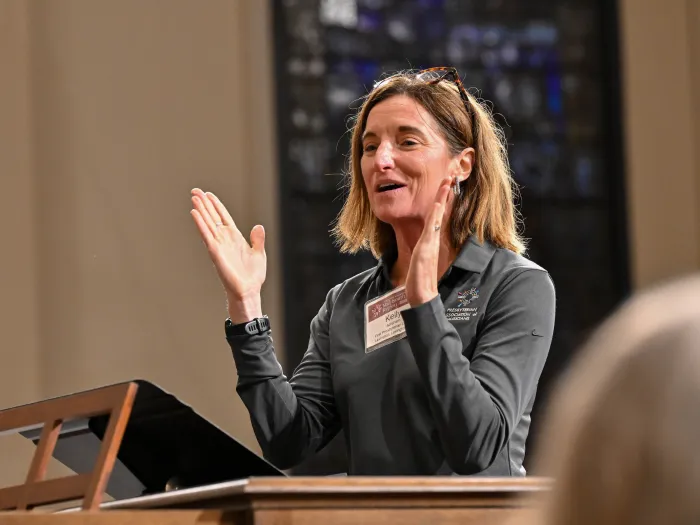
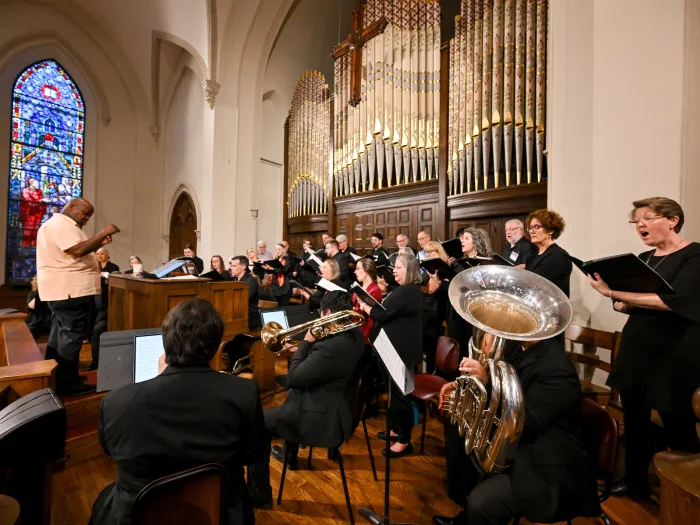
LOUISVILLE — For their most recent edition of “Sounding Board,” the podcast of the Presbyterian Association of Musicians, hosts Jeremy Roberts and Sarah Abushakra turned to fellow musicians Karrie Rushing and Brad Collier to learn more about they work so well together — and help members and friends to praise God during worship and choir rehearsal each week at First Presbyterian Church in Greenville, North Carolina.
Listen to their 60-minute conversation here.
Rushing is FPC’s director of music and worship arts, while Collier is the organist and piano player at the church and director of first-year and transition programs in the College of Engineering and Technology at his alma mater, East Carolina University. He’s also an adjunct music instructor at local community colleges.
Rushing recalled singing with the adult choir at her home church beginning in ninth grade, where she set the tradition of singing “O Holy Night” as a solo every Christmas Eve for the next dozen years or so, “no matter where I was in the world.”
“At 15, I wasn’t quite ready to do that,” she told the hosts. “But they said it wasn’t Christmas unless Karrie sings. I just knew that church family would always be there for me.”
Collier labeled himself a “church mutt,” having cut his teeth in a Pentecostal Holiness church, where he started playing the church’s Hammond B3 organ during worship, also at the age of 15. “I began by watching our pianist’s hands” to learn chord progressions, he told the hosts.
He went on to play for Baptist and Methodist congregations before coming to First Presbyterian Church while he was still an undergraduate student 20 years ago, seven years before Rushing’s arrival at the church.
“I fell in love with the congregation immediately, and with the way the PC(USA) does things and leads their worship services,” Collier said. “Then when Karrie arrived on the scene, I decided it was time to ditch the other churches [where he’d been playing] because this is where I belonged.”
“I walked into the door assuming I was going to have the best colleagues ever. That’s my go-to,” said Rushing, who three years ago was co-director of PAM’s Worship & Music Conference at Montreat Conference Center. “I walked in the door on Aug. 1, 2013, and said, ‘we’re going to be amazing colleagues and friends, and by the way, my name is Karrie. It’s nice to meet you.’”
“You walk in and you assume your colleagues — music colleagues, pastors, office administrators and sextons — everyone has something to teach you,” Rushing said. “If you can walk through the door with that openness, ready to absorb the gifts that other people bring, it just makes work a lot of fun, and that’s what it’s been for the last 13 years.”
“I am a strong personality and I do have opinions,” Rushing said. “But I don’t assume that my way is the only way. In music ministry in particular, it’s not always for me. Often the things we choose to do — the hymns and the anthems — aren’t my favorite. But after worship someone will inevitably come up to me and say, ‘oh, that song speaks to me in this way.’ It takes a little bit of the pressure off and reminds us to be open to other ideas.”
Roberts asked Collier what makes him feel supported as a church keyboardist.
“Have Karrie Rushing on your side,” Collier said with a laugh. “It’s what everybody needs.”
“In the 13 years we’ve been together, I can anticipate what she’s going to do with a piece of music,” Collier said. “She is so consistent in how she conducts.”
Sometimes he’ll receive a text from Rushing that starts out, “Now hear me out,” Collier said. “I know it’s going to work because she’s already thought it through.”
“We take our ego out of it,” Collier said. “We know the goal is not to glorify ourselves, but to make the worship service the best that it can be.”
“If we weren’t on the same page,” Collier said, “I don’t think we would have the thriving program that we have.”
“It comes back to trusting each other’s expertise,” Rushing said. “We’ve been blessed by pastors who trust our expertise with regard to music. They are open to us being creative, like, ‘what if we made this service an entire music service and you didn’t preach that day?’ and they said, ‘have it, because it’s a form of bringing the word.’”
Owing to his Pentecostal background, “Brad is incredible about improvising,” Rushing said. “Also, he has two organ degrees. Whatever keyboard he’s at, it makes my life so much easier.”
Asked for advice for musicians seeking their first church position, Rushing said the most important thing “when you’re walking into a new role is to listen. You’ve got to understand why things are done the way they’re being done before you can come in and change things.” After college, her pastor had a friendly word of advice for her: your first year on the job, you get to change one thing. Choose wisely.
“That first year, you have to learn the rhythms of the place so you can be part of it,” Rushing said. “You earn trust, make friends, and listen to the pastor and the choir members and the bell ringers and the parents of the kids to understand what your role is there.”
“Try not to change too much too fast,” Rushing advised. “I think that’s the hardest thing.”
Church volunteers, including choir members and handbell players, “need to feel accomplished and they need to have fun,” Rushing said. “If they don’t feel both of those things, they will find somewhere else” where they can.
At church there’s the added layer “that they need to feel they are giving back to the church and they need to feel spiritually fulfilled with what they’re doing — what they’re singing rather than why they’re singing it,” Rushing said.
Collier said his longtime position “is very much a marriage of music and faith and finding the place where you can serve and be effective, but also get fed. That’s probably why after my first Sunday at First Pres, I never wanted to leave because I had found my place.”
On his second Sunday on the job, Collier heard a sermon about the importance of welcome and inclusion. “I realized this is a special place and it’s where I needed to be,” he said. “You get to know the people and you begin to choose music that’s liturgically appropriate and is also meaningful to the congregation.”
“Even though we work a lot, on Sunday mornings I leave refreshed from worship and ready to see the choir again on Wednesday to rehearse,” he said. “They’re my people, and I want to give my people the best I have.”
You may freely reuse and distribute this article in its entirety for non-commercial purposes in any medium. Please include author attribution, photography credits, and a link to the original article. This work is licensed under a Creative Commons Attribution-NonCommercial-NoDeratives 4.0 International License.