
Iranian-American author makes a timely appearance on ‘A Matter of Faith: A Presby Podcast’
Dr. John Ghazvinian traces the roots of Presbyterian mission in Iran and places current hostilities in their historical context
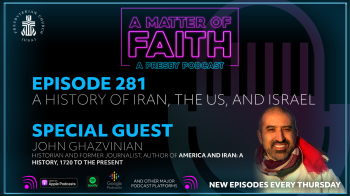
LOUISVILLE — As the Trump administration was threatening Iran with the destruction of its power plants and bridges this week, Dr. John Ghazvinian, an Iranian-American author, historian and former journalist, was the most recent guest on “A Matter of Faith: A Presby Podcast.” Listen to his 65-minute conversation with hosts Simon Doong and the Rev. Lee Catoe here.
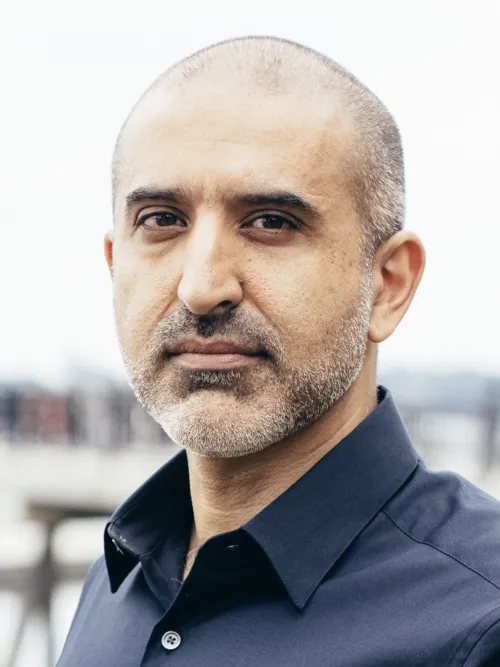
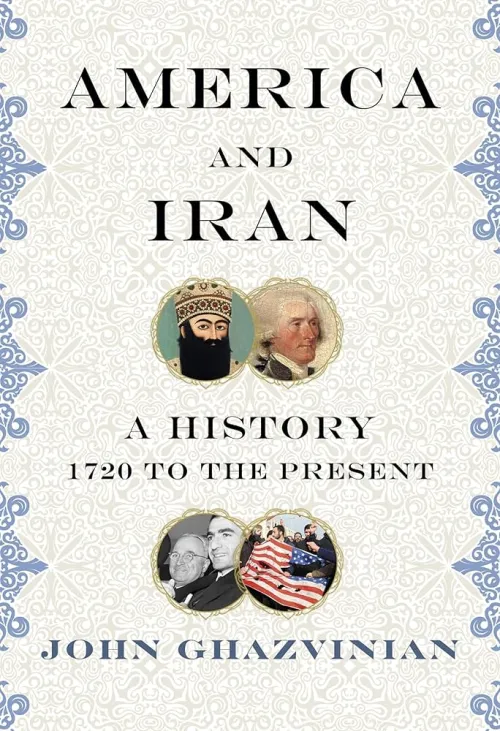
Ghazvinian is the author of the 2021 book “America and Iran: A History, 1720 to the Present.”
Ghazvinian is a U.S. citizen who grew up in the United Kingdom, for the most part. “As an Iranian-American, I was very curious to understand why these two countries hate each other so much,” he told the hosts. It may be reasonable to ask how things went so wrong and who’s to blame, “but it’s not a good way to approach history,” he said. There are more interesting questions, he said, including “did it ever go so right?”
“The overwhelming arc of history when you look at U.S.-Iran relations is a positive one,” he said. “These are two countries with mutual interests, mutual fascination — even a kind of mutual admiration. In some ways, the last 47 years [since the Iranian Revolution] has been a bit of an anomaly.”
Ghazvinian said there’s a role for people of faith in the current moment, “and I say this as someone who’s not particularly religious myself. I think faith can help us transcend the day-to-day pettiness, the conflict-driven narratives, and look for higher truth. I think I was looking for some kind of larger truth about these countries and whether there is something more positive or even transcendent we can bring out in this conversation.”
Asked by Catoe about Christian nationalism intertwining with Islamophobia in some quarters, Ghazvinian noted that “anytime you are that sure of yourself, you become a dangerous thing, no matter what that ideology might be. Unconstrained, unbounded ideology without humility, without strategy, without sophistication or a willingness to understand your adversary can quickly become a reckless thing.”
That kind of attitude is not unique to the United States, he noted. “Since the Revolution, the Iranians have become a lot more hard-nosed and steeped in realpolitik than they were,” he said.
Doong said that what often gets lost in the discussion is “the effects that these actions have on the people. If the purpose is unclear,” he said, “how do you know when any sort of action — military or sanctions — is successful?”
A larger issue is the dehumanization of Iranians “that’s gone on for a long time in the United States since the Revolution,” Ghazvinian said. “It makes it easy to impose sanctions without concern for the effects they have on people.”
Among politicians of both of the major U.S. political parties, “there has been this gleeful, strategic approach to sanctions,” he said. Their reasoning is this: “If we just turn the screws on these guys enough, they’ll rise up against the government and that will be a good thing because the government is so horrible, without any awareness or concern that you’re turning people into guinea pigs.”
When the Iranian Revolution took place in 1979, “there was a narrative in Washington that this was a collective moment of insanity among the Iranian people and that it wouldn’t last,” Ghazvinian said. It’s a narrative that persists, “this belief that the Islamic Republic is a house of cards that will collapse any minute under the weight of its own unpopularity.”
“There is no question that the Islamic Republic is far less popular than it has ever been in its history,” he said. “But that’s not the same as saying it’s a house of cards that’s about to collapse.”
In order to bring about that collapse, “you’ll be much more effective if you actually understand your adversary,” he said, “rather than indulge in fantasies about its brittleness or its fragility.”
That led Ghazvinian to “dip back into history” to the 1830s, when Presbyterians started sending missionaries to Iran. “The first Americans that Iranians ever came into contact with were Presbyterian missionaries,” he said, mission workers sent by what was then called the American Board of Commissioners for Foreign Missions. Straight out of college, young men “went there and lived their whole lives there. They built schools and clinics. The proselytizing was very low-key,” he said, as it was illegal in Iran to try to convert Muslims to Christianity.
“The first generation of Presbyterian missionaries who went over there focused on building schools and clinics and on helping people with hygiene and literacy,” Ghazvinian said. “The idea was if they could uplift the lives of Iran’s Christians, their Muslim neighbors would look at them and say, ‘I want to live like that. Maybe I should convert to Christianity.’”
“That seems far-fetched, and I can tell you it was not very successful,” he said. The Presbyterian mission in Iran lasted for a century, from 1835 to 1935. “In that entire time, it converted only 200 people to American-style Presbyterian Christianity,” he said. But “to this day, there is a Presbyterian church in Iran, and the descendants of those people are Presbyterian Christians.”
When U.S. Presbyterians decided to send someone over to understand why more Iranians weren’t converting from Islam, they selected James Lyman Merrick. Merrick spent nearly three years traveling all over the country and met with, among many others, government officials. Merrick “started getting angry” and wrote letters back to his Massachusetts church, saying, according to Ghazvinian, “the more I study Islam, the more I realize it’s not a brittle, fragile house of cards. It’s actually a sophisticated religion based on centuries of theology.” In Merrick’s words, it wasn’t this “flimsy, frost-work structure” that will blow over in the wind, and it’s similar to “what I and other people have been trying to say in the context of American foreign policy since the 1980s,” Ghazvinian said: “We may not like the Islamic Republic and we may wish that Iran had a different type of government,” but it’s an approach of “accepting the world as it is instead of how you want it to be.”
“If your goal is to bring about regime change in Iran, fine, but you’ve got to start with acknowledging some realities.”
Catoe asked Ghazvinian how he, as a historian, responds to “people who can’t hold multiple truths at the same time?”
“What you’re putting your finger on is one of the great maladies of our age,” Ghazvinian said. “Life is messy, but we don’t seem to be very good at holding the messiness.”
Ghazvinian said he set out to write the book “with one simple premise: I wanted to understand why decision-makers in both countries made the decisions they had at various points in history,” he said. “People make decisions because they are responding to a certain set of circumstances or because they are informed by certain experiences, and not because they are inherently evil.”
He then traced the history of the U.S.-Iran relationship and how Israel has related to both countries. A main difference today, of course, is the false assertion that Iran has nuclear weapons, which “creates a certain reality in [some] people’s brains that Iran has nuclear weapons stashed away somewhere that it’s going to use any minute now to destroy Israel and destroy the United States.,” he said. However, “you can’t build a nuclear weapon in secret.”
Catoe asked Ghazvinian how the “institutionalization of religion within government” is exacerbating hostilities.
“It’s ironic, isn’t it?” Ghazvinian replied. “Our enemy in Iran is supposed to be guilty of exactly that.” If Catoe and Doong had asked a Reagan administration official on their show in, say, 1980, just shortly after the Iranian Revolution, “they’d say we don’t like Iran because they’re a theocracy. They’re not a democracy.”
It’s ironic, he said, that 47 years after the Revolution, “you have people who are talking this way. It’s not an exact comparison. It’s not like we’ve had some sort of Christian revolution in the U.S. But some of these themes are much more mainstream than they used to be.”
“I don’t have an answer because it’s outside my area of expertise," he told the hosts, "but I appreciate the point you’re making.”
After thanking their guest, Doong and Catoe talked about their rich discussion.
“If you listen to John, at the beginning of this history was this fascination with each other’s cultures and the ability to ask questions and be curious about each other’s culture,” Catoe said. “At one point in time, we were so curious about each other. I hope we can spur more curiosity when it comes to the people of Iran.”
New editions of “A Matter of Faith: A Presby Podcast” drop every Thursday. Listen to previous installments here.
You may freely reuse and distribute this article in its entirety for non-commercial purposes in any medium. Please include author attribution, photography credits, and a link to the original article. This work is licensed under a Creative Commons Attribution-NonCommercial-NoDeratives 4.0 International License.


