Presbyterian Center hosts a walk for peace
About 100 people gathered at PC(USA) headquarters Saturday to speak, sing, listen and march
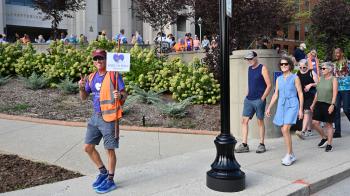
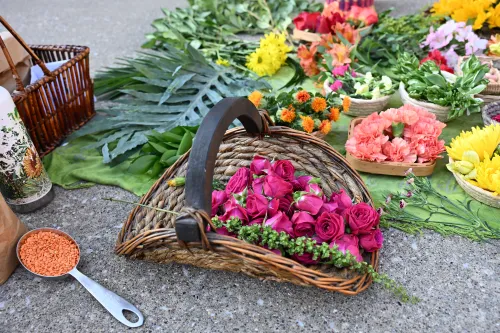
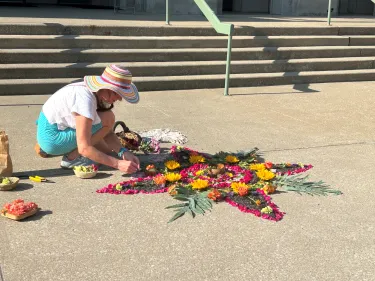
LOUISVILLE — Walk for Peace Louisville, an interfaith gathering of people seeking peace by working together, began and ended Saturday at the Presbyterian Center in Louisville, Kentucky. About 100 people turned out to hear brief speeches, sing, march for peace, and witness Louisville artist and teacher Jenny Bell build a mandala from flowers, ferns and seeds at the entrance to the headquarters of the Presbyterian Church (U.S.A.).
“We have the gift to look forward to the kind of community and nation and world we have a hand in creating, where differences are celebrated and learned from,” said event organizer Anne Walter, representing Nonviolent Louisville and the Drepung Gomang Center for Engaging Compassion. “This walk is just a little step to help restore the balance.”
“We are grateful for this commitment each of you bring to the work of peace,” said Ian Hall, President of Presbyterian Church (U.S.A.), A Corporation, adding part of the A Brief Statement of Faith as part of his welcoming remarks: “In a broken and fearful world, the Spirit gives us courage to pray without ceasing, to witness among all peoples to Christ as Lord and Savior, to unmask idolatries in Church and culture, to hear the voices of peoples long silenced, and to work with others for justice, freedom, and peace.”
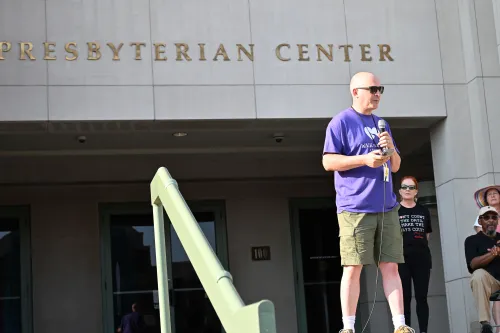
“Our faith does not allow us to give into fear or believe division can be the only way,” Hall said, adding that peace “requires justice, dignity, compassion and a willingness to hear from one another, especially those whose voices have too often been overlooked or silenced.”
“May our time today be filled with hope and courage and a renewed commitment to justice, hope and peace,” Hall said.
Bell, who worked on her mandala while most of the people gathered marched in downtown Louisville, called her floral creation “ephemeral. It’s meant to be impermanent.”
“This particular mandala will serve as a living, breathing prayer of our collective heart” for “peace, nonviolence, goodwill and compassion,” Bell said. “It’s a symbol of interdependence and a dedication of the merit of our actions today.”
Bell called the mandala “intuitive art” and gave those gathered a piece of the creation and a bag of seeds to take to their own community for use as they saw fit.
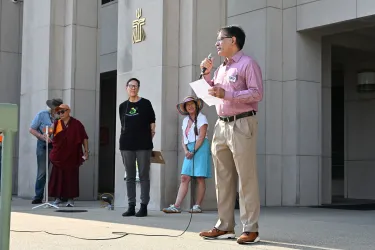
Speaking on behalf of the Muhammad Ali Center, Mary Casey called peace “a commitment we make every day through our actions and our words, and by how we treat one another.”
“The world knew Muhammad as a champion in the ring, but he spent much of his life championing peace and human dignity,” Casey said. Ali “often reminded us that service to others is the rent we pay for our room here on Earth.”
“Let us lead with compassion, act with courage and build communities where every person feels seen, heard and connected,” Casey said.
Dr. Eddie Woods said he and his wife started the organization No More Red Dots 30 years ago to “slow down gun violence” in Louisville.
“We say peace is inexpensive security. We show people how to get to their peace spot and how to maintain it,” Woods said. “It’s not super hard, but it’s simple. I’m always honored to be involved in peace walks.”
Representing the group Muslim Americans for Compassion, Dr. Waqar Saleem, a Louisville physician, noted that “those of us in developed societies can sometimes forget the value of tranquility.”
“Ask someone in an armed conflict how much they cherish peace,” Saleem said. “Ask someone in an authoritarian regime, or refugees seeking protection who are risking their lives.” Or “ask someone who was born in the wrong ZIP code, or who suffers from food insecurity or violence or decreased life expectancy.”
“We must actively work for peace. Times like these can be quite discouraging,” Saleem said, but hope is always present, such as the group of Buddhist monks who “awakened peace and kindness in us” by taking 109 days to walk 2,300 miles from Fort Worth, Texas, to Washington, D.C., for peace.
“They taught us how to be more caring and empathetic,” Saleem said, “a true recipe for inner peace.”
Once Saturday morning’s walk had concluded, marchers could see that Bell’s mandala had grown considerably. She called it “a dedication to our highest aspirations in our community.”
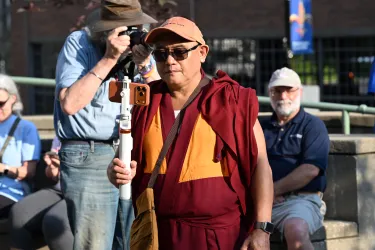
Geshe Rapgyal, a Buddhist teacher at the Drepung Gomang Center for Engaging Compassion, did some Tibetan chanting to draw the event to a close and noted that “it took many people to come together for the work of peace.”
Walter led participants in the Great Aspiration Prayer by the Buddhist master Shantideva, which states in part: “May I be a guide for those who do not have a guide, a leader for those who journey, a boat for those who want to cross over, and all sorts of ships, bridges, beautiful parks for those who desire them, and light for those who need light.”
Videos of Saturday’s Walk for Peace Louisville produced by the Drepung Gomang Center for Engaging Compassion can be seen here.
You may freely reuse and distribute this article in its entirety for non-commercial purposes in any medium. Please include author attribution, photography credits, and a link to the original article. This work is licensed under a Creative Commons Attribution-NonCommercial-NoDeratives 4.0 International License.