
‘That God is going with us’
The Co-Moderators of the 226th General Assembly of the PC(USA) slip into the roles of Moses and Elijah at the Transfiguration

LOUISVILLE — The Rev. Tony Larson and the Rev. CeCe Armstrong, Co-Moderators of the 226th General Assembly, took on the roles of Moses and Elijah during closing worship Wednesday at the General Assembly Leadership Briefing. Each donned a costume: Larson, playing Moses, wore a blue scarf, and Armstrong, portraying Elijah, a red scarf. They named their sermon “Listen to Jesus” and used Matthew 17:1-9, the gospel writer’s account of the Transfiguration, as their text.
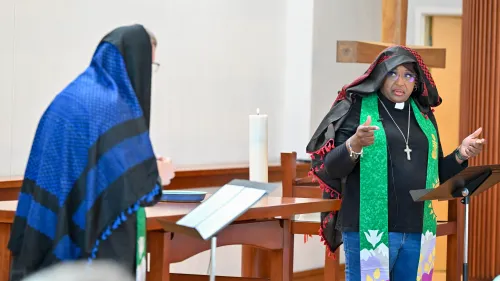
“So, here we are again,” Elijah said, looking around. “Another mountain.”
“We’ve been here before,” Moses said. “Different mountain, but the same energy.”
“We have stories,” Elijah said, to which Moses replied, “Stories? We have trauma!”
“We have character-building experience,” Elijah told Moses. “OK, Elijah,” Moses said. “We’d have therapy bills if there were therapists in our day.”
Moses told Elijah the story of smashed tablets and the Golden Calf. “I was angry,” Moses said. “Here I am on the mountain with the actual blueprint for the beloved community — the vision God has been dreaming about since Creation — and they can’t wait month, not a one, without building their own idol and doing whatever it is they want.”
“I guess the glory of the mountain doesn’t automatically fix what’s broken in the valley,” Elijah noted. “My mountain was the same — God showing up in unexpected ways. I just had this enormous victory — I mean, I called out fire from heaven! 450 prophets of Baal defeated in front of everybody! It was a peak prophetic moment.”
“I sense there is a big old ‘but’ coming,’” said Moses.
There was, Elijah explained. “I ran into the wilderness, sat under a broom tree and I told God I was done. I quit. Kill me. I can’t do this anymore.”
“I’ve been there,” Moses said , citing Numbers 11. “I said to God, ‘I am not able to carry these people alone. This burden is too heavy. If this is how you’re going to treat me, just kill me now, please.’”
“You know,” Elijah told the committee leaders, “biblical heroes were just like most of y’all. We also have breakdowns in the wilderness.”

Moses agreed. “The Bible is considerably more honest about its leadership than your average church newsletter,” Moses opined.
God sent Elijah an angel with bread and water and “told me to get up,” the prophet recounted. “I walked 40 days and God met me there — not in the wind, not in the earthquake, not in the fire — in a still, small voice.”
“Not the spectacular display of power that I was honestly expecting,” Elijah told Moses.
The two once again addressed the committee leaders.
“We’ve been watching y’all,” Elijah said.
“Your valley is a mess,” Moses said, to which Elijah said, “Now, Moses, we have to be prophetic and pastoral, remember?”
“Well, it is a mess,” Moses countered. “People are running around doing golden calves left and right — except now you call them platforms and brands and markets. Economic anxiety grinding people down. Families making impossible choices. War breaking out. Chaos in the halls of government. Democratic norms and institutions dismantling with stunning speed … and empire doing what empire always does: demanding loyalty, threatening those who resist, concentrating power in fewer and fewer hands, and telling the vulnerable they are disposable.”
“The people of God — the body called to be the alternative community, the embodiment of a different way of being human together — is fractured and exhausted,” Elijah said, “with some losing confidence that God’s kingdom is ever coming.”
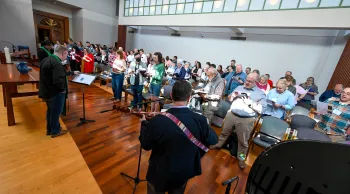
“Does that sound familiar to all of you?” Moses asked those in the Chapel. “So here’s what we need you to hear.”
“We have been here before,” Elijah reported, very slowly. “Write that down.”
“The empire may be different, but they’re using the same playbook,” Moses said. “Pharaoh, Ahab, Caesar — they’re all running the same scam. They tell you that their valley is all there is, that power is the only language that matters, that the vulnerable are acceptable losses.”
“When the prophets stand up and say, ‘God has a different vision — a vision of liberation and flourishing and beloved community,’” Elijah said. Moses completed the thought: “The people in power break out their toolbox — ignore, dismiss, propaganda and misinformation — and when the prophets refuse to stop, the empire goes to its favorite tool, violence.”
“Every single time,” Elijah said. “The people in the valley need to know that empire does not have the last word.” Those in worship applauded.
“Can I tell you something, Elijah?” Moses said. “Standing there on that mountain with Jesus, I knew what Jesus was going to do. I knew he was going to confront the empire of his day and face rejection — and walk right into the valley’s worst violence.”
“Christ was going to show the world that the way to defeat empire isn’t to out-empire the empire,” Elijah said. “That ain’t gonna work. It is to love so scandalously, so persistently, that the empire’s violence looks pathetic by comparison.”
Peter, who “sees the glory of Jesus transfigured, shining like the sun,” according to Moses, “does what people do when they encounter something holy and terrifying and beautiful. He starts a building project,” thinking, “let’s freeze this moment. Let’s stay on the mountain where everything is clear and bright and certain.”
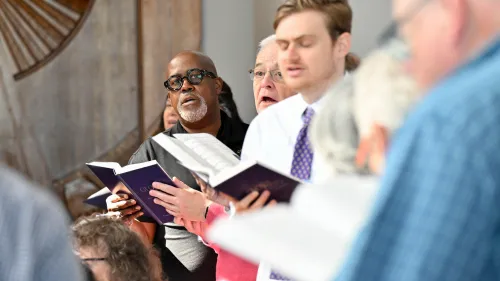
The voice from the cloud tells those witnessing the Transfiguration, “This is my Son, the Beloved, with whom I am well pleased; listen to him!”
“Then they were gone,” Elijah observed. “The prophets, gone. The spectacular and the historic, gone. When they looked around, there was no one there except Jesus.”
Then Armstrong and Larson stepped out of character and returned to being themselves.
“Jesus, the word that remained when everything else fell away,” Armstrong said.
“The word is not a strategy, not a process — although process matters, and we’re grateful for everyone in this room who’s going to uphold that process faithfully,” Larson said.
Larson said that the primary purpose of the General Assembly is to discern the will of Jesus Christ for the church, “not to manage expectations, not to balance competing interests, not to run out the clock on critical business — but to discern the will of Jesus Christ.”
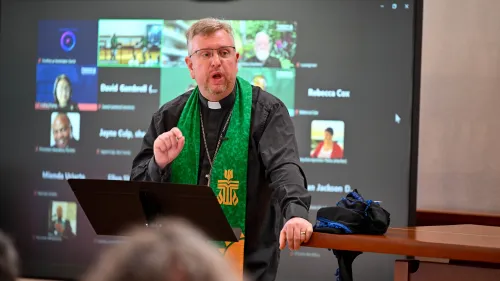
“We aren’t Moses and Elijah anymore,” he said. “We’re Tony and Cece, and we want to be honest with you about what we’ve learned in two years serving the church.”
“Like Elijah and Moses, we have seen some stuff,” Armstrong said.
“We know the weight of presbytery rooms and committee rooms — where the tension is there, the vote is close, and the stakes are real, where people on both sides and all sides are not wrong to care as deeply as they do,” Larson said.
“We know the weariness of staff who have given their professional lives to this institution and have spent years living in transition, wondering what comes next — wondering if there is a place for them,” Armstrong said.
Listen to Jesus when he says the last shall be first and the first shall be last, Larson said.
“Listen to Jesus when he feeds 5,000 people with what everyone said was not enough,” Armstrong said, “because there will be a moment in June when the resources feel inadequate and time feels short, and what you have in your hands doesn’t seem like it can possibly be sufficient. Y’all need to know and remember that Jesus has a history with insufficiency.”
“Listen to Jesus when he washes people’s feet, including Judas’ feet,” Larson said. “If we are going to lead in the spirit of this Jesus, we will be asked to extend care and dignity to people with whom we profoundly disagree — not as a strategy, but as a practice, a discipline of listening to and following Jesus.”
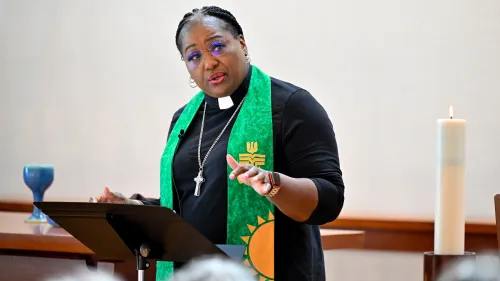
“Friends, listen to Jesus when he touches the untouchable and eats with the unacceptable,” Armstrong said, “and refuses to be anyone other than the One God made him to be.”
Listen to Jesus even when he’s standing silently before Pilate, Larson said. “There is a kind of witness that looks in the moment like losing,” he said. “The body of Christ in Milwaukee in June may be asked to embody that faithfulness, to resist the empire’s metrics of success and trust that the still, small voice is more powerful than the earthquake and the fire.”
“My dear friends, listen to Jesus when he says ‘It is finished’ — not as defeat but as completion,” Armstrong said. “There is work ahead of you that will feel unfinished long after the gavel falls. Overtures will pass and not fix everything. Reports will be received and not heal everything. Decisions will be made that leave people on both sides and all sides wondering if it was even a mountain.”
“The word from the cross,” she said, “is that completion does not always look the way we planned.”
“Listen to Jesus when he rises, because the resurrection is not a postscript. It is the whole argument,” Larson said. “It is the answer to every empire that has ever said, ‘We have the last word.’”
“It is the reason we can walk down from this mountaintop together into the valley of our world without despair — not because the work of ministry is easy, not because our institutions are helping, not because our world outside the Assembly doors is going to cooperate or even necessarily listen,” Larson said.
“But because the one who we follow has already been through the valley’s worst darkness and actually comes out on the other side,” Armstrong said.
Don’t build tents, Larson advised. “Take what you have received — all this training, the relationships you have built, the sense of what you’re actually a part of, and go down into the valleys of the world following and listening to Jesus.”
“For the God who met Moses in his exhaustion, found Elijah under the broom tree, fed him and said, ‘Get up! The journey is too great for you,’” Armstrong said, before the two said together: “That God is going with us.”
You may freely reuse and distribute this article in its entirety for non-commercial purposes in any medium. Please include author attribution, photography credits, and a link to the original article. This work is licensed under a Creative Commons Attribution-NonCommercial-NoDeratives 4.0 International License.


