PC(USA) representatives engage with Cuban leaders during UN conference
Delegates to the UN Commission on the Status of Women and Presbyterian leadership heard concerns from Cuban representatives during the event
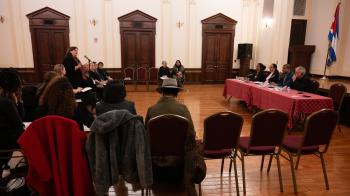
NEW YORK — As the first week of the 70th United Nations Commission on the Status of Women wound down, two sets of Presbyterian representatives visited the Permanent Mission of Cuba to the United Nations at a time the island nation finds itself at the center of United States foreign policy discussions.
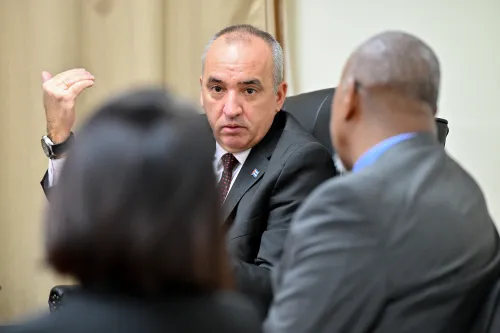
The Rev. Jihyun Oh, Stated Clerk of the General Assembly of the Presbyterian Church (U.S.A.) and Executive Director of Presbyterian Life & Witness, met with Ernesto Soberón Guzmán, Permanent Representative of Cuba to the UN, the morning of March 12. Joining Oh were Sue Rheem, Presbyterian Representative to the UN and Manager of the Presbyterian Ministry at the UN (PMUN); the Rev. Jimmie Hawkins, Director of Advocacy for the PC(USA); and Pam Snyder, Moderator of Presbyterian Women (PW).
Later the same day, several Presbyterian delegates to the annual Commission joined a group organized by Ecumenical Women at the United Nations for a dialogue with Cuban delegates to the Commission, Ambassador Yuri A. Gala López, the Deputy Permanent Representative of Cuba to the United Nations, and other Cuban leaders.
The conversations touched on numerous issues, including the fuel blockade and U.S. intervention for regime change, the impact of U.S. sanctions on Cuba, human rights and the status of women in Cuba, Cubans living in the U.S., and what Cuban officials considered overlooked positive stories about their country, including the development of vaccines during the Covid pandemic.
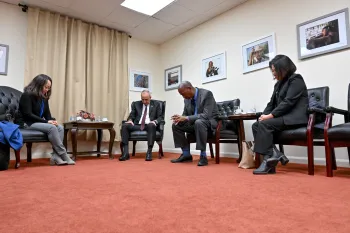
Following their visits, several Presbyterian participants shared their thoughts on the meetings in interviews or writing.
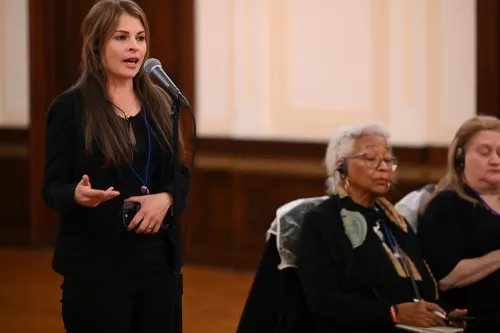
Sunelle Stander, a PC(USA) delegate, wrote: During our visit to the Permanent Mission of Cuba to the UN, we were received with so much grace, hospitality and friendliness. We had the opportunity to hear statistics and firsthand experiences of the current humanitarian situation in Cuba.
As with any crisis situation across the world, it is women and girls who are most affected. The power outages experienced across the country have far-reaching effects on every sector of society, including health care provided to pregnant women and children with cancer diagnoses, as well as the water and food supply. We also heard about ways in which the Cuban government works with women at the grassroots level to address women’s health problems, education and other gender-based issues. It was an honor and privilege to be a part of this incredible experience.
The Rev. Jimmie Hawkins: On our part, it was a lot of listening to be updated on the current situation. It’s been a number of years since I last visited Cuba, and it was struggling then. But my understanding now is that it’s much worse with the recent prohibition on countries selling oil to Cuba. We also heard that in the last four years, the embargo has really been even more horrific, and that people are suffering to a large degree.
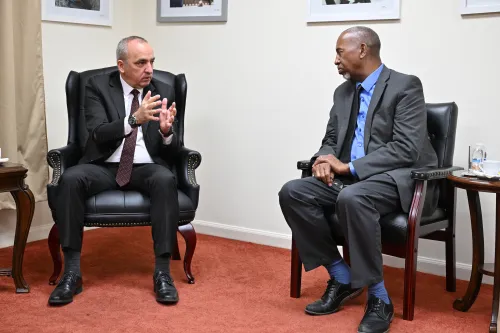
I can imagine (Guzmán’s) experience has been very frustrating. What is the foreign policy as it relates to Cuba? When are we going to have some consistency in our foreign policy as it relates to Cuba? And again, when are we going to stop bullying smaller nations, especially in Central and South America and in the Caribbean? ... So, I understand his position, because it’s unnecessary right now. Cuba is not a threat to us militarily. I do think I agree with him: it would be beneficial for both countries to have full diplomatic relations, because just think about all of the American goods that could be sold in Cuba. They don’t produce a lot of goods, and look at all the food that could be sold in Cuba.
It was good to be with the coalition that we had on our side — the Stated Clerk, our PMUN Director, and also a representative from PW. That was a good coalition of Presbyterians … where we can continue to press the issue of full diplomatic relations between Cuba and the U.S.
Pam Snyder: I always appreciate the fact that they take time to speak with us. Part of it for me is I travel a lot in my moderator role, and I have had so many women ask me why we are not doing more for Cuba, which is interesting in a way. But there are so many churches who are sending clothing, who are sending over-the-counter medications, who are sending money. And we’ve talked about it, and we have these meetings here. This is the fourth year we’ll be meeting with them, and it’s normally meeting with the delegates, who are predominantly women. So, I appreciated the fact that we actually got to meet with the permanent ambassador to Cuba to hear his thoughts about what the realities are in Cuba.
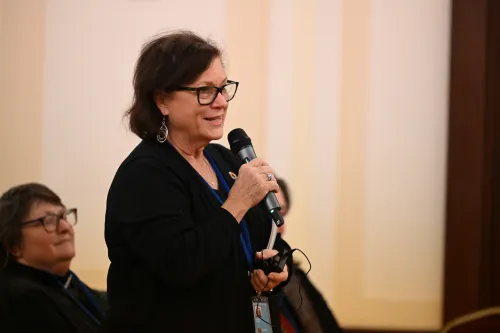
It’s very interesting this year, especially since our president has made some of the statements that he has made about Cuba. It puts us in an interesting position in the United States. But what I have learned too is how many Presbyterian churches are helping support Cuba.
With the oil situation, knowing full well how that impacts, but hearing it from him, confirming the fact that it involves heat, it involves the ability to run machinery, it involves the ability to have water, it’s food, it sounds very dire. It wasn’t good to begin with, and this certainly has impacted the severity of the number of people who really are struggling now in Cuba, and I constantly walk away saying, ‘What can we do? What should we be doing?’ and really pray about it, because what is the solution, and how can we be a part of it? I don't know if we could be a part of reform in Cuba, but be a part of the solution to the many problems that they face.
The previous two reflections were from interviews and were edited for length and clarity.
Oh and Hawkins were part of an international ecumenical delegation initiated by the World Communion of Reformed Churches (WCRC) that visited Havana, Cuba this weekend. Watch for more reporting about that visit soon through Presbyterian News Service.
You may freely reuse and distribute this article in its entirety for non-commercial purposes in any medium. Please include author attribution, photography credits, and a link to the original article. This work is licensed under a Creative Commons Attribution-NonCommercial-NoDeratives 4.0 International License.