The secret of life
New Testament scholar Dr. F. Scott Spencer dives into Philippians during a New York Avenue Presbyterian Church webinar

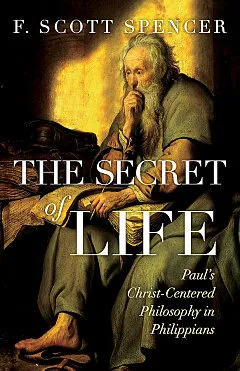
LOUISVILLE — “The Secret of Life: Paul’s Christ-Centered Philosophy in Philippians” is the latest book from New Testament scholar Dr. F. Scott Spencer. On Saturday, Spencer, who taught for 30 years, mainly at Wingate University and Baptist Theological Seminary, spent time with the faithful at New York Avenue Presbyterian Church in Washington, D.C., including a 90-minute webinar as part of the McClendon Scholars Program. Watch it here.
Spencer called Philippians “unquestionably my favorite letter of Paul. It has plenty of challenge, but I find it his most congenial letter, if not his most provocative.”
In his letter, “Paul claims, ‘I have learned the secret of life in any and all circumstances.’ Well, do tell, Paul,” Spencer said. Philippians 2:6-11, a short and memorable Pauline hymn, “befits Paul’s Christ-centered philosophy of life.”
“Paul is all in for Christ, but what does that mean? For Paul, Christ is the full-fleshed son of God,” Spencer said. “The central verse of this hymn is he humbled himself to the point of death, even death on a cross. Paul strives to know Christ’s resurrecting power in the crucible of his struggling.”
In Philippians 4:3, Paul lifts up Euodia and Syntyche, two women whom Paul says “struggled beside me in the work of the gospel,” as Spencer pointed out. “Paul stands shoulder to shoulder with the whole Christian community.”
During his talk, Spencer, who’s currently the New Testament General Editor for the Society of Biblical Literature Study Bible, looked at four struggles that Paul endured: as a prisoner, a partner, a runner and a consumer.
Paul’s struggle as a prisoner
“We don’t know where Paul is being held. It’s somewhere in the Roman empire,” Spencer said. “In Philippi, he has memory of his earlier imprisonment, which lingered with the congregation.” After a brief incarceration, “Paul and Silas are released by midnight as a well-timed earthquake opens their cell door without bringing the whole place down, Samson-style.”
“My imprisonment/chains is/are for Christ” is how Spencer translates Philippians 1:13. Paul “feels Christ in and with him in jail as much as anywhere.”
Paul’s struggle as a partner
Paul singles out Timothy as well as Epaphroditus, whom Paul calls a co-worker and a co-apostle, “a term Paul doesn’t throw around casually,” Spencer said. It could be Epaphroditus was at one time enslaved. At one point Epaphroditus falls ill and is on the brink of death, but happily for Paul he recovers.
“This is no stiff-upper-lip, stoical Paul,” Spencer said, “but a man of deep passion who wears his passion on his sleeve.”
Paul’s struggle as a runner
In Philippians 2, “Paul expresses a desire to not run in vain. He is committed to the goal, but is worried about not being fully up to speed,” Spencer said. “In chapter 3, he expands on that,” turning to the language of sports in verses 12 and 14.
“He may have been a sports fan or an active runner himself, but you don’t win races with chains around your legs,” Spencer noted. “All successful runners regardless of their talent must discipline themselves, pray hard and stretch with every fiber of their being toward the finish line.”
For Paul, “the Christ race is through a grace race,” Spencer said. “Gaining is not earning. Any gains are utter losses — rubbish — compared with the surpassing value of knowing and gaining Christ Jesus.”
Paul’s struggle as a consumer
“It’s unusual to think of Paul in Christ in this way,” Spencer said. “But consumers need not be consumerists who exist to maximize material goods and are never satisfied with what they have.”

In portions of the fourth chapter, Paul exhibits a “tension with gratitude, contentment and self-reliance, a good old American value,” Spencer said. “On the one hand, Paul’s secret is ‘I have learned to be content with whatever I have.’ This contentment secret is thoroughly relational, not transactional.” In verse 14, he tells the Philippians, “It was kind of you to share my distress.”
“The Philippians did so not as a wealthy church,” he said. “The Philippians minister to Paul out of a deep sense of solidarity as fellow strugglers to make ends meet.”
“But Paul also struggles with the discomfort of receiving aid,” he said, telling the church at Philippi “not that I am referring to being in need” and “not that I seek the gift.”
In effect Paul is saying, “I’m really grateful, guys, but I would have been fine without them,” Spencer paraphrased. “Self-sufficiency and self-reliance die hard … Paul regarded himself as the Philippians’ spiritual father, caring for them but not so much being cared for.”
“Part of the secret of life,” Spencer said, “is nailing some of that angst-ridden rugged individualism to the old rugged cross.”
You may freely reuse and distribute this article in its entirety for non-commercial purposes in any medium. Please include author attribution, photography credits, and a link to the original article. This work is licensed under a Creative Commons Attribution-NonCommercial-NoDeratives 4.0 International License.