
Explorations of nature and neurospicy childhoods
Theologian, educator and mom Dr. Kiara Jorgenson appears on Sounding Board
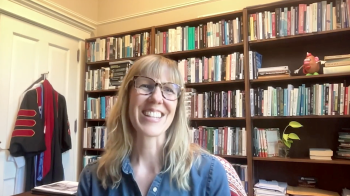
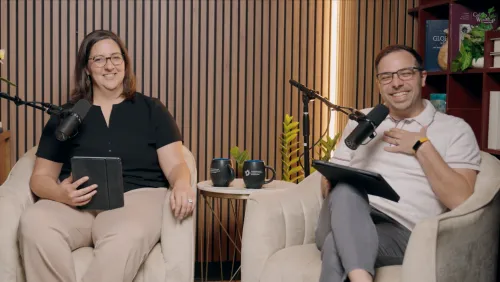
LOUISVILLE — As the mother of a girl with autism, Dr. Kiara Jorgenson of St. Olaf College has written about what she’s seen in worship spaces that’s been helpful and inclusive of neurospicy young worshipers. Last year she published “Explorations of Nature and Neurospicy Childhoods: Moving from Inclusion to Justice in Spaces of Worship” in Call to Worship. It was that article that led the hosts of the Presbyterian Association of Musicians’ Sounding Board broadcast, Jeremy Roberts and Sarah Abushaka, to ask Jorgenson to appear as their most recent guest. Watch the broadcast of their 77-minute conversation here or listen here or here.
Jorgenson said part of her faith story growing up was that her parents, who amicably divorced when she was about four, loved both the church and Creation. “For me, church and nature came together at a pretty young age,” she told the hosts. “Now, as a scholar and mother and someone who works with young adults, I’m keen to explore ways the natural world plays a role in the spiritual upbringing and development of young people.”
She said she relied significantly on disability scholars including Erin Raffety and Amy Kenny to complete her article for Call to Worship, a publication of the Office of Theology & Worship and PAM. “As the mom of an autistic daughter, I have firsthand experience of some of the differences I’m trying to articulate in that article,” she said, and she tried to answer this question: “Rather than providing a variety of perspectives and needs when it comes to physical, mental and cognitive differences, what does it look like to create spaces in our liturgical settings and in our church educational and youth ministry settings that brings disabled folks to the table to begin with?” That way, “there is agency right from the onset.”
“To be just is to make sure the people who have those needs have agency and power to articulate them,” she said, “and there are processes in place to support them.”
She said she uses the term “neurospicy” intentionally “because a lot of neurodivergent folks use it to self- identify.”
“I’m loving how this term ‘neurospicy’ is emerging,” she said. “I’m thinking about how much spice and flavor is being brought into my life and into communities because of the presence of these people who come into the world in a different space.”
For Jorgenson’s daughter and for many others, autism is “not just a facet of one’s life. One’s whole being is autistic. It’s proudly who my daughter is,” Jorgenson said. “’Neurospicy’ is a really positive term in that way.”
In worship, three means of accommodation “are pretty standard,” according to Jorgenson:
- One involves children worshiping separately in a children’s church space or experiencing Sunday school during the worship hour. When she and her husband were early on in the journey discerning what their daughter’s needs were, “we found this to be difficult,” she said. “We didn’t always feel safe dropping her off for Sunday school.” In some churches, children start off in worship and then leave for children’s church. “What I say in the article is what I think is lost when children are removed from worship and the teaching and worship is happening away from the rest of their community. They lose the opportunity to apprentice, to learn by watching others model things,” Jorgenson said.
- A second tool found in many churches is what Jorgenson called “busy bags.” “I think a lot of parents pack their own,” she said. “There are ways that can be done where it’s integrated into the service more thoughtfully to where it’s connected to the teaching and the Scriptures. Again, I’m trying to ask the question, Is it, ‘We want children in worship and they’re just there,’ or ‘Are there ways we can think about meeting children’s developmental needs and apprentice them in the worship space?’”
- A third is what some churches call a “prayground,” a deliberate play area in the worship space. “In some spaces, children and young families are making choices about what’s in that space,” she said. “I’ve seen creative and innovative ways congregations are making use of those spaces.” It’s always good to ask, “How can this space serve all our children and what can be added to some of these kinds of accommodations?”
When Abushakra noted just how little time many older children and young adults spend outdoors, Jorgenson discussed a Biophilia course she teaches at St. Olaf College. “It’s something we all know on some level, this idea that we have been created and evolved over time to have a need for nature — a kinship, a love for nature,” she said. A body of research shows that even 10 minutes outdoors after hours seated indoors in front of a computer can “restore our attention and have all sorts of bio-behavioral benefits,” she said. Those 10 minutes can “reset your central nervous system and your biofeedback.” In the Christian tradition there are “all sorts of spiritual practices connected to the natural work. People in the monastic traditions would seek solace out in the desert or the forest or near the sea. A lot of traditions have tapped into this reality.”
The nervous systems of most neurodivergent children “are in sensory overload a lot, and they don’t always know how to articulate that,” she said. “Dentists are onto this. They put pictures of the ocean or the forest on their ceiling for kids to look at when they have their first filling.”
When our brains are subject to so much sensory input, we experience deep fatigue, “which shows up in children’s behavior in all different ways. In the natural world, a neurospicy has a lot more control over what they attend to,” Jorgenson said. “In my experience working with children’s and youth ministry, it’s amazing to accompany children outside to notice what they notice and wonder what they wonder. It’s spiritual work.”
It can be especially important for neurospicy kids to have “a lot of agency, a lot of say in how they experience the natural world,” rather than, for example, having to go to soccer practice five days a week. “They can make up their own plays and build their own set,” Jorgenson said.
Like other professors, Jorgenson keeps office hours for her students. Once a week, she keeps what she calls walking office hours, where she and a student will enjoy the lovely grounds at St. Olaf College in Northfield, Minnesota. “For some students, that’s the difference they need,” she said. “They don’t have to sit across the table and look me in the eye. We can just talk and enjoy the benefit of everything around us.”
Inspired by naturalists including Aldo Leopold and Rachel Carson, Jorgenson has herself been thinking and writing about the importance of paying attention. “When our practices of worship change and we start to incorporate elemental aspects into worship,” she said, “we open doors and windows and start to blur the inside and outside lines of how we do worship together.”
In her 2020 book, “Ecology of Vocation,” Jorgenson wrote about attending to the needs of neighbors. “It’s asking that question of what is God calling me to do here, in this place. That requires a knowledge of the place and my having a relationship with this place.”
“When we’re baptizing, let’s talk about the watersheds and the aquifers,” Jorgenson suggested. “Let’s talk specifically about what’s growing in the fields near us. Once that becomes a focus in our liturgical settings and in our spaces of worship, our faith communities will start to pay attention. Care for Creation is no longer a task or a biblical mandate — it becomes a way to show gratitude to God. These gifts are all around us, if we focus our attention.”
Previous editions of Sounding Board can be seen or heard here.
You may freely reuse and distribute this article in its entirety for non-commercial purposes in any medium. Please include author attribution, photography credits, and a link to the original article. This work is licensed under a Creative Commons Attribution-NonCommercial-NoDeratives 4.0 International License.


