
Lecture at Louisville Presbyterian Theological Seminary explores the deep theological work of Sojourner Truth
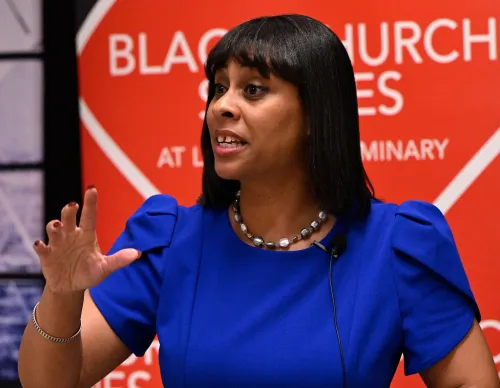
The Rev. Dr. Keri L. Day of Princeton Seminary delivers the Katie Geneva Cannon Womanist Lecture

LOUISVILLE — When she delivered the Katie Geneva Cannon Womanist Lecture at Louisville Presbyterian Theological Seminary earlier this month, the Rev. Dr. Keri L. Day took the time to define some of the terms in the title: “Resisting the Domestication of God-Talk: Towards a Black Feminist Apophatic Mysticism.”
Day is the Elmer G. Homrighausen Professor of Constructive Theology and African American Religion at Princeton Theological Seminary. View Day’s lecture and the question-and-answer session that followed it here. Day was introduced by the Rev. Dr. Perzavia Praylow, director of the Black Church Cornerstone Collaborative and the Black Studies Program at LPTS.
Day said she never knew Cannon well other than in academic spaces. Day first met Cannon as a doctoral student while attending a Christian ethics conference. Cannon was having breakfast “and I began to fangirl,” Day said. “I walked around the table trying to get the courage to say something. Finally I stopped and said, ‘Dr. Cannon, is anyone sitting with you?’ She said, ‘Sit down, girl. I thought you’d never ask.’”
“I remember that power and warmth,” Day said of Cannon. “What power to be so brilliant and yet have that sense of neighborly warmth and community spirit.” Thereafter, Cannon always responded to her emails, Day said, adding, “I am grateful for her witness.”
“She privileged the knowledge production of Black women and insisted that Black womanist and Black feminist theories matter for the doing of theology in a world of deep suffering,” Day said.
Similar to Cannon, Day said she’s been thinking for the past two decades “about harmful expressions of Christian faith that tend to depend on dogmatic and nationalist theological postures, exacerbating rather than healing suffering in the world.” One of those is imagining God “as a concept or a being to be mastered … and coherently interpreted through our unbending dogma.” But as Day’s grandmother used to tell her, “You don’t have to know everything. All you have to do is worship God.”
Through doctrine, “there is a certain domestication of God,” Day said. “I am worried about these kinds of dogmatic theological approaches.” Part of the task for Black churches is “to wrestle and challenge those white colonial inheritances and legacies, including dogmatic forms of God-talk.”
In the lecture, Day suggested that “a Black feminist apophatic mysticism encourages the de-objectification of God.” She described that through the life of Sojourner Truth, a name Truth selected for herself after being originally named Isabella Baunfree. “Truth invites us to not treat God as an object, something that’s in hand, something we can manipulate and control to our political and social agendas,” Day said.
“By Black feminist apophatic mysticism, I mean what Black women scholars note as the mystical dimensions of Black women’s religiosity and practices in the United States,” phenomena that includes visitations, prophecy, mystical travel and healing, “which historically enabled Black people to engage in activities to not only resist white domination but also experience wonder and pleasure within God’s spirited cosmos,” Day said. That tradition was grounded in “a mystic culture and ethos that was about spiritual efficacy” to “fight anti-Black violence as well as imagine a more expansive view of God and the cosmos in which they were situated.”
Black women “embraced a particular spiritual practice because it was effective and emancipatory in challenging racist violence and trauma,” Day said, “as well as responding with gratefulness to God’s spirited cosmos.” Apophatic here means immeasurable or ungraspable, Day said. “There’s a limit to what we can say about God.”
Born in 1797, Isabella Baumfree “had Congolese roots and was given an Iberian Catholic name,” Day said. As a child, she participated in Pinkster celebrations, “which drew on Afro-Catholicism and African religious influences to express Black creativity and agency,” Day noted. As an adult, she renounced her Afro-Catholic roots “for a Dutch Calvinist approach to the Divine,” eventually moving away from strict Calvinist connections. She renamed herself Sojourner Truth on Pentecost in 1843, and traveled around New England, becoming one of the most important voices for abolition.
As a young girl, her mother had taught her about an expansive God, but she embraced her white master’s Christianity while still in her youth. Later “she began to question this plantation theology and racist morality, withdrawing to a wide open space outside where she could commune with God.”
“It is here in this rural sanctuary that Isabella received an answer to the question of slavery, whether it was right or wrong,” Day said. “She receives the answer to run away, to escape.”
“As her understanding of God continued to adapt and expand, her imagining of the Divine would eventually talk back and challenge the … doctrines and practices of white Christian America,” Day said. She began to notice that God “was all over and pervaded the universe.” A revealing Truth comment was this one, according to Day: “O God, I did not know you were so big.”
She knew that Jesus appeared to her — not as a master, but as a friend, Day said. For Truth, God is provider and Jesus is her friend, not master, “the approachable imminent aspect of the Divine,” Day said, which parallels “the testimony of many of the enslaved.”
Naming God was important for Truth. “She’s marshaling the norms and traditions and theological ideas of the communities she’s a part of, which allows her to rethink God in a much more expansive way than simply the king who sits on a throne,” Day said. “Such naming for her did not exhaust who God was, is and will be.”
“We make claims about God through our religious encounters, through Scripture, norms and traditions,” Day noted. “But this does not exhaust who God is.”
As Day pointed out, the Rev. Dr. Karen Baker-Fletcher notes that an African folktale says that God is on one’s back. Baker-Fletcher says that one cannot see God, but one doesn’t have to build ladders to heaven to find God, for God is present in our everyday lives.” This is a God “who intimately seeks us out, who is on our back. God is the intimate grounding of our being.”
“To be loved is to be known. To me, that’s the power of the incarnation,” Day said. “It’s about making God’s self known in uncanny desire and love. … We can know God, but never fully — always imperfectly.”
The task of faith, then, “is not the struggle for philosophical or metaphysical certainty or complete clarity when telling the story of God,” Day said. “The task of faith is about faithful desire for our beloved — for God and others who are the beloved of God.”
“Christian faith in particular is awakening to God’s desire for us and delighting in it,” Day said, “as Sojourner Truth did.”
You may freely reuse and distribute this article in its entirety for non-commercial purposes in any medium. Please include author attribution, photography credits, and a link to the original article. This work is licensed under a Creative Commons Attribution-NonCommercial-NoDeratives 4.0 International License.


