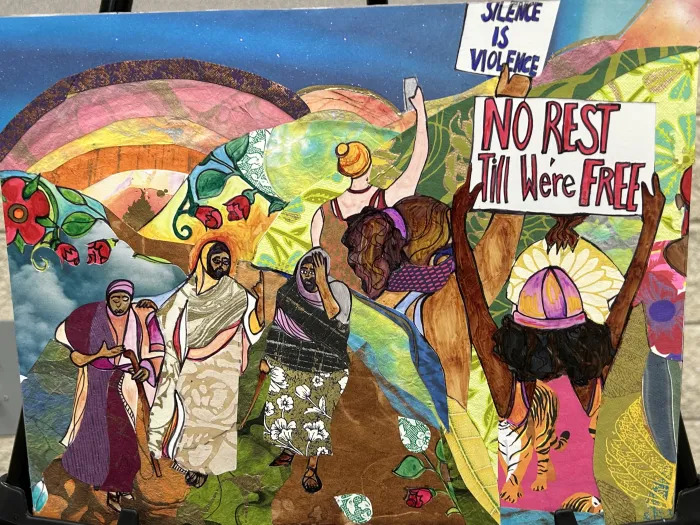
Who’s my neighbor?
Speaking at APCE last week, Rabbi Evan Moffic uses Midrash to offer at least 10 responses

LOUISVILLE — Rabbi Evan Moffic, who serves Congregation Solel in Highland Park, Illinois, took on the topic of loving our neighbor during his illuminating talk last week at the Annual Event of the Association of Partners in Christian Education. He used the Jewish tool of Midrash to study Leviticus 19:18: “You shall not take vengeance or bear a grudge against any of your people, but you shall love your neighbor as yourself: I am the Lord.”
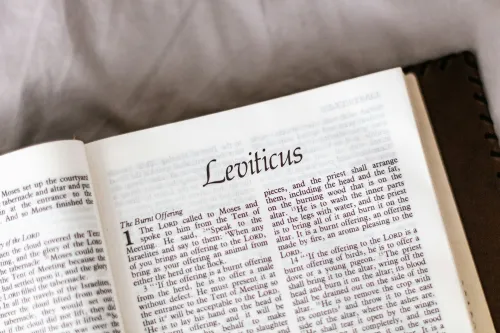
Moffic called Midrash “the Jewish sage’s way of making a timeless text timely.” He cited 10 ways of understanding the Hebrew word “Re’a,” a core term in Hebrew ethics, emphasizing a relationship of care, friendship and responsibility.
- “Re’a should not be translated as ‘neighbor,’” he said. “We think of neighbor as one next door or someone who knows our dog’s name.” One rabbi taught that it’s anyone with whom we have a relationship.
- Moffic offered a pragmatic interpretation. In the Talmud, a young man asks the greatest rabbi of the time to teach him the entire Torah while standing on one foot. The rabbi said it’s this: what is hateful to you, do not do to another person. “It’s a beautiful way of following the rabbinic tradition of making laws of Torah practical in each generation,” Moffic said. “The underlying idea here is empathy.”
- The most spiritual interpretation is to say that neighbor refers to every human being, which Moffic called “the fundamental underlying principle of Torah. This teaching embodies the core principle of the Hebrew Bible, that everybody is created in the image of God.” This interpretation “is the easiest to teach in principle but the hardest to carry out.”
- More attainable is what Moffic called the contextual approach. In Leviticus 19:17-18, we’re told not to hate anyone of our kin, to reprove our neighbor and not to take vengeance or bear a grudge against any of our people. “It’s not so much about caring for your neighbor, but holding your neighbor to a lovingly high standard,” Moffic said. “There’s a sense that when you truly love somebody, you hold them to high standards because you know what they’re capable of.”
- While the “love your neighbor” commandment appears only once in Leviticus, “love the stranger” appears 36 times. Rabbi Jonathan Sacks points out it’s much easier to love our neighbor than to love a stranger, but Torah “calls us to love the stranger as we love the neighbor, to expand what ‘neighbor’ means,” Moffic said. But one could argue the opposite, that it’s easier to love a stranger than your neighbor, he said.
- Theologian Martin Buber, who gave us the “I and Thou” framework, would say that our definition of “thou” determines our definition of who our neighbor is. “Does a refugee with documents change the ‘thouness’ of the person?” Moffic asked. “I don’t think it would for Buber.”
- The French philosopher Emmanuel Levinas said that every human being has a claim on us, just as we have a claim on others. We’re born with rights, but also with responsibility. “Levinas says we can’t love ourselves if we don’t love our neighbor,” Moffic said. “It’s a deeply philosophical idea, but think back to Adam and Eve. Certain concepts don’t emerge until there is a relationship.”
- The Hebrew word ‘kadosh’ can in translated as “holy,” “but the actual physical meaning is ‘set apart’ or ‘different,’” Moffic said. Sacks suggests that “loving our neighbor is not just something pragmatic — it’s something sacred and holy. It brings us closer to God.”
- Rabbi Maimonides, who lived more than eight centuries ago, said that loving your neighbor as yourself “is not about a feeling. It’s about action,” Moffic said. His Ladder of Tzedakah ranks eight acts of charity from “you only give a little, and you do it grumpily” to “help someone find a job or start a business.” “Maimonides puts love in a practical place,” Moffic said. “It’s about obligations.”
- Moffic’s final interpretation is “the one that may speak to us today.” It’s the covenantal approach. “What I think we can do in today’s interconnected world is extend our responsibility to all people,” he said. Rabbi Abraham Joshua Heschel reminds us that “not all people are guilty, but all of us are responsible.”
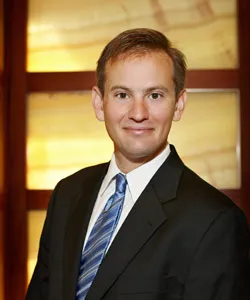
“Love your neighbor as yourself is about working together to create something good,” Moffic said. “It’s part of the divine task to bring redemption to a fractured world.”
Moffic said that Heschel was once asked why he participated in protests in Selma, Alabama, and in other social actions. He was asked, “why not spend more of your time in the Jewish community?”
Heschel replied that his father, another revered rabbi, was serving in Warsaw, Poland, before Poland was invaded by the Nazis. “He didn’t have one Christian minister he could call,” Heschel told the questioner. “If something awful happens, I have half a dozen people who would be in my office in 30 minutes.”
“People of faith working together is now more important than ever. I hope in the coming days we can follow Heschel’s vision,” Moffic said. “Our religious voice is critical in maintaining that expansive voice we’re rooted in.”
You may freely reuse and distribute this article in its entirety for non-commercial purposes in any medium. Please include author attribution, photography credits, and a link to the original article. This work is licensed under a Creative Commons Attribution-NonCommercial-NoDeratives 4.0 International License.