Preaching stewardship to skeptics and cynics is a good challenge for pastors
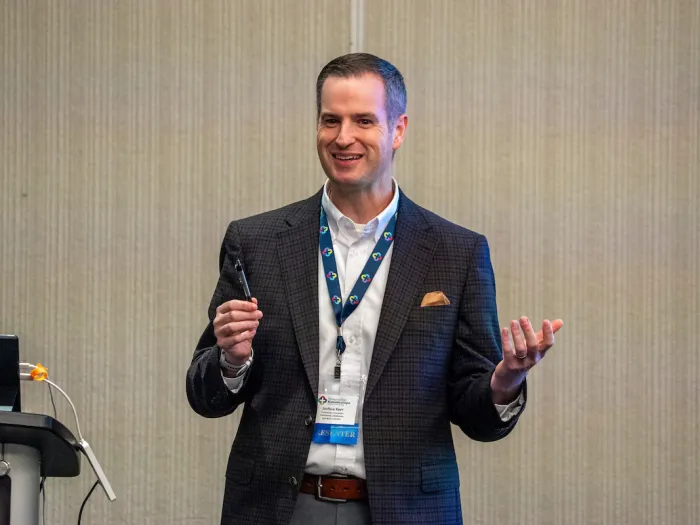
The Rev. Dr. Corey Nelson uses three buckets to illustrate a point at Stewardship Kaleidoscope

When the Rev. Dr. Corey Nelson arrived as the new senior pastor at First Presbyterian Church of Fort Collins, Colorado, in 2016, he soon discovered that “there was a lot of distrust and anxiety around talking about the church’s financial management practices.”
Members wondered, “How are the decisions being made? Who is in the room when the decisions are being made? And what voices not in the room are still being heard, such as significant members of the congregation who are not in formal leadership roles?”
Nelson shared some of what he had learned in the ensuing years during a workshop at Stewardship Kaleidoscope 2025, a conference presented by the Presbyterian Church (U.S.A.) and the Evangelical Lutheran Church in America; this year’s conference was held in New Orleans Sept. 22-24.
The church had a tradition of donor confidentiality; the only person who had access to specific individual giving records was the financial secretary. The senior pastor did not have access to that information. The previous pastor did not encourage pledging by members, leaving the session without good data to prepare a budget for the upcoming year. The secrecy and lack of clarity had created skepticism, and even cynicism, in the congregation.
Nelson knew he needed better information. To gather it, he applied the theological principle of exegesis: careful study of Scripture to understand it better.
“I applied exegesis to the financial structure of my new church,” Nelson said. “I looked at the history of financial management, the historical patterns of giving and pledging (which had been implemented by the interim pastor), and what concerns needed to be addressed.”
Nelson began to talk regularly and consistently about belief in the mission, leadership and stewardship of the church.
He also persuaded the session to create a narrative budget to tell the story of how the congregation’s gifts were serving the mission of the church and spreading the light of God in the community and the world. This budget serves as the framework for the church’s communications program throughout the year, including video testimonials from members. The eight-page printed document focuses on how those gifts made a difference last year and will make a difference next year.
The narrative budget placed funds in categories that more clearly explained how the money was being used: Leadership, Purpose, Challenges/Opportunities, Stories of Impact, and a Financial Overview, which can include specific budgetary items, such as a projected increase in expenditures and the need for increased revenue. Personnel expenses, the largest component of the church budget, are distributed across ministry areas rather than shown as a lump sum.
Nelson, who describes the focus of his doctoral program as “philanthropy through the ‘yes’ of the church,” shared an approach to preaching generosity that has been effective in overcoming the skepticism in his congregation. “Living Generously, Living Abundantly” focuses on why someone is motivated to give before determining what and how they give.
Nelson described a visual presentation he uses in his church to illustrate the process of making philanthropic decisions. He places three buckets, one inside the other, on the chancel. The first, he said, is “What I know about.” The second is “What I care about.” The final, smallest bucket, is “What I act on.”
“It feels weird as a Christian to say there are things I don’t care about,” he acknowledged. “But it is impossible to care effectively about all the things we know of. What I care about are the things that resonate with me.”
The illustration proceeds logically, and grounds individual acts of stewardship and philanthropy in the larger spectrum of collective generosity. “I can only know so much in a world full information. And I can only care about the things I know about,” Nelson said. “Finally, I act on the things I care about. I trust that God has other brothers and sisters who care about the things I don’t, and will act on them with generosity.”
Giving as an act of worship, not duty
Once the motivation is established, giving becomes an act of worship, not duty. “In our generosity, we are partners with God in the world God intends for us,” Nelson said. “You are engaging in worship when you give to the church.”
He also reassures his congregation that all their giving — to the church and to other organizations — can be seen as an act of worship, for as Psalm 24 says: The Earth is the Lord’s and all that is in it. “People are discovering their lives of generosity much more broadly than just giving to their church,” Nelson said. “I tell them I am interested in your being a generous human being, because that is what God is calling you to be.”
Skepticism and cynicism flourish in organizations where transparency and trust have withered. For a church, those values must also be guided by Scripture and the model of Christ. The antidote is honest conversation, inclusive decision-making, and clarity about the church’s financial position.
“We began to help people understand the story of what is happening in our church and not just showing them a spreadsheet,” Nelson said. “We asked ourselves some important questions: What are we doing to be Christ-centered? Are we truly open and welcoming to guests? What are the challenges of our time?”
“We unpacked what those questions mean to and for us as part of our conversation about stewardship,” Nelson said.
You may freely reuse and distribute this article in its entirety for non-commercial purposes in any medium. Please include author attribution, photography credits, and a link to the original article. This work is licensed under a Creative Commons Attribution-NonCommercial-NoDeratives 4.0 International License.