
‘Hope is what we do’
Montview Boulevard Presbyterian Church in Denver hosts a panel discussion on the crisis in Palestine
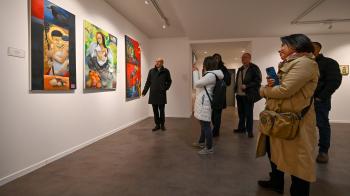
LOUISVILLE — “Hope is what we do” is the slogan for Bright Stars of Bethlehem, which raises awareness and support for Dar al-Kalima University, the first and only university of arts, culture and design in Palestine.
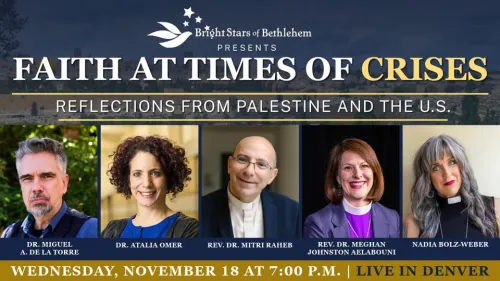
That hope was ably articulated Wednesday evening during a panel discussion hosted by Montview Boulevard Presbyterian Church in Denver, which was filled for a 90-minute event witnessed by another 350 people viewing online. The recording can be seen here.
Panelists represented a range of lived experiences and perspectives:
- The Rev. Dr. Mitri Raheb is founder and president of Dar al-Kalima University and co-founder of Bright Stars of Bethlehem.
- The Rev. Nadia Bolz-Weber is a Lutheran pastor who’s the theologian in residence at Montview Boulevard Presbyterian Church.
- Dr. Miguel A. De La Torre is Professor of Social Ethics and Latinx Studies at the Iliff School of Theology in Denver.
- Dr. Atalia Omer is Professor of Religion, Conflict and Peace Studies at the University of Notre Dame.
- The Rev. Dr. Meghan Johnston Aleabouni is Bishop of the Evangelical Luteran Church in America’s Rocky Mountain Synod.
Deacon Susan Lindberg Haley, a Bright Stars of Bethlehem board member, asked questions of the panelists.
“I see faith as a challenge with no easy answers,” Raheb said. “If you live in Palestine, faith is also resistance.”
But “we’ve been waiting too long,” he said. “Being Palestinian, I say that our Messiah came 2,000 years ago. He was born in the city I was born in. He said what he needed to say and did what needed to be done, and the ball’s in our court.”
“Faith is hope in action,” he said. “That’s my story.”
Omer recalled 2024 images of university students — Jews and non-Jews — protesting Israel’s war with Gaza by sitting on the ground and marking the Passover Seder by reading the Exodus account of liberation. “That moment, that act of resistance, is very powerful,” said Omer, an Israeli Jew who grew up in Jerusalem. “This is for me where faith comes in.”
“I don’t have special knowledge about this, but I have experiences I have written about,” said Bolz-Weber, who went to Palestine for the first time in 2014. “I have an interest in where theology and Scripture are manipulated to justify the domination of people.”
Bolz-Weber recalled not being allowed to take the safer route from Bethlehem to Jericho because one person on the tour bus had “the wrong color ID card.” The group had to take a road with numerous switchbacks and got stuck on one of them. Bolz-Weber suffered a panic attack and was taken back to Bethlehem when a car driven by Palestinians was flagged down. “There was the sense of moral injury I felt knowing how many of my tax dollars were being used to fund this [barrier wall] project,” Bolz-Weber said.
De La Torre explained that solidarity with the Palestinian people “and all the crucified people of today is because it defines the faith I have and the God I choose to believe in. It defines my humanity.”
Johnston Aleabouni is married to a Palestinian pastor. Their three children are dual citizens of the United States and Israel. For five years, they lived and served in Jerusalem as ELCA global mission pastors with the Evangelical Lutheran Church in Jordan and the Holy Land.
“I am and always will be a not-yet Palestinian,” she said, recalling a name given to her by a friend. “How do we speak the truth we know to be true” which the empire is “trying so hard to erase, nullify and overturn? All of the powers of empire cannot make the lie true and the evil good.”
After Omer and others spoke of the need to unlearn that they’d learned previously, Raheb called it “a very important theme.”
“If you are an average American who watches mainline media … and watches Hollywood films, you are by default a Christian Zionist,” he said. “We are all the time demonized, and this is why unlearning becomes so important. Faith needs critical minds.”
When Omer asked Bolz-Weber to say more about moral injury, Bolz-Weber said it’s “really easy to go through life as a deeply privileged person without understanding your complicity in things that go on in your country and in other countries. Everything colludes to keep you intoxicated with the ease of your life.”
Johnston Aleabouni called efforts “to bring Jesus to the place where Jesus was born problematic. Asking residents of Beit Sahour if they know Jesus will likely produce this response, she said: “Of course we do. Our ancestors were shepherds in the fields. But come in and have coffee.”
“Go to Palestine and see for yourself,” De La Torre encouraged those in attendance. “Then get involved in whatever you see, and from there build your theology. That might hopefully lead you beyond prayers and good thoughts.”
Panelists were asked about the role of Palestinian women in faith practices, justice movements and resistance.
Citing the Book of Proverbs, Raheb noted that 3,000 years ago in Palestine, women “were doing business, finance and raising her kids. You have to ask yourself: what was the husband doing other than drinking coffee?” he said.
Dar al-Kalima University has three vice presidents; all are women. Two-third of the more than 550 students are female, and more than two-thirds are Muslim. More than half the faculty are women, Raheb said.
“Offering that space at Dar al-Kalima is important to us,” he said, and Bolz-Weber replied, “The fact that there’s an arts university that exists in the West Bank is a light shining in the darkness.”
“The defiance is so beautiful to me,” Bolz-Weber said.
You may freely reuse and distribute this article in its entirety for non-commercial purposes in any medium. Please include author attribution, photography credits, and a link to the original article. This work is licensed under a Creative Commons Attribution-NonCommercial-NoDeratives 4.0 International License.


