This month in Presbyterian history
An 1884 portrait photograph, scraps of Civil War battle sketches, a groundbreaking in Pennsylvania, and a neighbor's anniversary
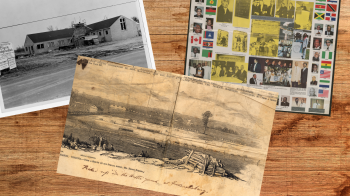
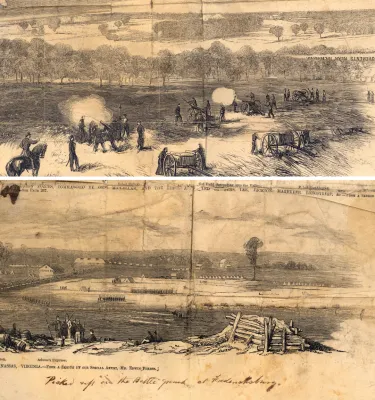
The edition of "Frank Leslie's Illustrated Newspaper" published on July 16, 1862 included these two sketches of scenes from the ongoing Civil War, a battle which started the previous April, among many other engravings and etchings documenting the conflict. The Presbyterian Historical Society holdings do not include a run of Leslie's "Illustrated Newspaper," which he started publishing in 1855— rather, these two pictures were found amongst the Tenney Family Papers.
The Tenney Family Papers consists primarily of the records kept by Samuel Mills Tenney and his father Samuel Fisher Tenney. Samuel Mills is perhaps best known for serving as the director and curator of the Presbyterian Historical Society of the Synod of Texas and the Historical Foundation of the Presbyterian and Reformed Churches in Montreat, North Carolina. He served in this capacity from 1904 to 1939. Included in his records are notebooks from his time at seminary, pastors' registers and memoranda books, historical sketches of 115 churches in Texas, documents from his chaplaincy at a prison in Rusk, Texas, sermons and scrapbooks, reports to the General Assembly, and lots of correspondence from all of his various endeavors.
The story of these Civil War battle scenes is connected not with Samuel Jr., but Samuel Sr. Samuel Fisher Tenney is the one who stumbled across these illustrations, torn from the pages of Leslie's July 16, 1862, "Illustrated Newspaper," while traversing a battleground near Fredericksburg, Virginia. Samuel Fisher's papers, along with these illustrations, serve to document his experience as a Confederate soldier serving in Virginia and North Carolina, as well as his post-war experiences as a Presbyterian minister in Texas. PHS houses Samuel Fisher Tenney's diary from 1861, correspondence, sermons, Civil War papers and pastoral records.
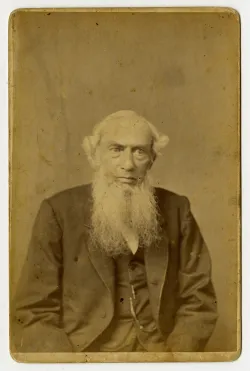
On July 7, 1803, the Rev. John Anderson was born at Dungannon, Ireland. In 1884, at the age of 81, he had his first photo taken, and his personal history was inscribed on the reverse side of the print.
Anderson, who served as President of Anderson College in Clarksville, Texas, from 1849 to 1875, had been educated in Belfast, where he received a degree and served as a professor from 1829 through 1833. In 1833, he was wed. He and his new bride came to America.
Upon their arrival, Anderson served as a "minister in N.Y. City 2yrs" before taking to a pulpit in Paterson, New Jersey, followed by a pulpit in a Virginia town, where he "also taught a school." In "1844 or 45" the Andersons moved to Spring Hill in Hempstead County, Arkansas, where he took "charge of an academy." In 1849, they moved to Clarksville, Texas, where Anderson "was actively engaged in school-room until 1876." Additionally, the Rev. Anderson organized a church in Paris, Texas, in 1857.
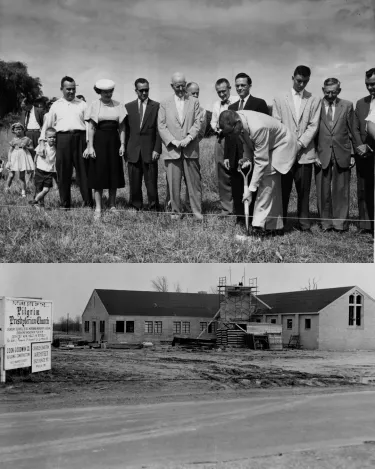
On July 29, 1956, the Presbytery of Philadelphia hosted a groundbreaking ceremony in Levittown, Pennsylvania, where they were to begin work on the final unit of the First Presbyterian Church complex there.
Before they'd started building, the chosen construction site was a tract then surrounded by cow pastures, cornfields, and asparagus patches. When this photograph was snapped, the church complex was in progress, as can be seen in the second image. The sign on the far left of the frame reads "Future site of the Pilgrim Presbyterian Church" and alerts viewers and passersby of the companies working to create the structure: Cook & Goodwin Co., Building Construction, 1612 Market Street, Philadelphia; and Charles L. Bolton, Architect, 1505 Race Street, Philadelphia.
The Presbytery of Philadelphia is the oldest continuous Presbyterian governing entity in the United States, having been established in 1717. Home to some of the oldest Presbyterian churches in the nation, the Presbytery of Philadelphia comprises more than 100 churches across the Greater Philadelphia area and parts of surrounding counties in Pennsylvania and New Jersey.
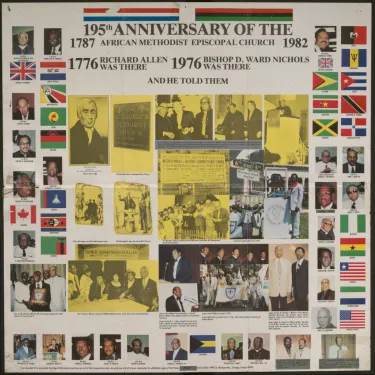
In late July 1982, worshipers and members of Mother Bethel African Methodist Episcopal Church in Philadelphia celebrated their church's 195th anniversary. Congregants put together a poster collage representing the wide breadth of the church's almost 200-year history. Flags from different countries dot the border of the poster, representing the various heritages of their many pastors, from the Rev. Richard Allen in 1776 to Bishop D. Ward Nichols in 1976, and everyone in between.
Mother Bethel was organized by a group of Black Methodists who'd walked out of their home congregation due to racial segregation in the worship services. Upon its dedication on July 29, 1794, by Bishop Francis Asbury, Mother Bethel African Methodist Episcopal Church became one of the first African American churches in the country. On Oct. 12, 1794, the Rev. Robert Blackwell announced that the congregation was received in full fellowship in the Methodist Episcopal Church. In 1816, the Rev. Richard Allen brought together other Black Methodist congregations from the region to organize the new African Methodist Episcopal Church denomination. Allen was then elected bishop of this denomination. After the Civil War, AME missionaries went to the South to help freedmen and planted many new churches in the region.
The Presbyterian Historical Society is located one block from Mother Bethel and is the repository of its records, which first arrived in 2013 during a renovation of the church building. The transfer was stewarded by Margaret Jerrido, previously the archivist of the Urban Archives at Temple University, who worked with PHS archivists to process and prepare the collection and its correlating guide, which can be accessed on the PHS website. Additionally, a 2016 oral history interview with Jerrido can be found in Pearl.
Jerrido provided the information included in the administrative history section of the Guide to the Mother Bethel African Methodist Episcopal Church Records, RG 551. She introduces the historic congregation by saying of the plot upon which the sanctuary stands: "This land is the oldest piece continuously owned by African Americans since the first structure was erected in 1794. The church was formed through determination, sweat, and tears." The evidence of the congregation's persistence and determination can be found within the pictures and illustrations included on the 195th anniversary poster. In early 2021, staff at PHS digitized a handful of records of Mother Bethel's Philadelphia congregation. The first volume of board minutes from 1848 through 1849 can be viewed in Pearl.
Visitors to the Presbyterian Historical Society are encouraged to venture down the block and tour the Richard Allen Museum in the basement of Mother Bethel. Visit the Mother Bethel webpage to learn more about touring the museum, named after the first pastor, whose tomb is also located in the basement. History buffs and churchgoers alike will find the collection of artifacts, architecture, and art awe-inspiring — including items like muskets used during the War of 1812, Richard Allen's Bible, and a ballot box in which marbles were used to cast votes.
Enjoy these glimpses into Presbyterian history in years past? Donate to the PHS Annual Fund, which supports the efforts of the Presbyterian Historical Society to collect, preserve, and share the past in order to transform your current perspective on church history.
You may freely reuse and distribute this article in its entirety for non-commercial purposes in any medium. Please include author attribution, photography credits, and a link to the original article. This work is licensed under a Creative Commons Attribution-NonCommercial-NoDeratives 4.0 International License.