The PC(USA) has policies on international intervention, peacemaking and international law
Office of Social Witness Policy provides sources for denominational policies

On Monday, Jan. 5, the Rev. Jihyun Oh, Stated Clerk of the General Assembly of the Presbyterian Church (U.S.A.) and Executive Director of the Unified Agency, issued a statement on behalf of the General Assembly regarding the military action that took place in Venezuela on Jan. 3. The statement reflects multiple social witness policies that have been approved by General Assemblies.

Presbyterian social witness policies provide ethical guidance for the church, as well as extensive background for study and reflection on complex social and ethical questions. They have emerged through the discernment of our predecessors in faith who also examined and wrestled with these complexities.
As the members and congregations of the PC(USA) discern faithful responses to the situation in Venezuela, as well as to other international interventions the United States might enact (such as in Greenland), we offer the following information about and context for relevant social policies. We hope this will help support your prayerful and thoughtful engagement with these topics.
Intervention for humanitarian purposes
The Resolution on Just Peacemaking and the Call for International Intervention for Humanitarian Rescue (1998) considers the idea of “humanitarianism” as a justification for international, military-based intervention. Given current discussions of the suffering and oppression of the Venezuelan people under Nicolás Maduro, this resolution provides useful guidance to assess when and how the international community should intervene for humanitarian purposes. In line with commitments to just peacemaking, the policy outlines the following criteria for such intervention:
- Intervention must respond to a real and genuine need that cannot be met by other means.
- It must have a reasonable chance of alleviating the conditions it seeks to overcome.
- It must constitute humanitarian rescue and not cloak the pursuit of the economic or narrow security interests of the intervening powers.
- Intervention, whenever possible, should have international auspices in order to achieve the greatest presumption of legitimacy.
- It should advance the general welfare of all the inhabitants of the region in question and not become a tool by which powerful elites further cement their power.
- Intervention should involve the minimum degree of coercion necessary to achieve the purposes of the action.
- Intervention in the forms of punitive sanctions should be targeted against those in authority rather than against broad population groups. (pages 4–5)
U.S. interventions in Iraq (2003 and beyond):
Iraq: Our Responsibility and the Future (2004) responds to the moral complexities and diverse opinions about “Operation Iraqi Freedom.” The document addresses the conflict between those who believe individual nations retain sovereignty to take unilateral action, and those who believe the behavior of individual nations should be held to the standards of international law and the collective scrutiny of the United Nations (the latter has been the position of multiple General Assemblies, page 12). Similarly, the document describes the division within Christianity itself “between those who hope that religious faith can help create world community and those who believe religious faith furnishes the warrant for moralistic efforts and even the unilateral use of military force to combat international malfeasance” (page 14).
Of particular interest in relationship to the situation in Venezuela is an “overarching consideration” of just-war teaching, which is the fundamental premise that:
…any [military] action proposed will be preceded by public debate and that the reason advanced for taking those actions will have the substantive credibility required to meet the requirements of open scrutiny. This assumption is indispensable to the principle that the cause for which military action is taken must be legitimate. No cause can be just if it is based on deceptive, fabricated, distorted, or even insufficiently demonstrated considerations. The burden of proof needed for taking military action should be rigorous, excluding both deliberate misuse of information (lying) and the triumph of ideology over reality (page 18).
The resources included in Iraq: Our Responsibility and the Future also state:
The natural resources of any nation, such as Iraqi oil and minerals, belong to the people of that nation. They should not become a commodity from which an occupying army, a foreign interim government, or even a United Nations transitional administration may benefit or support itself for an extended stay (Appendix A: Iraq and Beyond).
The document includes a three-session study guide that, while related to Iraq, remains applicable to other situations including Venezuela.
Support for international law and the United Nations
Since the founding of the United Nations, the PC(USA) and its predecessor bodies have supported efforts toward international cooperation, peacebuilding, and the adjudication of international law. This link provides an overview of General Assembly actions related to the United Nations.

In 1964, the Presbyterian Church in the United States affirmed that “Christians should give their unqualified support to the United Nations in its efforts to establish the reign of law in international affairs. The existence of unbridled nationalism is incompatible with this objective. All nations must be prepared to surrender in part their individual sovereignties to international authority. The United Nations is not a perfect organization, but it is at present the world’s best hope for the peaceful settlement of international disputes. It deserves the enthusiastic endorsement of the Christian Church.”
In 1999, the 211th General Assembly of the PC(USA) called on the United States to fulfill its legal and moral membership obligations to the United Nations, noting that the General Assembly had repeatedly affirmed the importance of the UN for international peacemaking, human rights, ecological standards, and controls on international weapons trading. The General Assembly also reiterated the importance of an international criminal court as a means by which to “affirm the need for international judicial mechanisms for the administration of justice capable of addressing major categories of crime with consistent application for all countries.”
The ecumenical document A Social Creed for the 21st Century was adopted by the National Council of Churches of Christ in the U.S.A. in 2007, and by the 218th General Assembly of the PC(USA) in 2008. The social creed reiterates the importance of peacemaking through “multilateral diplomacy rather than unilateral force, the abolition of torture, and a strengthening of the United Nations and the rule of international law.”
The PC(USA) maintains a Presbyterian Ministry at the United Nations.
The Doctrine of Discovery, the Monroe Doctrine and human rights
The 223rdGeneral Assembly (2018) approved Doctrine of Discovery: A Review of Its Origins and Implications for Congregations in the PC(USA) and Support for Native American Sovereignty, and confessed the church’s complicity in and issued a full repudiation of the Doctrine of Discovery. This doctrine originated in the 15th century, and authorized and justified the destruction, killing and appropriating of the lands of indigenous peoples and nations. It was incorporated into U.S. law in 1823 when the U.S. Supreme Court ruled in the case Johnson v. McIntosh, stating that European nations had assumed dominion over the lands of America upon discovery and as a result Native Americans had lost their rights to complete sovereignty as independent nations and retained a mere right of occupancy in their lands. The Doctrine of Discovery report and other resources for church study and reflection are available here.
That same year, the General Assembly required that PC(USA) policies and practices be consistent with the United Nations’ Declaration on the Rights of Indigenous peoples, and affirmed the United Nations Permanent Forum’s call for “a clear shift of paradigm … from colonial doctrines [such as the Doctrine of Discovery] to a principled human rights framework.” (See Iraq: Our Responsibility and the Future for more on this paradigm shift in relation to unilateral action in Iraq.)
In response to an overture requesting clearer expression of the connection between the Doctrine of Discovery and U.S. foreign and military actions, the 225th General Assembly (2022) affirmed that the church would:
- Recognize the harm caused by the Doctrine of Discovery and its legacy of influence on U.S. foreign policy, including the belief in Manifest Destiny and the evolution of the Monroe Doctrine to support U.S. military interventions in the Americas.
- Reject the principles of exceptionalism and power through conquest that have led to overuse of military force.
- Affirm the effectiveness of nonmilitary, collaborative international approaches to resolving conflict.
- Commit to developing advocacy positions and actions in partnership with those most affected by U.S. foreign policy and military action and seek ways to ensure their voices are heard by the decision makers responsible for shaping these policies.
- Commit to including in our discussions our global ecumenical partners and a broad range of Christian and other faith perspectives, as well as people from marginalized communities in the U.S. and from frontline communities in parts of the world affected by U.S. policy.
Commitments to peacemaking
Peacemaking —The Believer’s Calling (1980) is a foundational document from the United Presbyterian Church in the United States of America that undergirds much of our ongoing peacemaking efforts and policies. It emerged from the post-Vietnam era in which issues of foreign policy, colonial and imperial power, and nuclear weapons were at the forefront of Presbyterian consciousness and desire to live faithfully and biblically. One of the fundamental convictions of this document confirms the role of the church in being and becoming peacemakers in church and society:
“The church bears witness to Christ when it nourishes the moral life of the nation for the sake of peace in our world. The church’s faithful obedience to its calling means active participation in the formation of the values and beliefs of our society. It means seeking peace in the personal and social relationships of our culture and exercising our citizenship in the body politic to shape foreign policy. It is of strategic importance for us to nurture changes in public attitude and to raise public consciousness (page 6).
In relation to the current situation in Venezuela, “Peacemaking — The Believer’s Calling” reflects a broad understanding of our Reformed orientation to peacemaking and our call to work for peace across all spheres of life.
Risking Peace in A Violent World: Five New Peacemaking Affirmations (2016) reflects a church-wide discernment process that began as part of the 30th anniversary of Peacemaking — The Believer’s Calling. The five affirmations are:
- We affirm that peacemaking is essential to our faith in God’s reconciling work in Jesus Christ, whose love and justice challenge evil and hatred, and whose call gives our church a mission to present alternatives to violence.
- We confess that we have sinned by participating in acts of violence, both structural and physical, or by our failure to respond to acts and threats of violence with ministries of justice, healing and reconciliation.
- We follow Jesus Christ, Prince of Peace and Reconciler, and reclaim the power of nonviolent love evident in his life and teaching, his healings and reversals of evil, his cross and resurrection.
- Learning from nonviolent struggles and counting the costs of war, we draw upon the traditions of Just War, Christian pacifism, and Just Peacemaking to cultivate moral imagination and discern God’s redemptive work in history. We commit ourselves to studying and practicing nonviolent means of conflict resolution, nonviolent methods for social change, and nonviolent opposition to war. Even as we actively engage in a peace discernment process, we commit ourselves to continuing the long tradition of support by the Presbyterian Church (U.S.A.) for our sisters and brothers who serve in the United States military, veterans and their families. We promise to support materially and socially veterans of war who suffer injury in body, mind, or spirit, even as we work toward the day when they will need to fight no more.
- We place our faith, hope, and trust in God alone. We renounce violence as a means to further selfish national interests, to procure wealth, or to dominate others. We will practice boldly the things that make for peace and look for the day when “they shall beat their swords into ploughshares, and their spears into pruning-hooks; nation shall not lift up sword against nation, neither shall they learn war anymore.” (pages 2–3)
For a comprehensive list of and links to PC(USA) social witness policies by topic, visit our Social Witness Policy website.
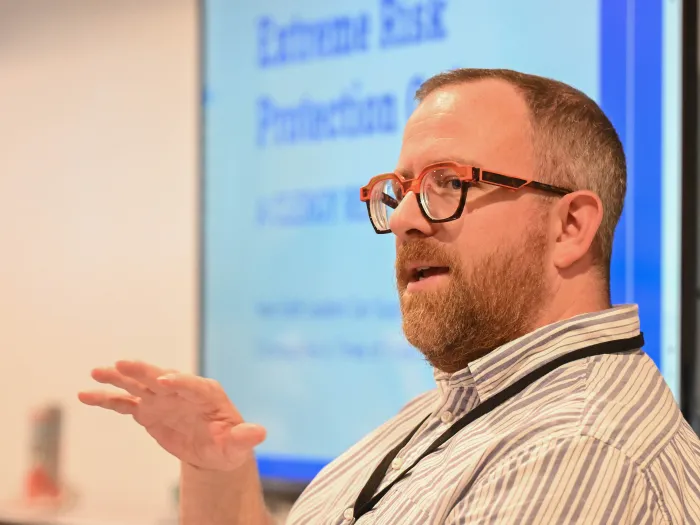
The Rev. Dr. Aimee Moiso manages the PC(USA)’s Office of Social Witness Policy.
You may freely reuse and distribute this article in its entirety for non-commercial purposes in any medium. Please include author attribution, photography credits, and a link to the original article. This work is licensed under a Creative Commons Attribution-NonCommercial-NoDeratives 4.0 International License.