

Dear Lovers of Food and Justice, I hope this letter finds you well!
This week we’re moving on from Colombia to Peru – and from the forest to the sea. Google Maps says it would take 879 hours (37 days) to walk the 2,386 miles from Santa Marta, Colombia to Lima, Peru, if your feet and legs were up to it. I took advantage of the miracle of jet fuel and enjoyed a high-altitude sunset.
Here's something to confess: my heart leans more toward animals and trees than toward people. I'm not defensive

about this! Trees are obviously amazing—see last week's letter—and animals have the advantage of being better at almost everything than humans. And we, if omnivorous, get to eat them too. For example, trout!
Are you a trout fan like me?
Peruvians certainly are. In Peru, trout farming is widespread—and the fish are delicious. I’ll come back to trout. But first: ceviche.
Have you ever had ceviche? I love it, but not everyone does. For some, it might take a little courage as the main ingredient is raw fish or seafood, “cooked” in lime juice.
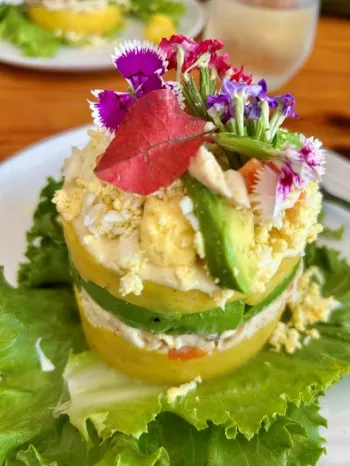
I took a cooking class in Lima where we made three things: ceviche, pisco sours, and causa—which is a cold mashed potato dish layered with chicken, seafood, or vegetables. (It looks better than it sounds and you can find a photo of mine below the P.S.'s)
For ceviche, the fish marinates in lime juice with onions, garlic, cilantro, and chili peppers. This marinade is called leche de tigre (tiger’s milk)—presumably for the bite of the peppers.The citric acid in the lime breaks down the proteins, causing the fish to firm up and turn opaque, much like it would
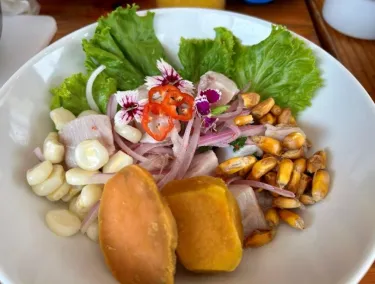
with heat. You still want very fresh fish, though; while lime has some antibacterial properties, it doesn’t eliminate bacteria and parasites the way cooking does.
For the pisco sours, you use pisco, which is an 80-proof grape brandy invented in Pisco, Peru—and not in Chile, unless you ask the Chileans.
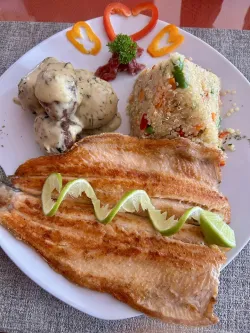
But back to trout. Did I mention that the food in Peru is fabulous? Even in the small town of Yanque, near the Colca Canyon in southern Peru, the little Sabores Andinos Colca Restaurant served up superb food like this feast with the pepper heart.
Beyond the food, the landscapes here are just as spectacular.
The Colca Canyon is famous for Andean condors. Once the
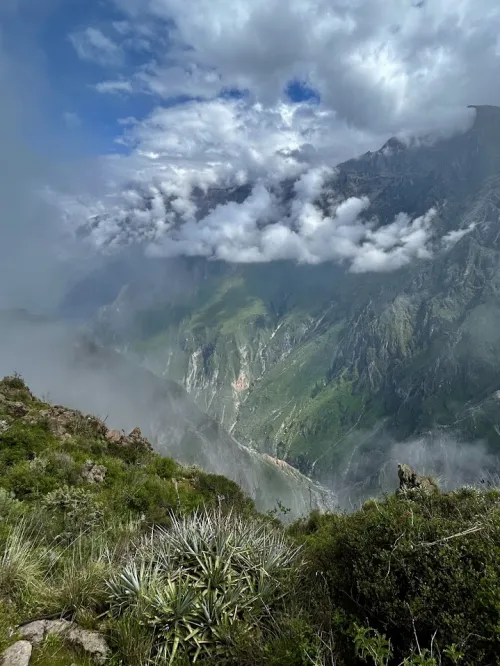

morning fog lifted, we watched them ride the thermals, gliding along the cliffs with almost no effort.
Okay, I’ve gotten a bit carried away with animals—edible and otherwise. What I really wanted to share is the inspiring work of Vilma Tumpe, whom I met in Cusco.
Vilma works with the Centro Bartolomé de las Casas (CBC) and spoke about the elder farmers they work with as “living libraries,” full of knowledge that can guide and inspire younger generations. The organization’s Colegio Andino brings this kind of learning to life in powerful ways.
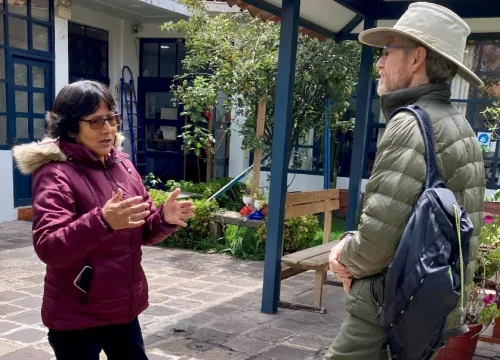
CBC stands out for its transformative popular education work among rural folk. In their innovative Biblioteca Campesina ("Farmer Library"), youth and sabios ("elders") together write context-specific books on diversified farming, agroecology, and Buen Vivir (which translates roughly to "Living in Harmony" or "Life in Balance"). This decolonized approach counters extractive agribusiness by fostering intercultural dialogues like Diálogos de Sabios y Sabiduría ("Dialogue of the Wise Ones and Wisdom"), blending ancestral knowledge with scientific insights on water, soils, pesticides, and climate resilience to empower communities. The Centro is doing fabulous work in several regions of the altiplano and even in the Amazonia. I'll tell you a bit more next week.
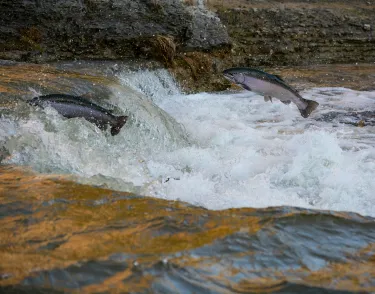
Things I Love: trout deception, smart whiskers, and orcas
Finally, a bit more about trout. I love to eat trout and so do seals. For their part, trout prefer to stay alive, and they’ve developed at least one ingenious way to trick hungry seals.
But seals are perceptive! Seals can detect a swimming fish, identify the type and size, and discern its direction from as far away as 100 yards with their whiskers – in dim or even no light. What? Yes.
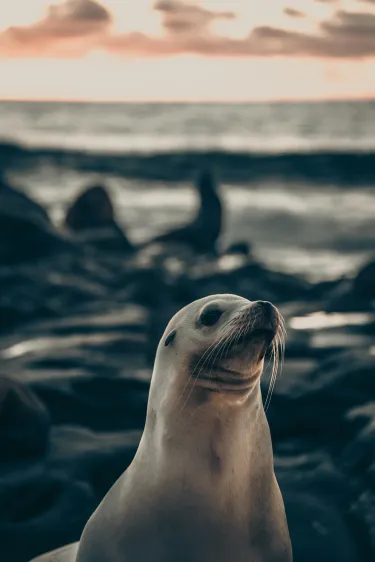
A fish leaves a wake, which they call a hydrodynamic trail, and trout have learned to twist their body to create an extra mini swirl before heading off in a different direction. The seal doesn’t know which swirl to follow and may choose the decoy, giving the trout a better chance to survive.
Watch how seals use their whiskers to sense hydrodynamic trails in this minute-long video.
And before I show you how orcas hunt seals, watch this endearing video of a man who has been diving and cuddling with seals for 20 years.
Orcas, the ocean’s top predator, use a special hunting technique in shallow, kelp-filled waters to track down evasive seals. These brilliant mammals navigate narrow channels by remaining submerged to avoid detection and they teach younger pod members these survival skills.
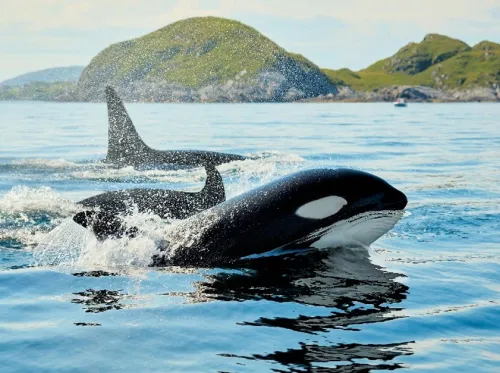
Photo by Vidar Nordli Mathisen (Unsplash)
Garden Update
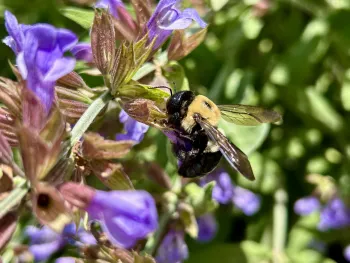
The flowers of sage, service berry, blackberry, raspberry, comfrey, and buckwheat, along with decorative flowers are all blooming and the bees -honey, sweat, wasp, and bumble - are collecting nectar and pollinating all over the yard. Yes, I love bees too. And maybe you’ve heard this inspiring quote –
“Aerodynamically, the bumble bee shouldn’t be able to fly, but the bumble bee doesn’t know it so it goes on flying anyway.”
~Mary Kay Ash
By next week, I should have some action photos of seedlings going into the welcoming soil! Until then…
And despite it all, may you go on flying anyway!
P.S. Here is a story and song about bees, which my wife sings to the children at our Waldorf school. While singing, the children wait with cupped hands for her to put a drop of honey lotion in their hands. “Zoom, zoom, zoom…”
P.P.S. Plus, a good news postscript – The global production of renewable electricity outpaced the growth in demand last year. Be heartened! See the article.
Learn more and donate to the Hunger Program via our website at pcusa.org/hunger.
You may freely reuse and distribute this article in its entirety for non-commercial purposes in any medium. Please include author attribution, photography credits, and a link to the original article. This work is licensed under a Creative Commons Attribution-NonCommercial-NoDeratives 4.0 International License.