Greetings to Readers of Food & Faith!
The PC(USA) web team has reactivated automated notification emails for this blog. Subscribers to the feed will now receive an email each time a Food & Faith blog post is published. You can unsubscribe at any time by clicking “unsubscribe” at the bottom of any notification email.
Know someone who might want to subscribe to these Food & Faith blog emails? They can do so here.
Thank you for reading!
Andrew Kang Bartlett
--
Dear Lovers of Food and Justice,
Welcome back to the Love Letters series!
Have you ever been to Virginia Beach? I hadn’t. Or if I had as a tyke, it was completely forgettable. It’s a small city that seems to have grown up without a parent with a plan, but it’s surrounded by beaches and vast estuaries and salt marshes. These tidal wetlands are all part of the Chesapeake Bay, the largest estuary in the United States. The water birds – ducks, loons, cormorants, egrets, ibises, gulls, herons, cranes, plovers, and skittering avocets – were everywhere!
On the way back from Virginia Beach, where I participated in meetings with farmers, fishers (“water men” and “water women,” as they call them there) and food & farm justice supporters, I stayed at one of my almae matres (I had to look up the plural of alma mater), Warren Wilson College, for two nights near Asheville, NC, and visited with two of PHP’s partners, Tierra Fertil Cooperative and BeLoved Asheville.
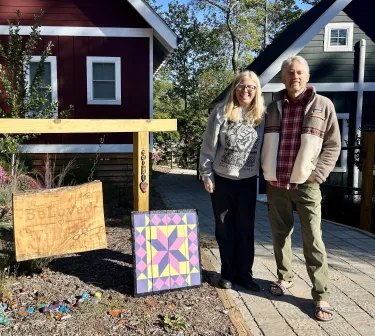
Describing our visits to both would be too much of a good thing, so I’ll begin with BeLoved Asheville, which blew my wife, Haeja, away! Next week, we’ll visit with Carlos at Tierra Fertil.
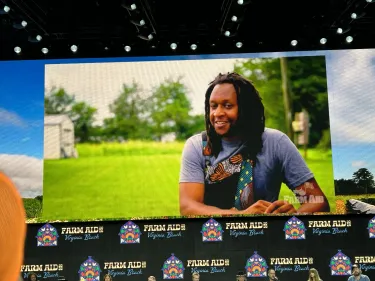
Haeja flew out and joined me in Virginia for the 41st Farm Aid concert. If you haven’t gone yet, you may want to add it to your bucket list. I’m not a country music listener, but it is more than country and I loved it! And it’s more than a concert; every year they create a Homegrown Village with farmers, storytellers, down-home activities, hands-on activities like spinning yarn, seed giveaways, and goats and sheep to pet. On the stage, Neil Young, Nathaniel Rateliff, Dave Matthews, Mon Rovîa, and Jesse Welles were outstanding!
BeLoved Asheville: Solving the Housing Crisis One “The Village” at a Time
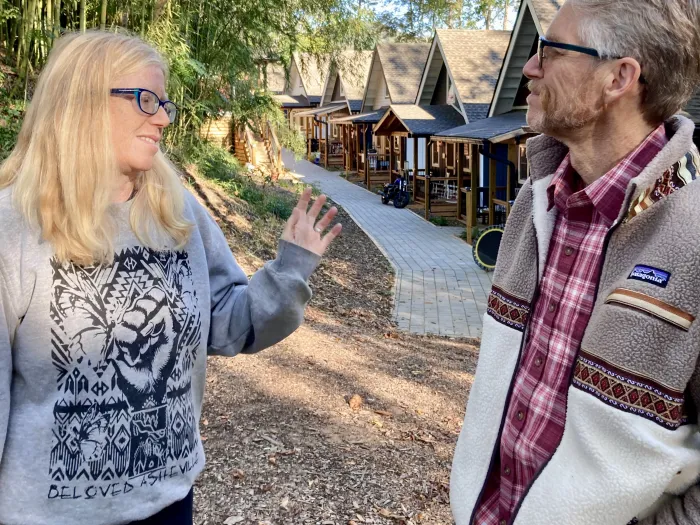
Meet Rev. Amy Cantrell, one of the co-directors of BeLoved Asheville. Amy met us as always with her strong, loving hugs on a sunny, late September morning. We met at The Village, a values-driven community of twelve micro homes that had only just been occupied two months before our visit.
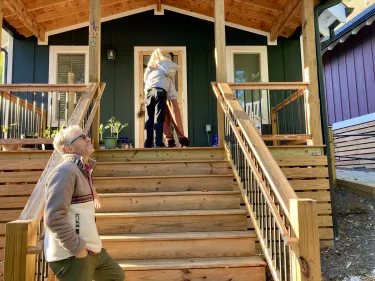
You find The Village by turning into Corazon Place a few miles east of Asheville. The land was donated and sits on the campus of Land of the Sky United Church of Christ (“a church for all people”), which has a huge garden and summer garden camp, and children swinging and running around a Montessori childcare center, all surrounded by large deciduous trees – albeit with the drone of the nearby Route 70 drifting through the trees.
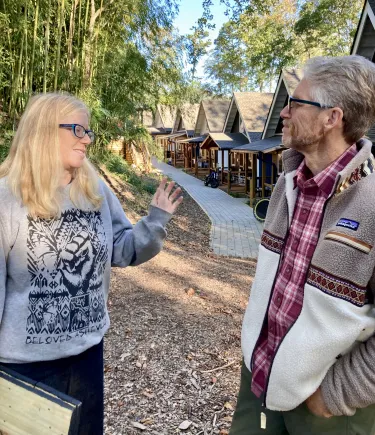
We walked through The Village with Amy, inadvertently meeting neighbors as they prepared for work or school or housekeeping. The love they shared was tangible! Many residents were formerly unhoused families who had struggled to find a place after Hurricane Helene destroyed much of the area two years before.
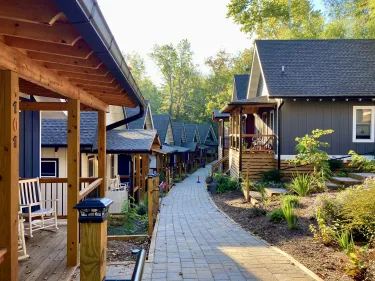
The Village is intentional about building community, steeped in the values of care, hospitality, mutual care, finding common yearning and commitment in the search for home.
Along those lines, Amy once said, “A mentor taught me that love requires proximity. We must cross boundaries in order to begin to build community. There are places that we just don’t go and people we just don’t know. This, I believe, is how injustice thrives. We can create healing through relationships. This is what Dr. King called the beloved community.”
These micro homes are for people whose income is just 30%-40% of the area’s median income. That's a single-person household earning $23,800 or less. Typically, these people are lost in what Amy calls the “housing gap.” Rents in Asheville are the highest in North Carolina and have increased dramatically over the past two years. Residents in The Village pay 30% of their income in rent, and 15% of each rent payment goes into an equity fund, so residents gradually buy into their homes. This is not affordable housing; it is deeply affordable housing.
BeLoved Asheville has created an innovative model solution to the housing crisis combining deep affordability, community, sustainability, and equity to help lift people out of poverty.
Haeja and I are investing in this beautiful ministry and you can too. Visit BeLoved’s website here, where you can learn more and donate.
One More Thing I Love: Dolphins Using Word-Like Communication
Rev. Amy preaches that love requires proximity, and maybe this applies to the more-than-human world as well. Scientists are finding that when we listen closely, dolphins too have something to say.
We all know dolphins are smart; some of us believe they may be wiser than we are! We’ve observed their empathy and complex social behaviors, but we hadn’t yet figured out much about how they communicate … until recently.
Scientists at Woods Hole Oceanographic Institution, working with the Sarasota Dolphin Research Program, think they may have found the first real hint that bottlenose dolphins share word-like sounds with each other, little whistles they call non-signature whistles, or NSWs.
The studies lead researcher, Dr. Laela Sayigh said about this, “Bottlenose dolphins have long fascinated animal communication researchers. Our work shows that these whistles could potentially function like words, shared by multiple dolphins.”
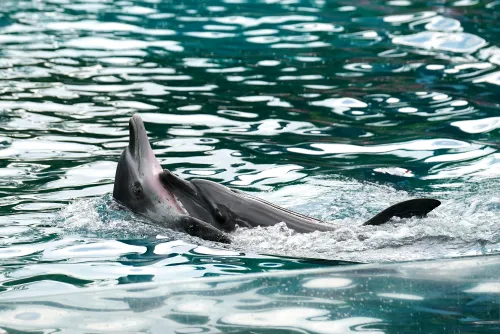
Scientists have studied signature whistles (the names dolphins have for each other) for decades, but the NSWs, which make up about half of all dolphin whistles, are patterned in ways that resemble how humans use shared sound sequences. And that is a step toward language!
While the research is preliminary and has many unanswered questions, the study (featured in this article) provides the first evidence that dolphins are likely using these whistles as part of a wide repertoire of shared, context-specific signals. And that is what language is!
I especially love the quote from Jeremy Coller, the founder of the Coller Dolittle Challenge, which awarded the dolphin language researchers the Challenge’s inaugural prize. He said, “Humans share this planet with millions of other species, but for far too long we’ve only talked among ourselves.”
Garden Update
I, for one (and I know I’m not alone), do talk to other species, and this year I’ve been singing praises to a semi-tropical relative of the morning glory.
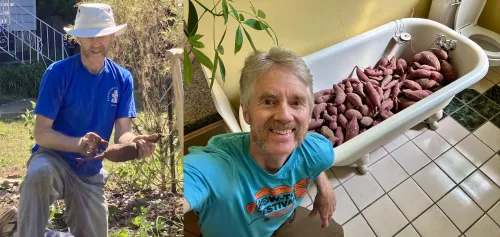
Sweet potatoes, sweet potatoes, and more sweet potatoes. I finished curing them and relegated them to the basement where they’ll fend off shy, hungry rodents over the winter. We’ve begun eating and giving away 180 lbs of tubers, mostly Japanese whites with a few Beauregards.
The home of sweet potatoes is Meso-America and archeologists discovered that the Polynesians made it to South America as early as 1000 or 1100 AD. Interestingly, one Polynesian word for sweet potato, kuumala, resembles the word for sweet potato in Quechua, khumara.
Beyond tubers, the winter cover crop is thirsty but coming up well, and I’m debating whether to try my luck at garlic again. Last year’s crop was pitiful for some reason. If you know garlic, please share your experiences. Thanks and see you next week for a visit to Tierra Fertil.
Warmly,
andrew
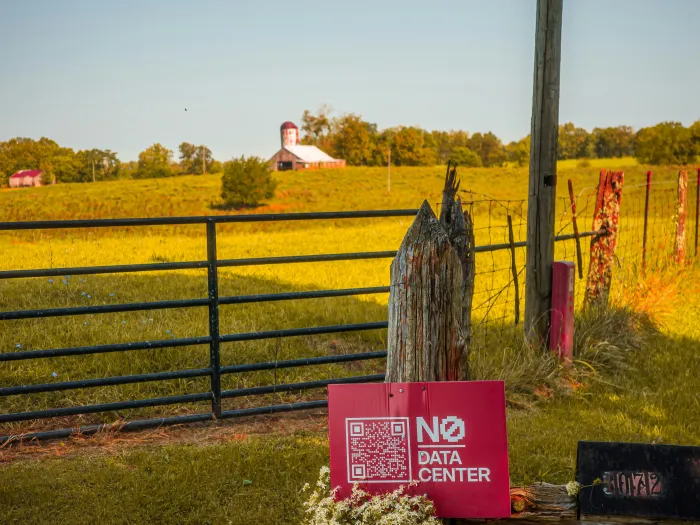
P.S. In case you missed it, you may be interested in my last post entitled, “Why AI Data Centers are a Hunger Issue.” As always, comments and questions are welcome.
Learn more and donate to the Hunger Program via our website at pcusa.org/hunger.
You may freely reuse and distribute this article in its entirety for non-commercial purposes in any medium. Please include author attribution, photography credits, and a link to the original article. This work is licensed under a Creative Commons Attribution-NonCommercial-NoDeratives 4.0 International License.