

Artificial intelligence is being woven into everyday life at an unrelenting pace. From search engines and social media to workplace software and other products, AI is increasingly invading our world as inevitable, necessary, and beyond question. But are enough people aware of the resources required to sustain this expansion, or the communities absorbing its costs? Behind every AI tool are networks of data centers, massive energy demand, water use, land consumption, and public funds used to support projects that often move forward with little transparency or community input.¹
The promises surrounding AI too often leave these realities out. While companies emphasize innovation and efficiency, the infrastructure powering AI is reshaping local economies, energy grids, and environmental conditions in ways that often remain invisible until the impacts are already felt.²
What Data Centers Are and How Secrecy Undermines Communities
Data centers are large industrial facilities filled with servers, cooling equipment, and networking infrastructure. They store, process, and transmit the data that makes AI systems possible. These facilities are among the most resource-intensive developments being built today.³
Data centers operate around the clock, requiring enormous amounts of electricity and water to keep servers from overheating. In many states, they receive generous tax abatements, discounted utility rates, and expedited zoning approvals. Yet once built, they employ very few local workers compared to the scale of land and resources they consume, leaving communities with long-term costs and limited benefits.³
In my hometown, a data center began construction in 2024 with little, if any, meaningful community input. The city council that approved tax cuts for the data center did so under the name “Project Slugger,” a vague label that obscured the true actor behind the development.⁴
This is not an isolated experience. Across the country, data center projects are routinely introduced under code names, shell corporations, or generic project titles. Non-disclosure agreements often limit what local officials and residents can know or share during the approval process. By the time communities understand who is building the facility and what it will demand in terms of water, power, and land, decisions have already been made.
This secrecy allows corporations to move quickly, avoid public scrutiny, and bypass democratic accountability, leaving communities to bear long-term consequences for projects they never meaningfully consented to.
Who Benefits From Calling AI Inevitable
The current wave of AI expansion is driven less by public need than by competitive pressure among corporations and investors. Companies are racing to embed AI into as many products and services as possible, even when those features add little real value to people’s lives. This push creates the impression that AI growth is unavoidable rather than the outcome of deliberate policy choices, public funds, and deregulated markets.⁵
As consumers increasingly push back against unnecessary and intrusive AI features, the gap between hype and lived experience becomes harder to ignore. Yet data center construction continues, locking communities into decades-long commitments around energy use, land conversion, and environmental impact before meaningful public debate can occur.
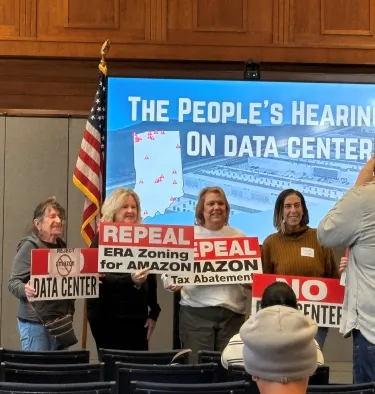
Energy Demand, Rising Costs, and Who Pays the Price
One of the most immediate consequences of data center expansion is its impact on energy systems. Data centers consume extraordinary amounts of electricity, sometimes exceeding the usage of entire cities.¹ To meet this demand, utilities must invest in new power plants, transmission lines, and substations.² In many cases, these costs are passed on to residential ratepayers and small businesses, while corporations benefit from discounted rates and public support. This approach shifts costs onto residents and deepens existing economic inequities.¹
While data centers serve governments, global corporations and distant users, their impacts are intensely local. They draw heavily on shared water sources, alter land use patterns, generate heat and noise, and reshape zoning and planning decisions. Residents living near data centers have also raised concerns about constant mechanical noise from cooling systems and backup generators, which can affect sleep, stress levels, and overall quality of life. These effects are disproportionately concentrated in communities with fewer political and economic resources, continuing a long history of siting industrial infrastructure where resistance is expected to be minimal.³ Community advocates have also warned that the rapid clustering of data centers can strain regional power grids and increase the risk of outages or blackouts.⁶ This reinforces a familiar pattern in which residents are expected to absorb harm in the name of progress, while decision-making power remains elsewhere.
A Moment the Church Cannot Ignore
The Presbyterian Church (U.S.A.) has already articulated a framework for engaging emerging technologies. In 2018, the General Assembly affirmed the Precautionary Principle, noting that “to manage the risks to health and safety from new and existing technologies, we need the Precautionary Principle or precautionary approach, based on the principles of sustainability, participation, sufficiency, and solidarity as developed in Christian environmental ethics.”⁷
Data centers raise fundamental questions that should concern any faith tradition committed to justice and care for creation. Who controls land and water? Who bears the burden of rising utility costs and environmental degradation? Whose voices are excluded from decisions that reshape entire communities? These are not abstract policy questions. They are lived realities for people already pushed to the margins.
Silence in the face of these realities is not neutral. When faith-based institutions fail to interrogate corporate secrecy, environmental harm, and the use of public funds to support these projects, they risk aligning themselves with power rather than with the people most affected.
The Advisory Committee on Social Witness Policy has also brought forward a recommendation for consideration by the 227th General Assembly (2026) encouraging the church to examine emerging technologies and economic systems through the lens of justice, accountability, and care for creation.⁸ Together, these theological commitments and emerging policy conversations invite the church to take seriously the justice implications of AI infrastructure and the communities whose land, water, and well-being are most affected by these decisions.
While faith communities have spoken with moral clarity on issues such as hunger, poverty, policing, housing, and climate change, will this moment be met with the same urgency?
Alternatives That Already Exist and Why This Conversation Matters Now
Despite the dominant narrative, this path is not inevitable. People and communities are already making different choices. On an individual level, many are opting for digital tools and search platforms that do not rely on large-scale AI systems or constant data extraction. These choices challenge the assumption that convenience must come at the expense of human and the Earth’s well-being.⁹
At the community level, congregation-based community organizing (CBCOs), environmental justice groups and grassroots organizers are developing practical resources to help residents understand data center proposals, ask informed questions, and intervene early in approval processes. Toolkits produced by advocacy organizations outline how data centers affect electricity costs, water use, and grid reliability while equipping communities to engage utilities, regulators, and local officials before decisions are finalized.¹⁰
The expansion of AI and data centers is not simply a technological shift. It is a political, moral, and theological one. Decisions about infrastructure shape who has access to resources, who bears risk, and whose voices matter in shaping the future.
Understanding the realities behind AI is a first step toward reclaiming public accountability for technologies that increasingly shape everyday life. These conversations will continue as communities, congregations, and advocates wrestle with how emerging technologies reshape our shared future. Our faith calls us not only to pay attention to these changes, but to stand with the communities whose land, water, and well-being are most affected by them.
Sources
1. Jacobs, Mike. “Data Centers Are Already Increasing Your Energy Bills.” Union of Concerned Scientists Blog, 2025.
https://blog.ucs.org/mike-jacobs/data-centers-are-already-increasing-your-energy-bills/
2. Sommer, Lauren. “Google’s AI Boom Is Driving Massive Growth in Data Centers and Electricity Demand.” NPR, October 14, 2025.
https://www.npr.org/2025/10/14/nx-s1-5565147/google-ai-data-centers-growth-environment-electricity
3. Mulholland, Rob. “What Is a Data Center and How Do They Affect Hoosiers?” Courier & Press, December 17, 2025.
https://www.courierpress.com/story/news/2025/12/17/what-is-a-data-center-what-are-data-centers-used-for-evironmental-impacts-hoosiers-indiana/86570031007/
4. WDRB News Staff. “Indiana Governor, Clark County Leaders Announce Major Economic Development Project.” WDRB, January 25, 2024.
https://www.wdrb.com/news/business/indiana-governor-clark-county-leaders-to-announce-major-economic-development-project-on-thursday/article_e4e0fadc-bb2f-11ee-af27-2b03101b6bec.html
5. Gault, Matthew. “Stuffing AI Into Everything Is Backfiring Spectacularly.” Vice, 2025.
https://www.vice.com/en/article/stuffing-ai-into-everything-is-backfiring-spectacularly/
6. Dayen, David. “Data Centers Are Pushing the Power Grid Toward Blackouts.” Jacobin, 2025.
https://jacobin.com/2025/12/data-centers-power-energy-blackouts
7. Presbyterian Church (U.S.A.). “The Precautionary Principle.” Adopted by the 223rd General Assembly (2018).
https://www.pc-biz.org/search/3000282
8. Advisory Committee on Social Witness Policy. Recommendation for consideration by the 227th General Assembly (2026).
https://myga.pc-biz.org/search/3001499
9. Whitney, Lance. “Sick of AI in Your Search Results? Try These Alternatives.” ZDNet, 2025.
https://www.zdnet.com/article/sick-of-ai-in-your-search-results-try-these-7-google-alternatives-with-old-school-ai-free-charm/
10. Citizens Action Coalition. “AI and Data Centers.”
https://www.citact.org/ai-data-centers
You may freely reuse and distribute this article in its entirety for non-commercial purposes in any medium. Please include author attribution, photography credits, and a link to the original article. This work is licensed under a Creative Commons Attribution-NonCommercial-NoDeratives 4.0 International License.