‘Every bit of work matters’
During a Chapel service based on Psalm 90, the Rev. Dr. John Wilkinson reminds PC(USA) national staffers that God prospers their work

LOUISVILLE — On a day when members of the national staff of the Presbyterian Church (U.S.A.) gathered during a Chapel service to celebrate service milestones of 53 their colleagues, those in worship heard insights into what faithful work can mean to the church and even the world.
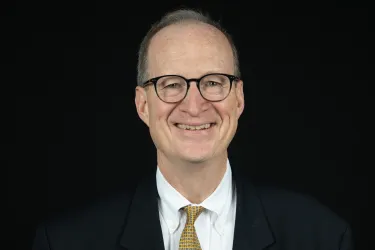
The Rev. Dr. John Wilkinson, director of Stewardship and Funds Development, used Psalm 90:1-6 and 13-17 as his preaching texts. He said he’s loved Psalm 90 from the moment he heard Ralph Vaughan Williams’ choral setting, “O How Amiable.”
“It’s a loaded psalm, an affirmation first of God as our dwelling place rather than a particular location,” Wilkinson said from behind the pulpit in the Chapel at the Presbyterian Center in Louisville, Kentucky. The psalm “is a reminder of our fragility and the swiftness of time and our own mortality in the face of God’s everlasting presence.”
Verse 17 includes this plea to the Almighty: “O prosper the work of our hands.”
“So rather than an earnest choir singing a well-crafted British anthem, imagine a group of faithful people — agrarian laborers — in worship, perhaps even headed toward Jerusalem with this song on their lips and in their hearts, offering their own temporal selves to God’s transcendent awesomeness,” Wilkinson told those in worship. “And after all of that, asking God to bless their work, which was planting and harvesting and building and repairing.”
“And then, by some transitive property, millennia later, we here now are asking God to bless our work.”
Wilkinson recently taught a course on Presbyterian history, theology and polity in Savannah Presbytery. “I’m asked a lot: What do Presbyterians believe? I say that Presbyterianism is as much about how we live together, our polity, and that we share many beliefs along the spectrum of Christian traditions,” Wilkinson said. “If I needed to choose one distinction, one emphasis, it’s this: sovereignty, the sovereignty of God. Others believe it; we double down on it, and our radical understanding of grace flows from our understanding that God is the God of all life, not just a part of it — not just the God of the church, or our private lives — but all of it.”
Affirming God’s sovereignty means, for example, “that politics is in play — not in a partisan way, but that God cares about and is interested in and is a God of a world where politics and how we organize ourselves and govern ourselves matters,” Wilkinson said. “We don’t tell people what to believe. Our theology teaches us that God alone is Lord of the conscience, after all. Nor do we say that if you are a Christian, you must believe certain things politically. That’s a distorted politics, and a distorted theology, if you ask me, masking in this moment as Christian nationalism.”
Our faith leads us to belief and even action on matters including the death penalty, school shootings, poverty, education and immigration, according to Wilkinson, who added, “If a sovereign God cares about these things, we should as well.”
And if God is sovereign over all of life, “that means that God is sovereign over all of work,” he said. “When we ask God to prosper our handiwork, it’s not just church work or private [sector] work, but all of our work.”
“It’s work we share together, and it impacts all of us. It impacts the church, and it therefore impacts the world,” Wilkinson said. “Every email sent, every [online] meeting logged into, every package packaged, every floor cleaned, every lesson created, every meeting organized, every gift cultivated, every paragraph edited, every social media post posted, every contract executed, every sermon preached, every loan processed, every meeting organized, every balance sheet balanced, every meal laid out, every journal voucher vouchered — every bit of work matters, contributes, makes a difference.”
“More than that, we believe that God prospers that work — forward-facing, behind the scenes — any of it, and all of it. That’s what we celebrate this day and what we recognize, giving thanks to and thanks for those who accomplished the work.”
Wilkinson noted that around the time of his 90th birthday, Walter Brueggemann, the late Old Testament scholar at Columbia Theological Seminary, wrote “We Count Our Days,” an essay on Psalm 90. “This is why we know that our days have a finite number. This is why we know that every day is a gift; that we may count it and make it count,” Brueggemann wrote. Then Brueggemann pivoted, Wilkinson noted: “But we pause in our counting and in our making count … In that pause we may turn our attention away from our frailty to the God of all compassion. It is to this God that we voice our petition that God may let the work of our hands count for something.”
“Colleagues and friends, let us affirm that God’s favor is upon us, and if on us, then on all the world,” Wilkinson said. “Let us as well thank God for work and for co-workers, that this work counts for something — in the church and in the world. Amen.”
You may freely reuse and distribute this article in its entirety for non-commercial purposes in any medium. Please include author attribution, photography credits, and a link to the original article. This work is licensed under a Creative Commons Attribution-NonCommercial-NoDeratives 4.0 International License.