Presbyterian Profile: Gabino Rendón (1864-1964)
The Presbyterian Historical Society celebrates Hispanic Heritage Month
"At the age of twenty years I experienced the new birth. Then I was firmly established in the Protestant faith, and in March, 1885, joined the Protestant Church."
This is the testimony of Gabino Rendón, and it is no ordinary story of conversion. When young Rendón made the decision to leave the Catholic Church to be a Protestant, he braved the opposition of his friends and neighbors in New Mexico, who ridiculed and ostracized him for his decision to pursue a missionary career.
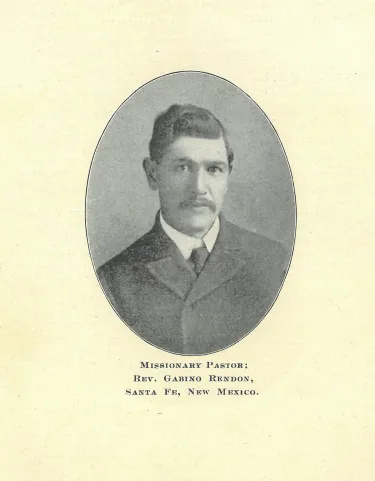
Hispanic Heritage Month stretches from September 15 through October 15. This month provides an opportunity to give extra recognition to the contributions, talents and histories of this nation’s Hispanic and Latino communities. In honor of Hispanic Heritage Month, the Presbyterian Historical Society shares the story of the first Spanish American missionary.
Gabino Rendón was born in Las Vegas, New Mexico, on February 19, 1864. His parents named him after the saint listed on the calendar for that day: San Gabino, Saint Gabinus. His father, Josè Maria Rendón, is said by some sources to have been a buffalo hunter, others claimed he was a farmer and veteran of the Union Army, having fought in the Civil War. His mother, Sabina Garcia Rendón, was the daughter of a tavern keeper. Josè never formally joined the church but studied the Bible regularly. He died in July 1903 at the age of 39 after being seized by sickness while accompanying Gabino on a missionary trip.
Gabino had lost his mother years earlier, when he was just 14. He dropped out of school then and stayed away from education for five years. At age 19, he re-enrolled in the mission school and began attending Sunday school classes and Presbyterian church services. The following year, he "experienced the new birth" and joined the Protestant faith.
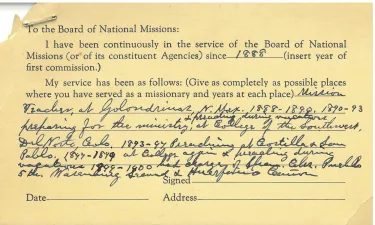
In 1886, Rendón was elected an elder of the Spanish Church at Las Vegas. He remained there for two years before he was sent to Golondrinas, New Mexico, to open a mission school. Shortly after his arrival in 1888 it became apparent to his coworkers and the ministers around him that he should train for the ministry. In 1890, Rendón enrolled in the College of the Southwest in Del Norte, Colorado, a training school for Presbyterian evangelists. After completing his training, Rendón was engaged by the Home Mission Committee of Pueblo Presbytery to serve in the San Luis Valley of Colorado as an itinerant evangelist. Through his labors, the church at San Pablo was organized. This was in 1893.
After four years evangelizing in the San Luis Valley, Rendón returned to Del Norte in 1897. Two years later, Rendón was ordained by Pueblo Presbytery and "was assigned to a field where I remained about a year and seven months … The Santa Fe Spanish field was vacant and they offered me the field and I accepted," he explained in a February 1951 letter to a colleague. Rendón was homesick: "I had stayed in Colorado ten years and I was longing for my New Mexico. We lived in Santa Fe eleven years."
In 1903, the Synod of New Mexico elected Rendón as Moderator, making him the first Spanish American to hold such an office. At the same time, the Synod appointed Rendón editor of the Spanish-English newspaper "La Aurora."
A fellow 20th century Presbyterian minister wrote that Rendón’s "work has been marked by that zeal and earnestness which a true missionary needs. He has been moderator of the Santa Fe Presbytery, and is held in the highest esteem by all his brethren. He has been adopted by the First Presbyterian Church of Mt. Vernon, NY, as their missionary, and has the oversight of the churches at Santa Fe (Spanish), Chimayo, El Quemado, Las Truches, and Embudo. In October 1903 he was unanimously elected moderator of the Synod of New Mexico. The first native Mexican to hold that position, he filled the office to the entire satisfaction of all the brethren. May he long be spared to labor for his fellow-men!" (Written by the Rev. Robert M. Craig; from Gabino Rendon's Biographical Vertical File).
Emmanuel Presbyterian Church in New Mexico, for example, has roots that reach back to 1909, when Rendón led the effort to organize a congregation in the town of Chamisal. The date of the first session was March 28, 1909, which is the date the church in Chamisal considers as its birthday. In 1947, when a new sanctuary was built, the church tower was dedicated to Rendón.
From 1903 until 1933, and even after his retirement, Rendón continued to serve the Presbyterian church as stated supply, missionary, and lecturer. He served churches in Pueblo, Walsenburg, and Las Animas, Colorado; Las Vegas, New Mexico; and El Paso and San Angelo, Texas.
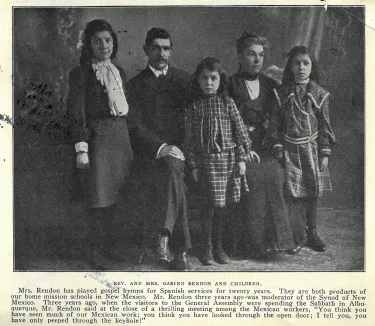
In a 1906 publication, a clipping from which was found in Rendón's Vertical File, a photograph of Gabino and his family — his wife and three daughters — was printed along with this caption: "Mrs. Rendon has played gospel hymns for Spanish services for twenty years. They are both products of our home mission schools in New Mexico. Mr. Rendon three years ago was moderator of the Synod of New Mexico. Three years ago, when the visitors to the General Assembly were spending the Sabbath in Albuquerque, Mr. Rendon said at the close of a thrilling meeting among the Mexican workers, 'You think you have seen much of our Mexican work; you think you have looked through the open door; I tell you, you have only peeped through the keyhole!'"
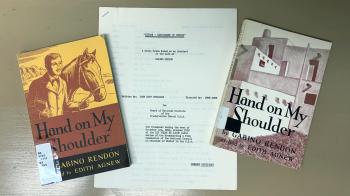
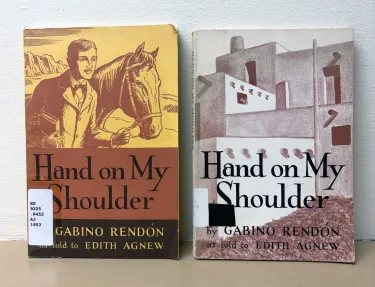
In 1953, when nearing his 90th birthday, Rendón had his past committed to paper with the help of Colorado author Edith Agnew. Together, they produced "Hand on My Shoulder," which was published by the United Presbyterian Board of National Missions. In an advertisement from Presbyterian Distribution Services promoting the book, Rendón is described as the "dean of Spanish American ministers and last of his generation." It characterizes him as being "caught between two eras, two culture, two types of religion. Yet he was far from frustrated … he always had a compelling sense of mission. God’s hand was on his shoulder."
His memoir was revised and reprinted in 1964, a decade after its initial publication — and the year that Rendón died, just four days short of his 100th birthday.
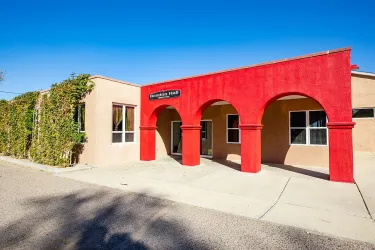
Born on February 19, 1864; died on February 15, 1964, Rendón was a man who lived through an entire century. He was a man who saw the first Santa Fe engine puff into Las Vegas; who survived both blizzards and the bullets of a disgruntled dance hall owner; who clung to his faith despite the reviling of those who thought he had betrayed his Spanish heritage by becoming a Protestant. In Santa Fe, a road is named for him. In Albuquerque, Rendón Hall,a building at the Menaul School, is named after him.
And now, the Presbyterian Historical Society has introduced him to you. Through the sharing of his story, the dimmed memory of Gabino Rendón is revivified. This is the magic of the archive — the reclamation of lives lost to time.
You may freely reuse and distribute this article in its entirety for non-commercial purposes in any medium. Please include author attribution, photography credits, and a link to the original article. This work is licensed under a Creative Commons Attribution-NonCommercial-NoDeratives 4.0 International License.